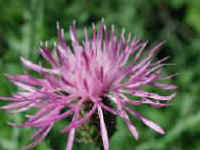
 Knapweed -
Star Thistle - Bachelor's Button (Centaurea spp.)
Knapweed -
Star Thistle - Bachelor's Button (Centaurea spp.)
Wild Flowers of Sleepy Hollow Lake From All-Creatures.org Art and Photo Journals and Galleries Directory
Dedicated to the Preservation and Restoration of the Whole of Creation: Humans - Animals - Environment
"And God saw all that He had made, and behold, it was very good.
And there was evening and there was morning, the sixth day" (Genesis 1:31)
Knapweed - Star Thistle - Bachelor's Button (Centaurea spp.)
Table of Contents

(Knapweed (Centaurea spp.) - 01) The knapweed, a member of
the Composite or Aster family, is a European native that escaped from cultivation. The leaves
of this species are lanceolate (shaped like a lance) and alternate on the stem. The
blooms develop on the head of the scale-like bracts in the same manner as do the thistles,
which led to the name "star-thistle".

(Knapweed (Centaurea spp.) - 02) This ten times normal size
photo of the knapweed clearly shows the bloom atop its scale-like bract. The
knapweed bloom is made up of numerous tiny tubular flowers, the outermost of which are
more distinguishable as individual "five-petaled" flowers.

(Knapweed (Centaurea spp.) - 03) This is an approximately
seven times normal size enlargement of the top view of the knapweed bloom showing its many
individual flowers. In the following two photos, we will zoom-in on some of these
flowers for a closer look.

(Knapweed (Centaurea spp.) - 03a) In this more than twenty
times enlarged photo of the knapweed we can see more of the structure of the white-topped
tubular flowers.

(Knapweed (Centaurea spp.) - 03b) This is a more than twenty
times enlarged view of the unfolding center of the knapweed bloom and some of the
individual flowers.

(Knapweed (Centaurea spp.) - 04) Even a common wildflower
like the knapweed has been blessed with such magnificently detailed beauty that it is
quite easy to understand why English maidens would wear these "bachelor's
buttons" as a sign of their eligibility for marriage.

(Knapweed (Centaurea spp.) - 05) The literature says that
knapweed bloom from June through August, but we have seen them blooming well into September.

(Knapweed (Centaurea spp.) - 06) Although the bloom heads of
the knapweed resemble the thistle, most species of this wildflower have no spines.

(Knapweed (Centaurea spp.) - 07) In this photo we can see the
bulbous bases of many of the individual flowers of the knapweed bloom.

(Knapweed (Centaurea spp.) - 08) It's a little after 6:30 in
the morning, and I'm sitting here in front of the computer contemplating how beautifully
God has created everything, of which this knapweed represents only an extremely small
part. Then, all of a sudden my peace and meditation is shattered by hunters along
the Hudson River. It sounds as though a war has broken out, but it is only the
reverberation of the hunters' depraved indifference to the pain of another of God's
magnificent creations. It is the sadistic sound that comes from taking pleasure in
causing suffering and death. Only a spiritually, morally, and ethically deficient
person would deliberately take a life rather than preserve it.

(Knapweed (Centaurea spp.) - 09) Knapweed grow to heights of
one to three feet and can be found in fields, along roadsides, and most other open areas.
We have several plants growing up through the rip-rap along our shoreline.
Knapweed have spread across most of the United States.

(Knapweed (Centaurea spp.) - 09a) This is a close up view of
one of the knapweed's scale-like bracts before the flowers spring forth from the top.

(Knapweed (Centaurea spp.) - 10) This is another of the
close-up photos that show the bulbous bases of the numerous individual flowers that make
up the knapweed's composite bloom.

(Knapweed (Centaurea spp.) - 10a) This is an approximately
thirty times enlargement of a few of the lower perimeter flowers of the knapweed composite bloom.

(Knapweed (Centaurea spp.) - 11) Like a star-burst at a 4th
of July fireworks display, the knapweed sends forth its flowers in all directions,
hopefully to receive the same "oohs and aahs" over its beauty. The more we
appreciate the little things in life and work to preserve them, the more we will learn to
appreciate all life and become the true peacemakers who will preserve it.

(Knapweed (Centaurea spp.) - 12)
In this photo, we're looking down at the top of a knapweed flower with its fully
opened ray flowers, and nearly fully opened disk flowers.

(Knapweed (Centaurea spp.) - 12a)
In this bee's eye view of a knapweed flower, we can see that the disk flowers
open from the outside toward the center of the disk. We also have a close
up look at some of the ray flowers. We are always fascinated by the amount
of detail that God puts into His creations.

(Knapweed (Centaurea spp.) - 13)
We took this photo of a knapweed flower early in the morning while it was still
covered with dew.

(Knapweed (Centaurea spp.) - 13a)
In this close up photo, we can see the tiny dewdrops coating the knapweed ray flowers.

(Knapweed (Centaurea spp.) - 14) This
is a knapweed bloom covered with early morning dewdrops.

(Knapweed (Centaurea spp.) - 14a)
This is a close up look at some of the 5-petaled knapweed ray flowers covered in dewdrops.

(Knapweed (Centaurea spp.) - 15) This
is another look at a dewdrop covered knapweed bloom.

(Knapweed (Centaurea spp.) - 16) This
is a top view of a recently opened knapweed bloom that clearly show the
individual ray flowers surrounding the central cluster of disc flowers.

(Knapweed (Centaurea spp.) - 16a)
This is a close up view of the disc and ray flowers of the knapweed. Note
that the central disc flowers are not yet opened.

(Knapweed (Centaurea spp.) - 17) This
is another look at a knapweed bloom.

(Knapweed (Centaurea spp.) - 17a) In
this bee's eye view, we can see more of the details of the disc and ray flowers of the knapweed.

(Knapweed (Centaurea spp.) - 18) The
stem leaves of the knapweed grow alternately along the stems and are lance-shaped.

(Knapweed (Centaurea spp.) - 19) This
is a closer look at some of the stem leaves of the knapweed.

(Knapweed (Centaurea spp.) - 20) This
is another look at the stem leaves of the knapweed (looking down the stem).

(Knapweed (Centaurea spp.) - 20a)
This is a closer look at the newly developing knapweed branch that is growing
from the leaf axil with it leaves and terminal flowering bract.

(Knapweed (Centaurea spp.) - 21) In
this photo, we can clearly see the stem branch of the knapweed growing from a
mature leaf axil.

(Knapweed (Centaurea spp.) - 22) A
knapweed plant viewed from above.

(Knapweed (Centaurea spp.) - 23) David Emmerson took this photo early in
the morning of 28 Jun 2009 at a meadow in Colchester, Essex, UK. Our
thanks to David for sending us the photo.
| Wild Flowers of SHL: Photo Identification, Common Name, Scientific Name | Art and Photos |

 Presented here are just a few of the countless components of God's creation.
Just as we cannot have human and animal life without water and plants, neither
can we have lasting peace without love and compassion. It is our hope and
prayer that this series will motivate people to live and act in a cruelty-free
manner; that we would no longer hurt or destroy each other, the animals or our
environment.
Presented here are just a few of the countless components of God's creation.
Just as we cannot have human and animal life without water and plants, neither
can we have lasting peace without love and compassion. It is our hope and
prayer that this series will motivate people to live and act in a cruelty-free
manner; that we would no longer hurt or destroy each other, the animals or our
environment.
Follow us on:


- Home Page
- What's New
- Contact Us
- Action Alerts
- Animal Exploitation
- Animal Issues
- Animal Rights Activism
- Archives
- Art & Photography
- Articles Directory
- Bible
- Bible Commentary Blog
- Books
- Campaigns
- Church & Religion
- Discussions
- Events / Podcasts / Media
- Health
- Hosted Web Sites
- Humor
- Kids' Korner
- Letters
- Links
- Nature Studies
- Newsletter
- Poetry & Stories
- Prayers
- Quotations
- Recipes with Photos
- Recipes Without Photos
- Sermons
- Stop Cruelty in Churches
- Video Library
- The Mary T. and Frank L. Hoffman Family Foundation
- Email: [email protected]
A web site sponsored by The Mary T. and Frank L. Hoffman Family Foundation and all-creatures.org
Copyright © 1998-2026 The Mary T. and Frank L. Hoffman Family Foundation. All rights reserved. May be copied only for personal use or by not-for-profit organizations to promote compassionate and responsible living. All copied and reprinted material must contain proper credits and web site link www.all-creatures.org.
Fair Use Notice: This document, and others on our web site, may contain copyrighted material whose use has not been specifically authorized by the copyright owners. We believe that this not-for-profit, educational use on the Web constitutes a fair use of the copyrighted material (as provided for in section 107 of the US Copyright Law). If you wish to use this copyrighted material for purposes of your own that go beyond fair use, you must obtain permission from the copyright owner.
Thank you for visiting all-creatures.org.
Since 