Toxicologists Recommend Human Cell-Based Methods to Identify Asthma-Causing Chemicals
Alternatives to Animal Testing, Experimentation and Dissection - An Animal Rights Article from All-Creatures.org
FROM
Physicians Committee
October 2017
Scientists can then use this method to identify gaps in knowledge and the most relevant test methods, which can increase testing speed, lower costs, and reduce animal testing.
Chemicals that could potentially cause asthma through an immune reaction
could be better identified with human cell- and computer-based test methods,
according to a new research paper co-authored by the Physicians Committee’s
Kristie Sullivan, M.P.H., in Applied In Vitro Toxicology.
Chemical respiratory allergens are chemicals that cause a serious immune
reaction known as respiratory sensitization. Sensitized individuals
experience coughing, wheezing, difficulty breathing, and obstruction and
hyperreactivity of the airways that can worsen upon repeated exposure.
Workers in the cleaning, painting, construction, and hairdressing industries
are most at risk, but consumers may also be exposed to chemical respiratory
allergens and become sensitized to these chemicals.
The Center for Disease Control and Prevention estimates that up to 18.4
million adults in the United States have asthma, and up to 25 percent of
those cases could be caused by occupational exposures.
Due to the severity and irreversibility of chemical respiratory allergy,
identifying allergens is of considerable public health and socioeconomic
importance. Currently, there are no standardized or regulatory-accepted test
methods for detecting these chemicals.
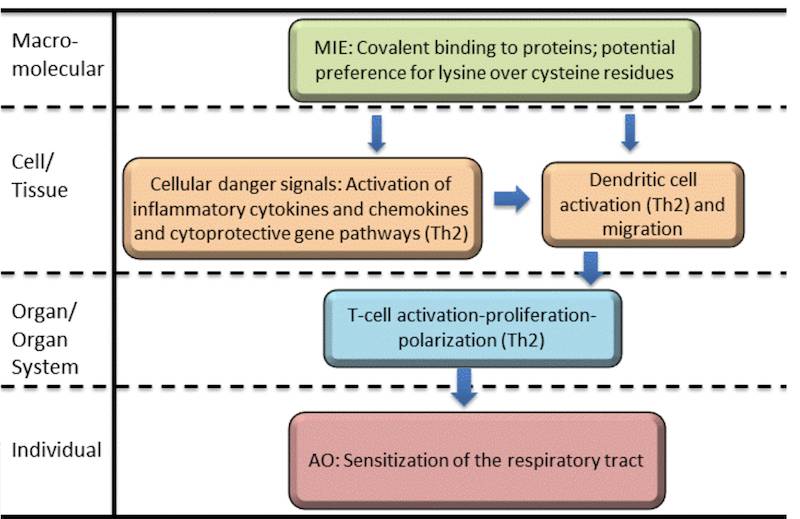
Sullivan and the paper’s co-authors have developed an Adverse Outcome
Pathway (AOP) to explain how these chemicals sensitize the respiratory tract
and highlights potential tests which could be used to identify them.
An AOP is an organized collection of existing data on how exposure to a
particular chemical may trigger a series of biological changes in the body
resulting in illness or injury to an individual (human or animal) or
population. Scientists can then use the AOP to identify gaps in knowledge
and the most relevant test methods, which can increase testing speed, lower
costs, and reduce animal testing.
Each AOP outlines a process that includes:
- A Molecular Initiating Event (MIE): The initial molecular event that occurs in the body after exposure to a chemical
- Key Events (KEs) and Key Event Relationships (KERs): The progression of events occurring in the body following the MIE, such as cell damage and changes in organ function
- Adverse Outcomes (AO): Diseases, extinction of a species
“The immune and respiratory systems of mice and rats react differently to chemicals than human systems do, making it difficult to detect chemical respiratory allergens and prevent people from developing these reactions,” says Kristie Sullivan, M.P.H., vice president of research policy for the Physicians Committee. “This AOP will help speed the further development of computer-based and cell-based tests that could be used to detect chemical respiratory allergens and lead to the regulatory acceptance of nonanimal approaches."
Return to Alternatives to Animal Testing, Experimentation and Dissection
Follow us on:


- Home Page
- What's New
- Contact Us
- Action Alerts
- Animal Exploitation
- Animal Issues
- Animal Rights Activism
- Archives
- Art & Photography
- Articles Directory
- Bible
- Bible Commentary Blog
- Books
- Campaigns
- Church & Religion
- Discussions
- Events / Podcasts / Media
- Health
- Hosted Web Sites
- Humor
- Kids' Korner
- Letters
- Links
- Nature Studies
- Newsletter
- Poetry & Stories
- Prayers
- Quotations
- Recipes with Photos
- Recipes Without Photos
- Sermons
- Stop Cruelty in Churches
- Video Library
- The Mary T. and Frank L. Hoffman Family Foundation
- Email: [email protected]
A web site sponsored by The Mary T. and Frank L. Hoffman Family Foundation and all-creatures.org
Copyright © 1998-2026 The Mary T. and Frank L. Hoffman Family Foundation. All rights reserved. May be copied only for personal use or by not-for-profit organizations to promote compassionate and responsible living. All copied and reprinted material must contain proper credits and web site link www.all-creatures.org.
Fair Use Notice: This document, and others on our web site, may contain copyrighted material whose use has not been specifically authorized by the copyright owners. We believe that this not-for-profit, educational use on the Web constitutes a fair use of the copyrighted material (as provided for in section 107 of the US Copyright Law). If you wish to use this copyrighted material for purposes of your own that go beyond fair use, you must obtain permission from the copyright owner.

Thank you for visiting all-creatures.org.