What breathes and bleeds, but doesnn't suffer or feel pain?
Alternatives to Animal Testing, Experimentation and Dissection - An Animal
Rights Article from All-Creatures.org
FROM
Barbara Stagno,
Citizens for Alternatives to Animal Research and Experimentation (CAARE)
January 2016
From its beginnings as a small company called “Animal Replacement Technologies,” SynDaver has grown to manufacture over 100 synthetic body parts made from novel materials that mimic the essential properties of living tissue. They are used around the globe by medical device manufacturers, hospitals, universities, medical schools, and the U.S. military.
At the center of the expanding industry in non-animal technologies are
the pioneering companies using innovative technology to develop and design
these methods.
One such company, SynDaver Labs, is a booming biotech business that
manufactures synthetic medical-grade tissue crafted into realistic models of
body tissues and organs, including life-size synthetic cadavers for surgical
education, training, and other research.
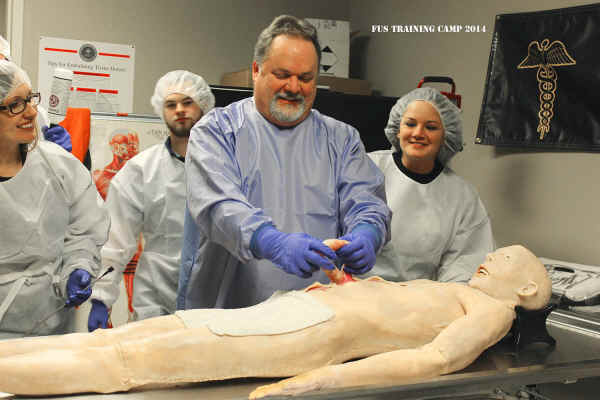
Clinicians train using SynDaver's life-size cadaver
Photo credit: SynDaver Labs
From its beginnings as a small company called “Animal Replacement
Technologies,” SynDaver has grown to manufacture over 100 synthetic body
parts made from novel materials that mimic the essential properties of
living tissue. They are used around the globe by medical device
manufacturers, hospitals, universities, medical schools, and the U.S.
military.
The company’s flagship product, The SynDaver Synthetic Human, has gained
widespread attention through appearances on Shark Tank, MythBusters, Grey's
Anatomy, and in the prestigious journal Science. Why all the hype? SynDaver
Labs claims that their bleeding, breathing model of a living patient is more
accurate, reliable, and cost-effective than real cadavers and animals.
The company’s synthetic tissues are specifically designed to replicate the
structural and physical properties of their human analogues. These
properties, like the density of a bone or the elasticity of a muscle, make a
difference when a force is exerted upon the body, and can greatly impact the
quality and outcomes of surgical training or research.

Close-up SynDaver Human Patient
Photo credit: SynDaver Labs
According to a SynDaver white paper, the SynDaver Human also allows for
better statistical controls and more precise results because its components
are manufactured to specification. This minimizes any natural variation and
increases the reliability of the results. As an added bonus, any of its
synthetic tissues or organs can be replaced with an identical one, allowing
for multiple tests under nearly uniform conditions. This increase in control
and reliability makes for better science.
Thanks to SynDaver and pioneering scientists in the U.S. Military, it looks
like the sun may finally be setting on the days of brutally mutilating
animals for combat medic training. The SynDaver Patient can be cut, crushed,
and damaged in any way that a human being can, and it actually responds like
real person, not a goat or a pig.
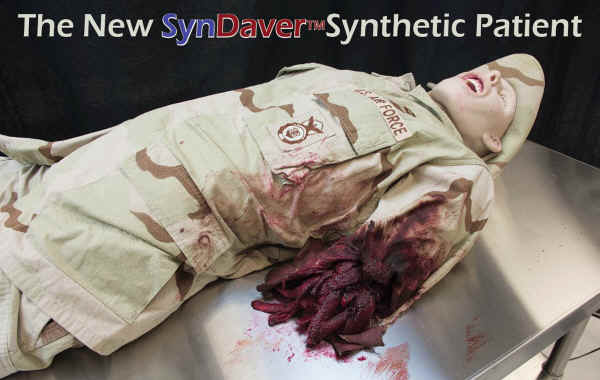
Photo credit: SynDaver Labs
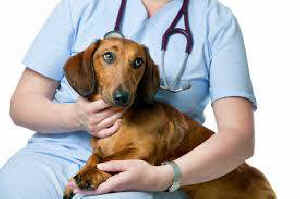
But what will we use for veterinary training? That's where the new
SynDaver Surgical Canine comes in.
Dr. Christopher Sakezles, President and founder of SynDaver Labs, tells
CAARE that the company recently started a veterinary medicine division, and
they are building animal surgical simulators now. They are starting with
dogs but will be moving on to high-quality simulation models for cats,
horses, cows and others. The canine model, which is being rolled out at the
University of Florida veterinary school this year, is anticipated to
completely replace the use of live dogs there.
But why stop there? Next on the list, according to Dr. Sakezles, “will be
introduce the canine model to the 50 other vet schools in the U.S. and later
the 500 or so worldwide.”
Citizens for Alternatives to Animal Research (CAARE), is a 501(c)(3)
non-profit organization, established to highlight and promote research
without animals.
Please donate to support CAARE’s mission to reduce animal suffering by
disseminating information about the power and progress of research without
animals.
Return to Alternatives to Animal Testing, Experimentation and Dissection
Follow us on:


- Home Page
- What's New
- Contact Us
- Action Alerts
- Animal Exploitation
- Animal Issues
- Animal Rights Activism
- Archives
- Art & Photography
- Articles Directory
- Bible
- Bible Commentary Blog
- Books
- Campaigns
- Church & Religion
- Discussions
- Events / Podcasts / Media
- Health
- Hosted Web Sites
- Humor
- Kids' Korner
- Letters
- Links
- Nature Studies
- Newsletter
- Poetry & Stories
- Prayers
- Quotations
- Recipes with Photos
- Recipes Without Photos
- Sermons
- Stop Cruelty in Churches
- Video Library
- The Mary T. and Frank L. Hoffman Family Foundation
- Email: [email protected]
A web site sponsored by The Mary T. and Frank L. Hoffman Family Foundation and all-creatures.org
Copyright © 1998-2026 The Mary T. and Frank L. Hoffman Family Foundation. All rights reserved. May be copied only for personal use or by not-for-profit organizations to promote compassionate and responsible living. All copied and reprinted material must contain proper credits and web site link www.all-creatures.org.
Fair Use Notice: This document, and others on our web site, may contain copyrighted material whose use has not been specifically authorized by the copyright owners. We believe that this not-for-profit, educational use on the Web constitutes a fair use of the copyrighted material (as provided for in section 107 of the US Copyright Law). If you wish to use this copyrighted material for purposes of your own that go beyond fair use, you must obtain permission from the copyright owner.

Thank you for visiting all-creatures.org.