Cruelty-free dissection via virtual reality software
An Animal Rights Article from All-Creatures.org
FROM
the University of Buffalo
February 8, 2008
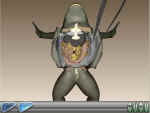
BUFFALO, N.Y. -- V-Frog, the world's first virtual-reality-based frog dissection software designed for biology education -- allowing not mere observation, but physically simulated dissection -- has been developed and is being marketed by Tactus Technologies.
A provider of virtual reality, visualization and simulation products and services, Tactus Technologies is a spin-off of the University at Buffalo Virtual Reality Laboratory.
"Other products out there are multi-media, not true virtual reality," explains Kevin P. Chugh, Ph.D. '01, president and chief scientist at Tactus Technologies, based in Getzville, a northern suburb of Buffalo.
V-Frog, which operates on a personal computer using a standard mouse, actually simulates nearly unlimited manipulation of specimen tissue. As a result, every dissection is different, reflecting each student's individual work. The software is designed for grades 7 through 12, plus advanced placement biology students.
Using a simple mouse and PC, students can "pick up" a scalpel, cut open V-Frog's skin, and explore the internal organs -- with true real-time interaction and 3-D navigation that actually accommodates discovery and procedures not possible with a physical frog specimen.
"You can go through the entire alimentary canal, using the endoscopic function -- something you could never do with a real frog," says Chugh. "Likewise, with our V-Frog, you can explore nerves and blood vessels, and look closely at how the brain is wired. Students would never get the opportunity to see and work with these things this way with a real frog."
Life-like V-Frog, which was in development for three years, uniquely allows for comparative anatomy, letting students make parallels and contrasts between the amphibian's physiology and that of a human being, crab and other organisms. In addition, V-Frog allows students to watch a beating heart, observe digestion, dissect, probe and perform endoscopic procedures.
"With other products, it's just a video -- static and two-dimensional," Chugh explains. "This is a simulation product, not simply a static Web site. It's actually superior to physical specimens and multi-media representations. The technology allows for virtual surgery. Our tissue simulation lets students see the correlation between form and function, and can be manipulated however the student wishes. It's truly a physically simulated dissection."
The Humane Society of the United States, as well as educators, legislators, students and others, support the realization that the use of virtual-reality frog dissection means no exposure to chemicals and potentially dangerous instruments, no specimen or ecosystem harm and no specimen disintegration.
"This is very much a sign of the times," declares Chugh, noting that at least 25 states have laws or ordinances mandating that, if dissection is part of a school's curriculum, students must have an alternative to dissection. "It's a mainstream reality."
Additionally, the use of V-Frog means students are not constrained to a lab environment. The state-of-the-art product complies with both inquiry and life science standards. Instructors can also model a dissection, observable by the entire class, using a projector. This teaching and learning experience can be conveniently repeated as often as desired.
V-Frog passed an important milestone when California approved V-Frog for legal and social compliance as per their State board of Education guidelines. It is also in the final stages of a similar review in New York State.
According to Chugh, V-Frog's simulated dissection is more economical than real dissection due to its one-time license cost versus annual replacement of real frogs, dissection supplies and chemicals.
Tactus Technologies received a Small Business development grant from the Institute of Educational Services, a division of the U.S. Dept. of Education, for the development of V-Frog, which has a patent pending.
Others involved in research and development of V-Frog -- which drew upon some 120 sources in its overall production -- include Kesh Kesavadas, Ph.D., chief technology officer for Tactus Technologies; James Mayrose, Ph.D., chief executive officer, and James Lalley, Ph.D., director of educational products. Kesavadas is director of UB's Virtual Reality Lab and an associate professor of mechanical and aerospace engineering.
Additional information is available at http://www.vfrog.net, or by calling (716) 206-8463.
The University at Buffalo is a premier research-intensive public university, a flagship institution in the State University of New York system that is its largest and most comprehensive campus. UB's more than 28,000 students pursue their academic interests through more than 300 undergraduate, graduate and professional degree programs. Founded in 1846, the University at Buffalo is a member of the Association of American Universities.
Contact : John DellaContrada [email protected] 716-645-5000 ext 1409
Return to Animal Rights Articles
Follow us on:


- Home Page
- What's New
- Contact Us
- Action Alerts
- Animal Exploitation
- Animal Issues
- Animal Rights Activism
- Archives
- Art & Photography
- Articles Directory
- Bible
- Bible Commentary Blog
- Books
- Campaigns
- Church & Religion
- Discussions
- Events / Podcasts / Media
- Health
- Hosted Web Sites
- Humor
- Kids' Korner
- Letters
- Links
- Nature Studies
- Newsletter
- Poetry & Stories
- Prayers
- Quotations
- Recipes with Photos
- Recipes Without Photos
- Sermons
- Stop Cruelty in Churches
- Video Library
- The Mary T. and Frank L. Hoffman Family Foundation
- Email: [email protected]
A web site sponsored by The Mary T. and Frank L. Hoffman Family Foundation and all-creatures.org
Copyright © 1998-2026 The Mary T. and Frank L. Hoffman Family Foundation. All rights reserved. May be copied only for personal use or by not-for-profit organizations to promote compassionate and responsible living. All copied and reprinted material must contain proper credits and web site link www.all-creatures.org.
Fair Use Notice: This document, and others on our web site, may contain copyrighted material whose use has not been specifically authorized by the copyright owners. We believe that this not-for-profit, educational use on the Web constitutes a fair use of the copyrighted material (as provided for in section 107 of the US Copyright Law). If you wish to use this copyrighted material for purposes of your own that go beyond fair use, you must obtain permission from the copyright owner.
Thank you for visiting all-creatures.org.
