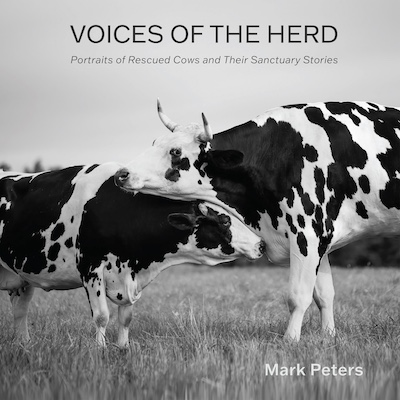
Voices of the Herd: Portraits of Rescued Cows and Their Sanctuary Stories
Available at
Lantern Publishing & Media
Hardcover ISBN 978-1-59056-751-7
eBook ISBN 978-1-59056-752-4
Book Recommendations, Reviews and Author Interviews from All-Creatures.org
Voices of the Herd: Portraits of Rescued Cows and Their Sanctuary Stories By Mark Peters
Publisher: Lantern Publishing & Media
Author interviewed by Marc Bekoff, Psychology Today
Marc Bekoff's Interview: The Social and Emotional Lives of Cows From the Outside In
Mark Peters' 'Voices of the Herd' is a must-read and must-see work of art.
Key points
- Science, common sense, and heart provide the best windows into the inner lives of cows and other animals.
- There's a lot more going on in cows' inner lives than we give them credit for.
- 'Voices of the Herd' reframes cows as individuals with intrinsic worth, not commodities.
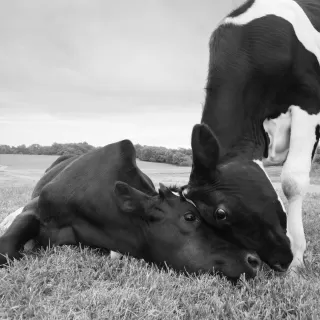 |
Mikey was rescued from a roadside petting zoo, and Clifford from a small farm. Both were spared the grim fate awaiting most calves. They found friendship in sanctuary, their bond a reminder of what compassion makes possible. Source: Mark Peters. |
Cows are highly intelligent and deeply sentient and emotional beings with distinct individual personalities.1 Each and every individual has a unique personality, and it’s fair to say not a single cow enjoys being farmed for human meals.
In his new science-based and beautifully illustrated book, Voices of the Herd: Portraits of Rescued Cows and Their Sanctuary Stories, Mark Peters shares deeply moving and personal photographs and stories of rescued cows—the fortunate few spared from lives of unimaginable suffering. Through the heartfelt care of compassionate humans, these individuals find safety, love, and healing from their scars of torture and confinement. Reading about Lucky, Moksha, and Watson, to name a few whose stories are told, I was reminded that the right question isn’t "What’s for dinner?" but "Who’s for dinner?" I hope Mark's book inspires readers to honor the voices of farmed and rescued cows, who express far more than a simple "moo,” and rethink the anonymous and hidden lives behind steak, beef, and burgers.
Marc Bekoff: Why did you write Voices of the Herd?
Mark Peters: The first cow I ever met wrapped his body around me and gently licked my face. It felt like meeting an enthusiastic dog—only one who weighs more than a golf cart!
During that same sanctuary visit, I watched another cow bend over a relaxing herd mate and lick her back. Social grooming among cows, as with certain primates, strengthens friendships, eases tensions, and supports the herd’s social and emotional well-being.
Most people only see cows in commercials or from the roadside. Unless you stop and watch them, you might think they just graze, chew cud, and gain weight for slaughter. That perception misses so much. Over the past 11 years, I’ve come to know many cows as individuals with distinct personalities and social bonds. I wrote Voices of the Herd to reveal their emotions and illuminate the depth of their relationships.
MB: Who do you hope to reach?
MP: I hope to reach people drawn to animals or social justice—readers who value storytelling, fine art photography, and nonfiction with heart. Some may already be vegan or advocates, yet I’m even more interested in readers beginning a journey of compassion for other species.
I imagine this book in the hands of teenagers or adults with open hearts, willing to ask: What if we’ve misunderstood farmed animals, not because they lack complexity, but because we’ve never looked closely enough?
MB: What are some misconceptions about cows, and how does your book address them?
MP: One of the biggest misconceptions is that cows exist solely for human use—that they’re just “livestock” because that’s how we exploit them. Many also assume cows produce milk spontaneously, the way flowers produce nectar. In reality, like all mammals, a cow only produces milk when she is expecting a calf.
Consider dogs used in biomedical laboratory research. Most people never see these dogs; they exist behind closed doors, treated as test subjects rather than thinking, feeling beings. If you only knew about dogs from research reports, you might assume they were little more than biological machines, bred to endure experiments. You would never see the affectionate, goofy, joyful personalities that many dogs exhibit.
Cows, too, have rich emotional lives: They form lifelong friendships, grieve losses, protect vulnerable herd members, and show curiosity and playfulness. Voices of the Herd reframes cows as individuals with intrinsic worth, not commodities. The photographs and stories present them with dignity and emotional depth, encouraging people to see cows as beings deserving respect.
Cows are intellectually curious and emotionally complex. These behaviors illustrate the depth of their social and emotional lives:
- Excitability: Steers entering a new pasture often run and jump. New arrivals quarantined for weeks have broken through stalls or barn doors to join their herd.
- Friendships: Cows form lifelong bonds. Their heart rate drops when near a friend, and they often nap together.
- Memory: They remember faces, hold grudges, and recall acts of kindness.
- Protection of the vulnerable: In one sanctuary, a blind calf kept pace with her herd only because older cows circled back and nudged her along.
- Maternal protectiveness: Mothers are like “helicopter parents.” Also, they sometimes shield their calves from humans they don’t trust. Other cows often babysit young calves.
- Grief: On dairy farms, calves are taken from mothers hours after birth. The mothers bellow and attempt to chase after their baby. They can cry out for days.
When a herd member dies, friends lick the body, moo loudly, and sometimes stand vigil where they were buried.
Voices of the Herd invites readers into the inner lives of these beings, showing them as complex, sentient individuals rather than livestock. The portraits offer glimpses into the lives of rescued cows living in farmed animal sanctuaries. Caregivers’ stories add emotional depth, and an essay by animal welfare scientist Dr. Helen Lambert helps readers interpret cow body language to recognize calmness, excitement, agitation, and other emotional states.
It also helps people connect and feel for cows and, by extension, all exploited animals. Awareness is often where change begins. When someone realizes cows feel emotions just like dogs or cats, it gets harder to look the other way. By contributing to a growing body of work on the emotional lives of animals, Voices of the Herd supports the movement’s momentum and helps reshape how we think about animals often hidden from view.
MB: Are you hopeful people will treat cows with more respect and compassion?
MP: Absolutely, because the movement for animal compassion is growing from every direction. There are more voices than ever. Restaurants are expanding plant-based menus, showing people new possibilities. Media are sharing more stories spotlighting individual animals.
In my own conversations, I’ve noticed that many people are genuinely willing to open their minds to the idea that cows have emotional and social lives. Each time someone connects with a cow through a story, a photograph, or a sanctuary visit, it opens their heart a little more—and that ripple of empathy can change how they treat these animals.
References
In conversation with photographer Mark Peters, who has immersed himself in the everyday lives of the cow residents of farmed animal sanctuaries. He earns their trust by walking respectfully alongside the herd, coming to know each animal personally. Peters’ ability to earn the trust of his portrait subjects has resulted in numerous cow licks, having his ear chewed on, and getting chased (but never caught) by playful “puppy cows” on occasion.
1) Is Dairy Farming Cruel to Bright and Emotional Cows?; The Mistreatment of Female "Food Cows" Includes Sexual Abuse; Cows: Science Shows They're Bright and Emotional Individuals; What Would a Mother "Food" Cow Tell Us About Her Children?; Do Cows Moo "Get me the Hell out of Here" on Factory Farms?; The Emotional Lives of Cows: Ears Tell Us They're Feeling OK.
Interview originally published on PsychologyToday.com:
https://www.psychologytoday.com/us/blog/animal-emotions/202509/the-social-and-emotional-lives-of-cows-from-the-outside-in
Posted to All-Creatures: October 20, 2025
Return to Book Recommendations
Read more at Book Directory
Follow us on:


- Home Page
- What's New
- Contact Us
- Action Alerts
- Animal Exploitation
- Animal Issues
- Animal Rights Activism
- Archives
- Art & Photography
- Articles Directory
- Bible
- Bible Commentary Blog
- Books
- Campaigns
- Church & Religion
- Discussions
- Events / Podcasts / Media
- Health
- Hosted Web Sites
- Humor
- Kids' Korner
- Letters
- Links
- Nature Studies
- Newsletter
- Poetry & Stories
- Prayers
- Quotations
- Recipes with Photos
- Recipes Without Photos
- Sermons
- Stop Cruelty in Churches
- Video Library
- The Mary T. and Frank L. Hoffman Family Foundation
- Email: [email protected]
A web site sponsored by The Mary T. and Frank L. Hoffman Family Foundation and all-creatures.org
Copyright © 1998-2026 The Mary T. and Frank L. Hoffman Family Foundation. All rights reserved. May be copied only for personal use or by not-for-profit organizations to promote compassionate and responsible living. All copied and reprinted material must contain proper credits and web site link www.all-creatures.org.
Fair Use Notice: This document, and others on our web site, may contain copyrighted material whose use has not been specifically authorized by the copyright owners. We believe that this not-for-profit, educational use on the Web constitutes a fair use of the copyrighted material (as provided for in section 107 of the US Copyright Law). If you wish to use this copyrighted material for purposes of your own that go beyond fair use, you must obtain permission from the copyright owner.
Thank you for visiting all-creatures.org.
Since 