A Vegan Health Article used with permission from All-Creatures.org
These vegan health articles are presented to assist you in taking a pro-active part in your own health.
See All-Creatures.org Health Position and Disclaimer
Jessica Fu reports on the lackluster launch of NYC's "Vegan Fridays" initiative as well as how other school districts across the country are responding to an increased demand for vegan meals.
New York City’s “Vegan Fridays” school-food program is as vegan as its mayor—that is, not entirely
From Jessica Fu, TheCounter.org
February 2022
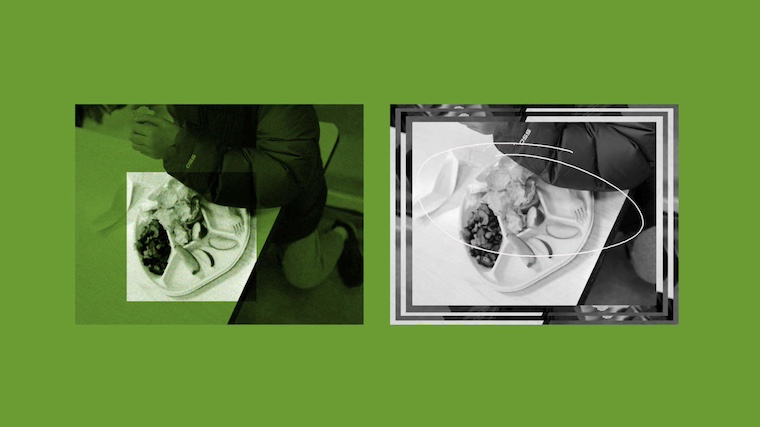
Graphic by Alex Hinton | Source Image: Michael Loccisano/Getty Images
[This story was originally published by The Counter, a non-profit newsroom covering the forces shaping how and what we eat. It is republished here by permission.]
But does it deserve at least an ‘E’ for effort?
Last week, New York City Mayor Eric Adams announced the launch of a new “Vegan Fridays” initiative at the largest school district in the country. Depending on where you were on the internet at the time, the announcement landed with either a splash or a sputter.
On the inaugural Vegan Friday, one day after the announcement, photos of clearly non-vegan options, or of seemingly vegan-yet-unappetizing meals, began to circulate on Twitter.
“This was served to a public school student […] for Vegan Fridays,” Jessica Ramos, a New York State senator, tweeted. Her comment accompanied a photo of a cafeteria tray carrying a bag of chips, a few apple slices, and a scoop of what looked like a stir-fry medley of zucchini, mushrooms, and corn. (After a quick browse of the city’s school food menu for the month of February, our best guess is that this was the “vegan veggie tacos” offering.) “The only real meal some of our city’s kids can count on is what they get @ school. This wasn’t thought through,” Ramos went on.
But, as is the case with most tweets, the critical posts didn’t necessarily capture the full story. Some parents jumped in to defend the program, suggesting that any hiccups that day were likely due to school-by-school variations in food preparation, rather than a sign that the initiative as a whole was problematic. And a closer reading of the New York City Department of Education’s (DOE) messaging around Vegan Fridays suggests that much of the hubbub about non-vegan options still being available to students that day may have been the result of a simple misunderstanding over what exactly the program was trying to do.
As it turns out, prior to last week, most New York City schools were already serving a combination of vegan and vegetarian items to students on Mondays and Fridays. When meat or dairy products were served, students could typically request a vegan alternative, the education department told local news station NY1. In other words, the Vegan Fridays initiative wasn’t as much a complete overhaul of the status quo, as much as it was a slight change in emphasis on ingredients that were already on the menu.
In fact, for those who follow municipal food procurement news (if that’s not you, we don’t blame you) Vegan Fridays may not have even been that much of a surprise. In September, the city published its first-ever report on “Good Food Purchasing,” a non-binding strategy that prioritizes sourcing food from contractors that support animal welfare, worker wellbeing, environmental sustainability, and supply chain transparency. As part of the strategy, which focused on institutions citywide, the report encouraged municipal agencies to prepare more “plant-based entrees,” directing the education department in particular to incorporate more non-meat protein sources into school menus.
While it’s unclear whether Vegan Fridays was a direct result of the Good Food Purchasing report, the initiative dovetails pretty neatly with its broader goals. (The mayor’s office didn’t respond to an emailed list of questions about the development of Vegan Fridays.)
New York City is the nation’s largest school district to implement vegan meals on a broad scale for its students, but it’s certainly not the first. In 2017, the Los Angeles Unified School District (LAUSD) launched a first-of-its-kind pilot program offering vegan options to students on a daily basis. The program was initially a response to a student campaign at the Pacific Palisades High School, located in one of the country’s most affluent neighborhoods. It was eventually extended to more than 40 schools. The pilot was warmly received by students and staff, but struggled with low participation rates more broadly, found a 2018 report on the program. A California bill introduced in 2019 to incentivize schools to serve more plant-based meals received initial support, but later died. Portland Public Schools in Maine resumed daily vegan offerings at its elementary schools last fall, following two years of pause during the pandemic.
Recent efforts to introduce vegan meals to school cafeterias are driven by a number of factors, including student pressure and concerns over high greenhouse gas emissions linked to livestock production.
“We’re seeing increased demand from the K through 12 student population for more plant-based, environmentally conscious meals,” said Kari Hamerschlag, deputy director of the food and agriculture program at Friends of the Earth, an environmental group that has advocated for changes to the federal school meals program that would make it easier for school nutrition departments to serve vegetarian and vegan meals. “There’s definitely growing demand, but there’s a lot of challenges for the school district space to meet that demand.”
For example, Hamerschlag pointed out, the Department of Agriculture’s (USDA) school nutrition program rules dictate that in order to receive federal reimbursement, each meal has to include a few distinct components. To qualify, vegan products must be visually “recognizable.” That means tofu blended into a soup or pasta made of lentils won’t count. USDA also requires schools to offer milk with every meal, a mandate that means New York City’s school meals could never be fully vegan on Fridays, even if all meat and dairy products were taken off the menu. (Children who are lactose-intolerant need to provide medical documentation in order to receive milk substitutes.)
In other words, the city’s Vegan Fridays program was never meant to be completely vegan. Rather, it takes after the mayor’s own dietary pattern: Vegan in name, but not necessarily in strict adherence to the dietary rules of abstinence.
In any case, we’ll see everyone on Friday for another round of rage-tweeting about school meals. It looks like we’re having Mediterranean chickpeas this week.
Return to Vegan Health Articles
Visit Food Hazards in Animal Flesh and By-products
All-Creatures.org Health Position and Disclaimer
We began this archive as a means of assisting our visitors in answering many of their health and diet questions, and in encouraging them to take a pro-active part in their own health. We believe the articles and information contained herein are true, but are not presenting them as advice. We, personally, have found that a whole food vegan diet has helped our own health, and simply wish to share with others the things we have found. Each of us must make our own decisions, for it's our own body. If you have a health problem, see your own physician.
Follow us on:


- Home Page
- What's New
- Contact Us
- Action Alerts
- Animal Exploitation
- Animal Issues
- Animal Rights Activism
- Archives
- Art & Photography
- Articles Directory
- Bible
- Bible Commentary Blog
- Books
- Campaigns
- Church & Religion
- Discussions
- Events / Podcasts / Media
- Health
- Hosted Web Sites
- Humor
- Kids' Korner
- Letters
- Links
- Nature Studies
- Newsletter
- Poetry & Stories
- Prayers
- Quotations
- Recipes with Photos
- Recipes Without Photos
- Sermons
- Stop Cruelty in Churches
- Video Library
- The Mary T. and Frank L. Hoffman Family Foundation
- Email: [email protected]
A web site sponsored by The Mary T. and Frank L. Hoffman Family Foundation and all-creatures.org
Copyright © 1998-2026 The Mary T. and Frank L. Hoffman Family Foundation. All rights reserved. May be copied only for personal use or by not-for-profit organizations to promote compassionate and responsible living. All copied and reprinted material must contain proper credits and web site link www.all-creatures.org.
Fair Use Notice: This document, and others on our web site, may contain copyrighted material whose use has not been specifically authorized by the copyright owners. We believe that this not-for-profit, educational use on the Web constitutes a fair use of the copyrighted material (as provided for in section 107 of the US Copyright Law). If you wish to use this copyrighted material for purposes of your own that go beyond fair use, you must obtain permission from the copyright owner.
Thank you for visiting all-creatures.org.
