What's Happening to Arctic Ice?
 Sea
ice in Canada's Arctic and sub-Arctic regions has been melting rapidly
over the past three decades, causing concerns that climate change is
speeding this fragile region toward an uncertain future. If thinning
continues at its current rate, by 2050 the Arctic Ocean could be
completely ice-free in summer. Sea
ice in Canada's Arctic and sub-Arctic regions has been melting rapidly
over the past three decades, causing concerns that climate change is
speeding this fragile region toward an uncertain future. If thinning
continues at its current rate, by 2050 the Arctic Ocean could be
completely ice-free in summer.
What may seem like a boon to the shipping industry would bring
unprecedented social, economic, and environmental changes to the North.
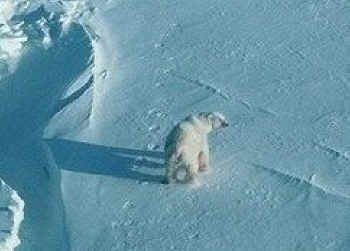
Aboriginal people and many species of wildlife, including polar bears
and caribou, rely on sea ice for hunting, feeding, and travel. On a
global scale, Arctic ice and snow play a key role in regulating the
Earth's temperature by reflecting sunlight before it warms the surface.
Altering this dynamic will affect the planet's climate in ways that are
only now being imagined.
Numerical simulations of future climate by various global
models�including Environment Canada's state-of-the-art global coupled
model�support the theory that the effects of climate change will be felt
first and most intensely in the Arctic. Although there is uncertainty
over timing, most scientists agree that there will be less sea ice in
the future, and there is concern that this thawing trend may be
irreversible.
Observational evidence also supports this theory. Environmental
monitoring shows that the Arctic is warming at a rate that is
unprecedented over the past 400 years. The average annual temperature at
Resolute Bay�a meteorological station in the Arctic archipelago�has
increased by 1.3�C since 1969. Over the Canadian Arctic as a whole, the
increase was more than 1�C over the last half of the 20th century.
The extent of Arctic sea ice, as observed primarily by passive microwave
radiometers on satellites, has decreased at a rate of about three per
cent per decade since the 1970s. Sonar records from British and American
submarines indicate that Arctic ice thickness in summer has diminished
by some 40 per cent since the 1950s. A recent study by the U.S. National
Aeronautical and Space Agency says Arctic sea ice is vanishing at a rate
of roughly nine per cent per decade�a rate that is speeding up as more
ocean is exposed and greater amounts of solar energy are absorbed.
Historically, Canada's Arctic waters are covered by an essentially solid
ice pack throughout winter. The ice starts to break up in July,
permitting a three- to five-month shipping season before freeze-up
begins in October. While some areas of the Arctic Ocean, such as Hudson
Bay and the coastal zone of the Beaufort Sea, almost always become
ice-free in the summer, others remain covered in ice year-round. In
recent years, however, forecasters at Environment Canada's Canadian Ice
Service have noticed that the ice is melting much more extensively than
normally and is not forming as early in the fall.
To determine if there was any quantitative trend to this pattern, the
Ice Service digitized the weekly ice charts it has produced for the
Canadian Arctic since 1969. By totaling the ice coverage on these charts
for each summer season (June 25 to October 15) from 1969 to 2001,
meteorologists were able to study differences in total accumulated
coverage from one year to the next.
Their studies confirmed that the total coverage of sea ice in summer had
decreased by about 15 per cent in the Arctic (north of 60� latitude),
and by about 40 per cent in the sub-Arctic area of Hudson Bay. The data
were then further divided to look at differences in trends between the
Eastern and Western Arctic. In the Eastern Arctic, a 15-per-cent
decrease in coverage was detected overall, while the three sub-regions
of the Western Arctic showed declines of 10 per cent (Viscount
Melville), 12 per cent (Beaufort Sea), and 36 per cent (Western Arctic
Waterway). Not surprisingly, the shipping season in these regions had
increased by three to nine per cent during this same period.
While confidence was lower that the trends observed in the first two
sub-regions of the Western Arctic were statistically significant,
confidence in the figure for the Western Arctic Waterway was 95 per
cent. This is of particular importance, because ice in the Waterway is
believed to be driven mainly by local thermodynamics�in that it does not
circulate into or out of the area on any large scale, but rather tends
to form in winter and melt each summer in situ. This may indicate that
the ice decline observed in this sub-region is more reflective of rising
surface temperatures than in the Beaufort Sea sub-region, where a large
flux of multi-year ice from the Arctic Ocean enters and exits.

A map of the Canadian Arctic, indicating areas where sea-ice studies
have taken place.
As an adjunct to these studies, Canadian Ice Service
scientists examined weekly ice charts for the northern Labrador Sea
area. While global climate models predict a local cooling trend in the
area even under global warning scenarios, observations made in recent
years indicate that almost all of the ice in this sub-Arctic region has
melted completely before June 25 and not reappeared until after October
15. The database showed strong support for these observations,
indicating a decrease in summer ice coverage of 72 per cent between 1971
and 2001�with 98 per cent confidence in the trend's statistical
significance.
While total accumulated coverage is considered an excellent indicator of
the long-term effects of climate change, the meteorologists also looked
at minimum ice cover in summer for each year in the database. While this
information is not meaningful for areas such as Hudson Bay, where all of
the ice frequently melts during summer, it adds to our understanding of
what is happening to Arctic ice. The results of this arm of the study
showed a 24-per-cent decrease between 1969 and 2001 in the area covered
by sea ice at the summer minimum in both the Eastern and Western
Arctic�a decline of eight per cent per decade.
There are few certainties when it comes to predicting future
climate�particularly when such predictions are based on observations
made over a very short period of time, relatively speaking. The probable
scenario, however, is that there will always be winter ice in the Arctic
Ocean; extreme inter-annual variability in coverage will persist,
regardless of climate change; and there will be less sea ice in the
Arctic in years ahead. Despite the uncertainties, scientific studies
such as these are an important step toward recognizing and better
understanding the impacts of climate change in time to reduce or
mitigate its effects.
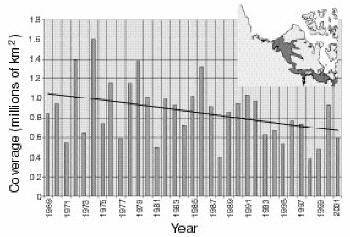
Accumulated seasonal ice coverage in the Western Arctic Waterway during
summer, from 1969 to 2001.
|


 Since
Since
