
|
|
Arctic and Antarctic under Global Warming |
Articles and Reports: Arctic and Greenland
Record Low for June Arctic Sea IceJune 2005
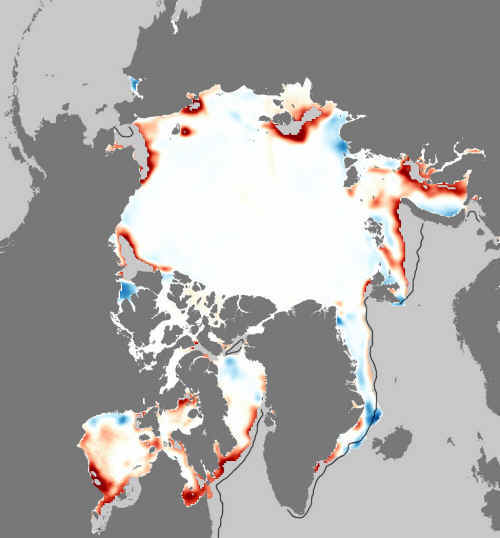
June marks the beginning of the melt season for Arctic sea ice, which reaches its minimum extent at the end of the season in September. In the past few Septembers, Arctic sea ice concentration (the amount of ice in a given area) has been markedly reduced. September 2002 set a new record low at 15 percent below average. It was followed closely by September 2003 and September 2004. So far, 2005 is shaping up to be another record-low sea ice year in the Arctic. This image shows places where Arctic sea ice was above (blue) or below (red) average in June 2005, the end of the first month of the melt season. The images are made from data from the satellite-based, Scanning Multi-channel Microwave Radiometer (SMMR) and Special Sensor Microwave/Imager (SSM/I). Ice-free areas appear in light gray, and landmasses appear in dark gray. The black line shows the median ice edge for 1979 through 2000. Except for a small area in the East Greenland Sea, Arctic sea ice has retreated almost everywhere in June 2005. The month set a new record low: 6 percent below the long-term mean for June sea ice extent. During the melt season in any year, some areas may experience positive anomalies�higher than average sea ice concentration�or negative anomalies�lower than average ice concentrations. Most anomalies occur along the margins of the ice cap, but they can also occur near the pole at the end of the melt season. Few if any anomalies occur near the pole in June. Different explanations have been proposed for Arctic sea ice decline, including the strong positive mode of the Arctic Oscillation (AO). This oscillation is an alternating pattern of atmospheric pressure at polar latitudes and mid-latitudes. In the early 1990s, the AO was in positive mode. In that mode, the AO produces a strong polar vortex, and resulting winds tended to flush older, thicker ice out of the Arctic. Since the late 1990s, however, the AO has been much more neutral, yet Arctic sea ice decline continues. Another explanation for declining sea ice is climate change. Global temperatures have risen, and climate models generally agree that one of the strongest signals of greenhouse warming is a loss of Arctic sea ice. Changes in surface albedo provide another, related explanation. Just as light clothes reflect the Sun�s heat on a hot day, bright sea ice reflects much of the Sun�s energy back into space. As sea ice melts, less energy is reflected back into space, and more energy is absorbed by the darker ocean waters. This creates a �feedback loop� in which sea ice decline fosters further decline. Even after warm summers, Arctic sea ice has typically recovered in wintertime, but this has changed in recent years. Besides showing dramatic retreat in the summer, Arctic sea ice has begun to decline in the wintertime as well. Some scientists have begun to wonder whether Arctic sea ice has crossed a critical threshold from which it can�t recover. Image courtesy of Ken Knowles and Terry Haran,
National Snow and Ice Data Center. Information provided by Julienne
Stroeve, Walt Meier, Florence Fetterer, Ken Knowles, and Mark Serreze,
NSIDC. |
Return to:
Articles and Reports
Return to: Arctic and Antarctic under Global
Warming
Return to:
Home Page
Your Comments and Inquiries are Welcome

Fair Use Notice: This document may contain copyrighted material whose use has not been specifically authorized by the copyright owners. We believe that this not-for-profit, educational use on the Web constitutes a fair use of the copyrighted material (as provided for in section 107 of the US Copyright Law). If you wish to use this copyrighted material for purposes of your own that go beyond fair use, you must obtain permission from the copyright owner.
|

 Since
Since
