Global Warming Puts the Arctic on Thin Ice
Answers to questions about the Arctic's shrinking
ice cap and its global significance.
1. Why are global warming specialists watching the
Arctic so closely?
2. What kinds of changes are taking place in the Arctic
now?
3. How does this dramatic ice melt affect the Arctic?
4. Will Arctic ice melt have any effects beyond the polar
region?
5. Can we do anything to stop global warming?
1. Why are global warming specialists watching the
Arctic so closely?
The Arctic is global warming's canary in the coal mine. It's a highly
sensitive region, and it's being profoundly affected by the changing
climate. Most scientists view what's happening now in the Arctic as a
harbinger of things to come.
 2.
What kinds of changes are taking place in the Arctic now? 2.
What kinds of changes are taking place in the Arctic now?
Average temperatures in the Arctic region are rising twice as fast as
they are elsewhere in the world. Arctic ice is getting thinner, melting
and rupturing. For example, the largest single block of ice in the
Arctic, the Ward Hunt Ice Shelf, had been around for 3,000 years before
it started cracking in 2000. Within two years it had split all the way
through and is now breaking into pieces.
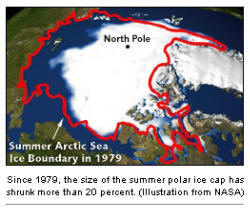
The polar ice cap as a whole is shrinking. Images from NASA satellites
show that the area of permanent ice cover is contracting at a rate of 9
percent each decade. If this trend continues, summers in the Arctic
could become ice-free by the end of the century.
3. How does this dramatic ice melt affect the Arctic?
The melting of once-permanent ice is already affecting native people,
wildlife and plants. When the Ward Hunt Ice Shelf splintered, the rare
freshwater lake it enclosed, along with its unique ecosystem, drained
into the ocean. Polar bears, whales, walrus and seals are changing their
feeding and migration patterns, making it harder for native people to
hunt them. And along Arctic coastlines, entire villages will be uprooted
because they're in danger of being swamped. The native people of the
Arctic view global warming as a threat to their cultural identity and
their very survival.
 4.
Will Arctic ice melt have any effects beyond the polar region? 4.
Will Arctic ice melt have any effects beyond the polar region?
Yes -- the contraction of the Arctic ice cap is accelerating global
warming. Snow and ice usually form a protective, cooling layer over the
Arctic. When that covering melts, the earth absorbs more sunlight and
gets hotter. And the latest scientific data confirm the far-reaching
effects of climbing global temperatures.
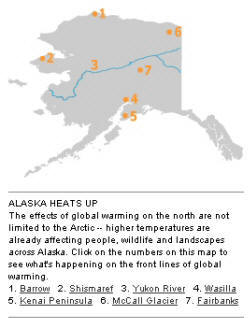
Rising temperatures are already affecting Alaska, where the spruce bark
beetle is breeding faster in the warmer weather. These pests now sneak
in an extra generation each year. From 1993 to 2003, they chewed up 3.4
million acres of Alaskan forest.
Melting glaciers and land-based ice sheets also contribute to rising sea
levels, threatening low-lying areas around the globe with beach erosion,
coastal flooding, and contamination of freshwater supplies. (Sea level
is not affected when floating sea ice melts.) At particular risk are
island nations like the Maldives; over half of that nation's populated
islands lie less than 6 feet above sea level. Even major cities like
Shanghai and Lagos would face similar problems, as they also lie just
six feet above present water levels.
Rising seas would severely impact the United States as well. Scientists
project as much as a 3-foot sea-level rise by 2100. According to a 2001
U.S. Environmental Protection Agency study, this increase would inundate
some 22,400 square miles of land along the Atlantic and Gulf coasts of
the United States, primarily in Louisiana, Texas, Florida and North
Carolina.
A warmer Arctic will also affect weather patterns and thus food
production around the world. Wheat farming in Kansas, for example, would
be profoundly affected by the loss of ice cover in the Arctic. According
to a NASA Goddard Institute of Space Studies computer model, Kansas
would be 4 degrees warmer in the winter without Arctic ice, which
normally creates cold air masses that frequently slide southward into
the United States. Warmer winters are bad news for wheat farmers, who
need freezing temperatures to grow winter wheat. And in summer, warmer
days would rob Kansas soil of 10 percent of its moisture, drying out
valuable cropland.
5. Can we do anything to stop global warming?
Yes. When we burn fossil fuels -- oil, coal and gas -- to generate
electricity and power our vehicles, we produce the heat-trapping gases
that cause global warming. The more we burn, the faster churns the
engine of global climate change. Thus the most important thing we can do
is save energy.
And we can do it. Technologies exist today to make cars that run cleaner
and burn less gas, generate electricity from wind and sun, modernize
power plants, and build refrigerators, air conditioners and whole
buildings that use less power. As individuals, each of us can take steps
to save energy and fight global warming.
|


 Since
Since
