NASA Sees Rapid Changes in Arctic Sea Ice
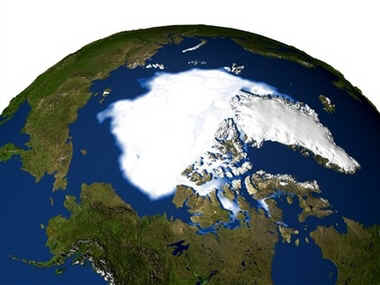
This satellite image released by NASA shows
the concentration of Arctic sea ice in 2005. Arctic sea ice in winter is
melting far faster than before
Sept. 13, 2006-NASA
data shows that Arctic perennial sea ice, which normally survives the
summer melt season and remains year-round, shrunk abruptly by 14 percent
between 2004 and 2005. According to researchers, the loss of perennial
ice in the East Arctic Ocean neared 50 percent during that time as some
of the ice moved from the East Arctic to the West.
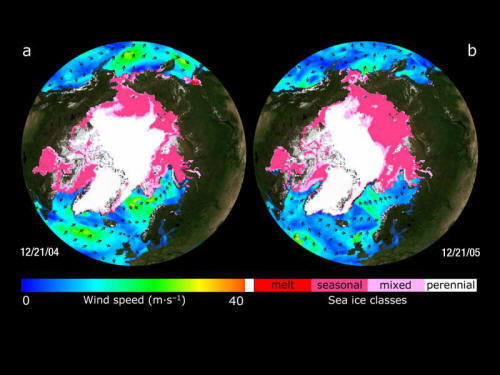
NASA QuikScat shows inter
annual observations of sea ice over the Arctic enabling the detection of
recent drastic reductions in the extent of perennial ice and its
depletion from the eastern Arctic Ocean between 2004, left and 2005.
Arctic sea ice in winter is melting far faster than before, two new NASA
studies reported Wednesday, a new and alarming trend that researchers
say threatens the ocean's delicate ecosystem. For more than 25 years
Arctic sea ice has slowly diminished in winter by about 1.5 percent per
decade. But in the past two years the melting has occurred at rates 10
to 15 times faster.
The overall decrease in
winter Arctic perennial sea ice totals 280,000 square miles--an area the
size of Texas. Perennial ice can be 10 or more feet thick. It was
replaced by new, seasonal ice only about one to seven feet thick that is
more vulnerable to summer melt.
The decrease in the perennial ice raises the possibility that Arctic sea
ice will retreat to another record low extent this year. This follows a
series of very low ice-cover years observed over the past four summers
from active and passive microwave satellite data.
A team led by Son Nghiem of NASA's Jet Propulsion Laboratory, Pasadena,
Calif., used NASA's QuikScat satellite to measure the extent and
distribution of perennial and seasonal sea ice in the Arctic. While the
total area of all the Arctic sea ice was stable in winter, the
distribution of seasonal and perennial sea ice changed significantly.
"Recent changes in Arctic sea ice are rapid and dramatic," said Nghiem.
"If the seasonal ice in the East Arctic Ocean were to be removed by
summer melt, a vast ice-free area would open up. Such an ice-free area
would have profound impacts on the environment, as well as on marine
transportation and commerce."
The researchers are examining what caused the rapid decrease in the
perennial sea ice. Data from the National Centers for Environmental
Prediction, Boulder, Colo., suggest that winds pushed perennial ice from
the East to the West Arctic Ocean (primarily located above North
America) and significantly moved ice out of the Fram Strait, an area
located between Greenland and Spitsbergen, Norway. This movement of ice
out of the Arctic is a different mechanism for ice shrinkage than the
melting of Arctic sea ice, but it produces the same results - a
reduction in the amount of perennial Arctic sea ice.
Researchers indicate that if the sea ice cover continues to decline, the
surrounding ocean will get warmer, further accelerating summer ice melts
and impeding fall freeze-ups. This longer melt season will, in turn,
further diminish the Arctic ice cover.
Nghiem cautioned the recent Arctic changes are not well understood and
many questions remain. "It's vital that we continue to closely monitor
this region, using both satellite and surface-based data," he said.
This is one of three study results being released today by NASA. The
findings are the result of a new study by NASA; the U.S. Army Cold
Region Research and Engineering Laboratory, Hanover, N.H.; and the
National Ice Center, Washington, D.C. Study results are published in a
recent issue of Geophysical Research Letters.
Arctic Sea Ice Hitting Major Lows in Wintertime
09.13.06
The Arctic winter
wonderland, known for its icy waterways and white snowy scenery, is
experiencing record low sea ice in the last two years. In a new NASA
study, scientists have used satellite observations to observe unusually
warm wintertime temperatures in the region and a resulting decline in
the length of the Arctic ice season.
The maximum amount of sea ice in the Arctic winter has fallen by six
percent over each of the last two winters, as compared to a loss of
merely 1.5 percent per decade on average annually since the earliest
satellite monitoring in 1979. This is happening as summer sea ice
continues its retreat at an average of 10 percent per decade. This
amount of Arctic sea ice reduction the past two consecutive winters has
not taken place before during the 27 years satellite data has been
available," said Joey Comiso, a research scientist at NASA's Goddard
Space Flight Center, Greenbelt, Md. "In the past, sea ice reduction in
winter was significantly lower per decade compared to summer sea ice
retreat. What's remarkable is that we've witnessed sea ice reduction at
six percent per year over just the last two winters, most likely a
result of warming due to greenhouse gases."
Comiso used a computer simulation and satellite data to carry out the
study, to be published in Geophysical Research Letters this month.
Computer simulations of the climate warming effect of greenhouse gases
had predicted that winter sea ice would decline faster than summer sea
ice. Satellite data has shown otherwise until two years ago, when record
low winter ice cover and warmer temperatures have prevailed.
Sea ice cover in the Northern Hemisphere spans nearly 10 million square
miles in the winter. Satellite sensors are the only means to observe
such a large region effectively. Comiso confirmed the accuracy of
satellite sea ice data by comparing it with high-resolution satellite
information and data gathered from sensitive instruments aboard
aircraft. Surface temperature data from satellite sensors are checked
against measurements from meteorological stations in the region.
Adding to the plight of winter sea ice, previous research has shown a
trend in which the melt period lasts about 2 weeks longer per year
annually due to summer sea ice decline.
According to Comiso, if the winter ice retreat continues, the effect
could be very profound, especially for marine animals. "The seasonal ice
regions in the Arctic are among the most biologically productive regions
in the world," he said. "For example, sea ice provides melt-water in
spring that floats because of low density. This melt-water layer is
considered by biologists as the ideal layer for phytoplankton growth
because it does not sink, and there is plenty of sunlight reaching it to
enable photosynthesis. Plankton are at the bottom of the food web. If
their concentration goes down, animals at all tropics level would be
deprived of a basic source of food." "A continued reduction of the
Arctic winter ice cover would be a clear indicator of the warming effect
of increasing greenhouse gases in the atmosphere. It would at least
confirm our current understanding of the physics of the Arctic climate
system that has been incorporated in our models," said Comiso.
Slow Retreat of Sea Ice Lengthens Arctic Polar
Bear's Fast
09.13.06
Many
of us have watched documentary film clips or seen touching photos of
mother polar bears walking on the icy surface of Arctic waters, at times
with cubs in tow, hunting for food. For some time, scientists have
suggested that the same icy Arctic surface -- sea ice -- is slowly
retreating because of an ever-warming climate.
Scientists from NASA
and the Canadian Wildlife Service are now reporting that the slow
reduction in sea ice is forcing Arctic polar bears to fast for longer
and longer periods, posing danger to their survival.
Claire Parkinson, a senior scientist at NASA's Goddard Space Flight
Center, and Ian Stirling, a research scientist specializing in polar
marine mammals with the Canadian Wildlife Service in Edmonton, Alberta,
also suggest that the progressively earlier breakup of sea ice, caused
by climate warming, shortens the spring hunting season for female polar
bears and is probably responsible for the observed weight loss in these
bears. The lighter the females, the more their ability to reproduce, and
ability for their young to survive declines.
As the bears become thinner, they will also have a greater tendency to
seek alternative food villages and hunting camps, giving the impression
to some that the population is increasing. The study will be published
this week in the September issue of the Journal Arctic.
"A key result of our research is its strong suggestion that climate
warming is having a significant and negative effect on a primary species
reliant on the sea ice cover for survival," said Parkinson.
The researchers used NASA satellite observations captured over 26 years
from 1979 to 2004 to show the reduction in sea ice cover in several
specific areas. In most of the areas studied, they found that ice
break-up in these areas has been occurring progressively earlier over
time.
"Polar bears live much of their lives on the sea ice, which is
fundamental for their survival, at least in terms of their traditional
lifestyles. For instance, it�s the sea ice surface that provides them a
platform from which to hunt seals and other marine mammals for food,"
said Parkinson. Sea ice is most scarce during the summer months, causing
the bears to retreat to land and fast on their stored fat reserves until
sea ice comes back in the fall.
"By reviewing satellite data, we found that sea ice cover break-up in
Western Hudson Bay took place at about seven to eight days earlier per
decade," said Stirling. "An extra month of fasting resulting from this
phenomenon over four decades can significantly impact the polar bears'
eating habits and survival."
The researchers' data also indicate the likelihood that progressively
earlier breakup of the sea ice was likely to also cause reproductive
problems for polar bears.
"In 1980 the average weight of adult females in western Hudson Bay was
650 pounds. Their average weight in 2004 was just 507 pounds � a
143-pound reduction," said Stirling. A 1992 study in the Canadian
Journal of Zoology indicated that no females weighing less than 416
pounds gave birth the following spring.
According to Stirling, if the climate continues to warm as projected by
the Intergovernmental Panel on Climate Change and the ice continues to
break up progressively earlier, it is likely that in another 20-30 years
polar bear reproduction in western Hudson Bay will be significantly
limited and may be repeated elsewhere.
|


 Since
Since
