
|
|
Arctic and Antarctic under Global Warming |
Articles and Reports: Arctic and Greenland
Arctic sea ice shrinking faster, NASA findsResearchers cite global warming in one study, winds in another MSNBC A pair of new studies shows that winter sea ice in the Arctic has shrunk dramatically in the past two years and that perennial ice in particular is disappearing. Two types of sea ice cover the Arctic Ocean: thick perennial ice that resists thaw year-round and thinner seasonal ice that melts during the summer and freezes again in the winter. Both types are experiencing decline, according to analyses of microwave satellite data. Researchers led by Joey Comiso of NASA's Goddard Space Flight Center in Greenbelt, Md., found that the amount of ice covering the Arctic has declined by 6 percent over each of the last two winters, compared to a loss of merely 1.5 percent per decade since 1979. Comiso's team did not distinguish between perennial and seasonal ice,
but he told LiveScience most of the loss was likely seasonal ice. "This amount of Arctic sea ice reduction the past two consecutive winters has not taken place before during the 27 years satellite data has been available," Comiso said. The researchers said that warming temperatures and a shorter
winter-ice season are likely to blame. Losing perennial ice In addition to finding a loss of the ice cover extent, the team found
a stark change in ice distribution. The perennial ice shrunk abruptly by
14 percent between 2004 and 2005, with an overall decrease of 280,000
square miles (725,200 square kilometers) � an area the size of Texas.
That's a much faster rate than NASA's earlier data, which found that between 1979 and 2003 Arctic perennial sea ice had been decreasing at a rate of 9 percent per decade, with the most significant loss in 2001, 2002 and 2003. While perennial ice can reach a thickness of more than 10 feet (3 meters), seasonal ice thickness ranges from 1 to 7 feet (0.3 to 2 meters). The team is still trying to figure out the reason for the shrinking ice cover. Typically, a loss of sea ice results from an increase in temperatures, which causes the ice to melt. However, Nghiem suggested that, in this case, strong winds pushed the thicker sea ice from the East to the West Arctic Ocean, sending giant chunks of ice along the eastern coast of Greenland toward warmer climes. That means this once melt-resistant ice could melt. Possible consequences
The thick ice, which has increased in thickness as layer upon layer of snow melts and freezes on top of it, contains loads of air bubbles. �These bubbles scatter the sunlight out of the ice so less solar energy can be absorbed,� Nghiem said. The seasonal ice doesn�t contain these sun-scattering bubbles, and thus absorbs more sunlight. If the perennial sea ice cover continues to decline and be replaced by thinner ice, the surrounding ocean could get warmer, further accelerating summer ice melts and impeding fall freeze-ups, the scientists said. � 2008 LiveScience.com. All rights reserved. |
Return to:
Articles and Reports
Return to: Arctic and Antarctic under Global
Warming
Return to:
Home Page
Your Comments and Inquiries are Welcome

Fair Use Notice: This document may contain copyrighted material whose use has not been specifically authorized by the copyright owners. We believe that this not-for-profit, educational use on the Web constitutes a fair use of the copyrighted material (as provided for in section 107 of the US Copyright Law). If you wish to use this copyrighted material for purposes of your own that go beyond fair use, you must obtain permission from the copyright owner.
|
 NASA
-
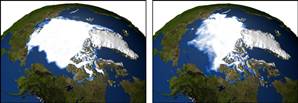
These satellite-derived images show the minimum Arctic perennial sea ice
measured in 1979, left, and 2003. The coverage declined by 9 percent per
decade during that time. Two new studies found the rate of shrinking has
accelerated.
NASA
-
These satellite-derived images show the minimum Arctic perennial sea ice
measured in 1979, left, and 2003. The coverage declined by 9 percent per
decade during that time. Two new studies found the rate of shrinking has
accelerated. Albedo is a measure of how much light a surface reflects.

 Since
Since
