NEW DATA SHOW DOWNWARD TREND IN ARCTIC SEA ICE
NOAA
Nov. 20, 2006
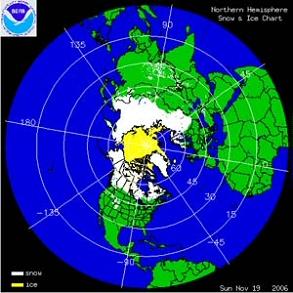
The extent of Arctic Sea ice has experienced a steady declining trend
during the past 33 years, based on a new comprehensive analysis of
satellite data by experts at the U.S. National Ice Center, a tri-agency
team from NOAA, the U.S. Navy, and U.S. Coast Guard, based in Suitland,
Md.
 This
new climatology dataset is expected to be a more useful and accurate
tool for the research community to use than other datasets previously
available. This tool can be applied to improve seasonal and
climatological sea-ice-change forecast research in the Arctic. This
new climatology dataset is expected to be a more useful and accurate
tool for the research community to use than other datasets previously
available. This tool can be applied to improve seasonal and
climatological sea-ice-change forecast research in the Arctic.
The data set, New 30-Year Arctic Sea Ice Climatology, is derived from a
1972 - 2004 chart series that provides a close representation of the sea
ice extent as derived from a combination of satellite observations,
measuring instruments on the surface and model output.
"The new data sets show shrinkage in the Arctic Ocean summer ice
cover of more than eight percent per decade and gives us concrete
information with which to develop improved seasonal and long-term
forecasts in the future," said Pablo Clemente-Col�n, the ice
center's chief scientist.
The new data set confirms that the overall trend in summer, winter and
multi-year total ice extent is down. Both winter (maximum) and summer
(minimum) sea ice extents are decreasing, although summer shrinkage is
more pronounced. The percentage of multi-year ice in the winter is also
decreasing significantly.
The NIC's new data set is available at the Web site of the National Snow
and Ice Data Center.
Since 1972, the ice center has produced weekly, or bi-weekly operational
sea-ice charts for Antarctica, and the Arctic and other ice-covered
waters. These analyses are used primarily for mission planning and safe
navigation. They also are incorporated into weather forecasts and serve
as a comprehensive global record of sea-ice extent and concentration
that can be used for climate monitoring. The ice center is celebrating
its 30th anniversary as an interagency operational sea ice service with
global monitoring responsibilities.
In 2007 NOAA, an agency of the U.S. Commerce Department, celebrates 200
years of science and service to the nation. Starting with the
establishment of the U.S. Coast and Geodetic Survey in 1807 by Thomas
Jefferson much of America's scientific heritage is rooted in NOAA. The
agency is dedicated to enhancing economic security and national safety
through the prediction and research of weather and climate-related
events and information service delivery for transportation, and by
providing environmental stewardship of the nation's coastal and marine
resources. Through the emerging Global Earth Observation System of
Systems (GEOSS), NOAA is working with its federal partners, more than 60
countries and the European Commission to develop a global monitoring
network that is as integrated as the planet it observes, predicts and
protects.
|


 Since
Since
