
|
|
Arctic and Antarctic under Global Warming |
Articles and Reports: Arctic and Greenland
Arctic Will Melt To Projected 2050 Levels, This YearWritten by The Naib
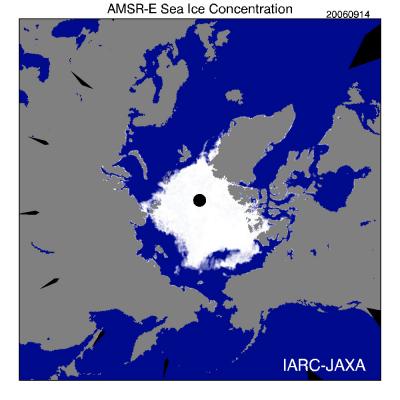
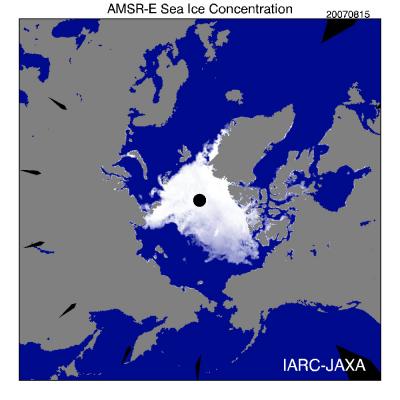
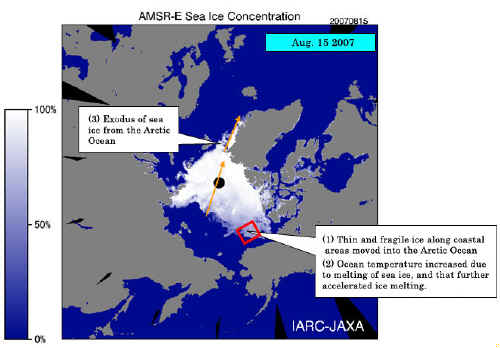
On August 15, 2007, the area got smaller than the worst record marked in September 2005. The receding of sea ice is especially noticeable toward the North Pole in North American Coastal areas and the Northern ocean area of East Siberia.
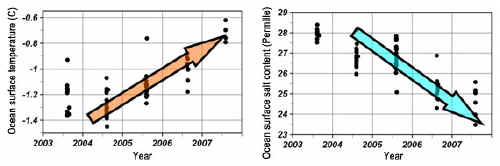
The following are estimated causes of accelerated sea ice reduction
this year as a result of the comprehensive analysis of the observation
data acquired by JAMSTEC including observation data by ships, continued
observation by drifting buoys (JCAD, POPS*2) and atmospherics data.
A graph showing the change in the sea ice area in the Arctic Ocean
between 2002 and 2007. Until this June, the area change trend was about
the same as previous years, but since July, each day sets a new low
record. On August 15, the previous worst record marked in Sept. 2005 was
broken more than one month earlier. The shrinking area is expected to
continue, and new records are expected. If you are into this sort of
thing you can find the most up to date image of the shrinking arctic ice
here.
Call, email, phone your senator and representative and badger them
about this, send them links to these sites, and let them know we want
action now to reduce green house gases, that we want renewable energy,
and that we want it now. |
Return to:
Articles and Reports
Return to: Arctic and Antarctic under Global
Warming
Return to:
Home Page
Your Comments and Inquiries are Welcome

Fair Use Notice: This document may contain copyrighted material whose use has not been specifically authorized by the copyright owners. We believe that this not-for-profit, educational use on the Web constitutes a fair use of the copyrighted material (as provided for in section 107 of the US Copyright Law). If you wish to use this copyrighted material for purposes of your own that go beyond fair use, you must obtain permission from the copyright owner.
|
 The Japan Agency for Marine-Earth Science and Technology (JAMSTEC)
and the Japan Aerospace Exploration Agency (JAXA) cooperatively analyzed
oceanic and atmospheric observation data and sea ice data acquired by
satellites, and found that the sea ice area in the Arctic Ocean has been
decreasing at a much faster pace than expected compared to the previous
worst record in the summer of 2005. After satellite observations started
in 1978, the observed area shrunk to its lowest level on August 15,
2007. Ice melting normally continues until mid September, thus further
shrinkage of the sea ice area is expected. The observed phenomenon
significantly exceeded the forecasted model submitted in the
Intergovernmental Panel on Climate Change (IPCC) fourth Assessment
Report, and the big difference tells us that the model may not precisely
reflect the actual situation in the Arctic Ocean.
The Japan Agency for Marine-Earth Science and Technology (JAMSTEC)
and the Japan Aerospace Exploration Agency (JAXA) cooperatively analyzed
oceanic and atmospheric observation data and sea ice data acquired by
satellites, and found that the sea ice area in the Arctic Ocean has been
decreasing at a much faster pace than expected compared to the previous
worst record in the summer of 2005. After satellite observations started
in 1978, the observed area shrunk to its lowest level on August 15,
2007. Ice melting normally continues until mid September, thus further
shrinkage of the sea ice area is expected. The observed phenomenon
significantly exceeded the forecasted model submitted in the
Intergovernmental Panel on Climate Change (IPCC) fourth Assessment
Report, and the big difference tells us that the model may not precisely
reflect the actual situation in the Arctic Ocean.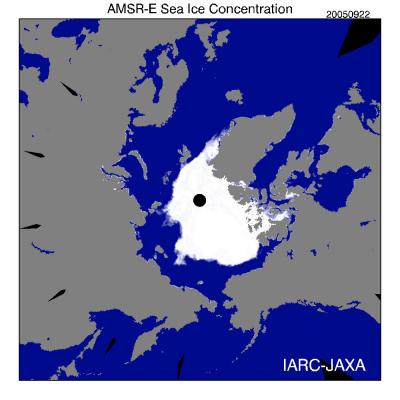


 Since
Since
