Arctic sea ice 50% thinner compared to 2001, ocean
currents and biological communities changing
Thursday, September 13, 2007
First results from an expedition to the North Polar Sea led by Germany's
Alfred-Wegener-Institute for Polar and Marine Research in the Helmholtz
Association, show that large areas of the Arctic sea-ice are only one
metre thick this year, a dramatic thinning of around 50 percent compared
to 2001. Fifty scientists have been on board the research ship
Polarstern for two and a half months. Amongst other things, they have
found that not only the sea-ice is thinning, but that ocean currents are
changing and that biological community structures in the Arctic
altering.
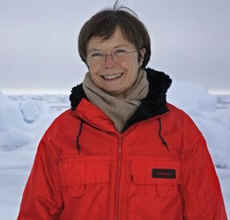 The ice cover in the North Polar Sea is dwindling, the ocean and the
atmosphere are becoming steadily warmer, the ocean currents are
changing. We are in the midst of phase of dramatic change in the Arctic,
and the International Polar Year 2007/08 offers us a unique opportunity
to study this dwindling ocean in collaboration with international
researchers. - Dr Ursula Schauer, chief scientist, Alfred-Wegener-Institute
for Polar and Marine Research The ice cover in the North Polar Sea is dwindling, the ocean and the
atmosphere are becoming steadily warmer, the ocean currents are
changing. We are in the midst of phase of dramatic change in the Arctic,
and the International Polar Year 2007/08 offers us a unique opportunity
to study this dwindling ocean in collaboration with international
researchers. - Dr Ursula Schauer, chief scientist, Alfred-Wegener-Institute
for Polar and Marine Research
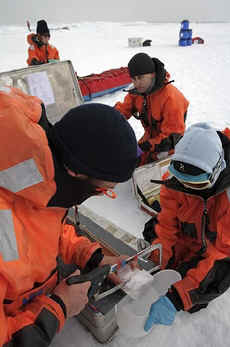 Dr Schauer is currently in the Arctic, underway with 50 scientists from
Germany, Russia, Finland, the Netherlands, Spain, the USA, Switzerland,
Japan, France and China, where they are investigating ocean and sea-ice
conditions. Oceanographers on board the research ship Polarstern are
investigating the composition and circulation of the water masses,
physical characteristics of sea-ice and transport of biological and
geochemical components in ice and seawater. Sea-ice ecosystems in the
seawater and on the ocean floor will also be a focus of investigations.
Scientists will take sediments from the ocean floor in order to
reconstruct the climatic history of the surrounding continents.
Dr Schauer is currently in the Arctic, underway with 50 scientists from
Germany, Russia, Finland, the Netherlands, Spain, the USA, Switzerland,
Japan, France and China, where they are investigating ocean and sea-ice
conditions. Oceanographers on board the research ship Polarstern are
investigating the composition and circulation of the water masses,
physical characteristics of sea-ice and transport of biological and
geochemical components in ice and seawater. Sea-ice ecosystems in the
seawater and on the ocean floor will also be a focus of investigations.
Scientists will take sediments from the ocean floor in order to
reconstruct the climatic history of the surrounding continents.
Oceanographic measuring buoys were set out in all regions of the
Arctic ocean for the first time during this International Polar Year
(more on Germany's contribution here). They are able to drift freely in
the Arctic Ocean whilst collecting data on currents, temperature, and
salt content of the seawater. The buoys will continuously collect data
over and send them back to the scientists via satellite. In addition,
the deployment of a new titanium measuring system which allows
contamination free sample collection of trace elements for the first
time due to its high effectiveness.
 Changes in Sea-Ice Changes in Sea-Ice
The thickness of the arctic sea-ice has decreased since 1979, and at the
moment measures about a metre in diameter in the central Arctic Basin.
In addition, oceanographers have found a particularly high concentration
of melt-water in the ocean and a large number of melt-ponds. These data,
collected from on board the Polarstern, and also from helicopter flights
allow the scientists to better interpret their satellite images.
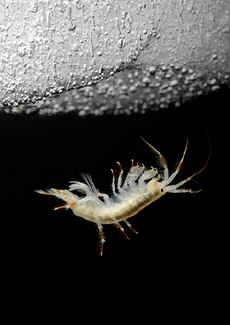
Sea-Ice biologists from the Institute of Polar Ecology at the University
of Kiel are studying the animals and plants living in and beneath the
ice. They are using the opportunity to investigate the threatened
ecosystem. According to the newest models, the Arctic could be ice free
in less than 50 years in case of further warming. This may cause the
extinction of many organisms that are adapted to this habitat.
 Ocean Currents Ocean Currents
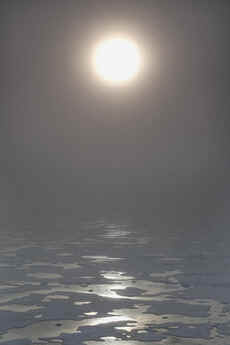
The Arctic Ocean currents are an important part of global ocean
circulation. Warm water masses flowing in from the Atlantic are changed
in the Arctic through water cooling and ice formation, and sink to great
depths. Constant monitoring by the Alfred-Wegener-Institute for Polar
and Marine Research over the last ten years have recorded significant
changes, and have demonstrated a warming of the incoming current from
the Atlantic Ocean. During this expedition, the propagation of these
warming events along each of the currents in the North Polar Sea will be
investigated.
The large rivers of Siberia and North America transport huge amounts of
freshwater to the Arctic. The freshwater appears to function as an
insulating layer, controlling the warmth transfer between the ocean, the
ice and the atmosphere: energy :: sustainability :: climate change :: greenhouse gas emissions
:: Arctic :: sea-ice :: ocean currents :: International Polar Year ::
The study area stretches from the shelf areas of the Barents Sea, the
Kara Sea and the Laptev Sea, across Nansen and Amundsen bays right up to
Makarow Bay.
Between Norway and Siberia and up to the Canadian Bay the scientists
have taken temperature, salinity, and current measurements at more than
100 places. First results have shown that the temperatures of the influx
of water from the Atlantic are lower as compared to previous years. The
temperatures and salinity levels in the Arctic deep sea are also slowly
changing. The changes are small here, but the areas go down to great
depths, and enormous water volumes are therefore involved. In order to
follow the circulation patterns in winter, oceanographic measuring buoys
will be attached to ice floes, and continuous measurements will be taken
whilst they float along with the ice. The measurements will be relayed
back via satellite.
In addition to the ocean currents and sea-ice, zooplankton, sediment
samples from the sea floor as well as trace elements will be taken.
Zooplankton are at the base of the food chain for many marine creatures,
and are therefore an important indicator for the health of the
ecosystem. The deposits found on the ocean floor of the North Polar Sea
read like a diary of the history of climate change for the surrounding
continents. Through sediment cores, the scientists may be able to unlock
the key to the glaciation of northern Siberia.
In addition, the members of the expedition will be able to measure trace
elements from Siberian rivers and shelf areas, that through polar drift
are being pushed towards the Atlantic.
These studies will take place within the context of different research
projects, all taking place during the International Polar Year: SPACE
(Synoptic Pan-Arctic Climate and Environment Study), iAOOS (Integrated
Arctic Ocean Observing System) and GEOTRACES (Trace Elements in the
Arctic). At the same time, a large component of the work is supported by
the European Union Program DAMOCLES (Developing Arctic Modelling and
Observing Capabilities for Long-term Environment Studies).
The Alfred-Wegener Institute (AWI) conducts research in the Arctic,
Antarctic and in oceans of temperate and high latitudes. The AWI
coordinates polar research in Germany, and provides important
infrastructure, such as the research icebreaker Polarstern and research
stations in the Arctic and Antarctic for international scientific
enterprises. The Alfred Wegener Institute is one of 15 research centres
of the 'Helmholtz-Gemeinschaft' (Helmholtz Association), the largest
scientific organisation in Germany.
|


 Since
Since
