
|
|
Arctic and Antarctic under Global Warming |
Articles and Reports: Arctic and Greenland
Arctic Walruses Displaced by Polar Ice RetreatMore disheartening news on the global warming front: Arctic walruses have moved from their customary ice sheet habitat to the rocky Alaskan Northwest coast, raising fears that their new foraging grounds won't provide sufficient food. Naked Capitalism Walrus feed on clams, snails and other bottom dwellers. Given the choice between an ice platform over water beyond their 630-foot diving range or gathering spots on shore, thousands of walrus picked Alaska's rocky beaches. "It looks to me like animals are shifting their distribution to find prey," said Tim Ragen, executive director of the federal Marine Mammal Commission. "The big question is whether they will be able to find sufficient prey in areas where they are looking." According to the National Snow and Ice Data Center at the University of Colorado at Boulder, September sea ice was 39 percent below the long-term average from 1979 to 2000. Sea ice cover is in a downward spiral and may have passed the point of no return, with a possible ice-free Arctic Ocean by summer 2030, senior scientist Mark Serreze said. The immediate concern of new, massive walrus groups for the U.S. Fish and Wildlife Service is danger to the animals from stampedes. Panic caused by a low-flying airplane, a boat or an approaching polar bear can send a herd rushing to the sea. Young animals can be crushed by adults weighing 2,000 pounds or more. Longer term, biologists fear walrus will suffer nutritional stress if they are concentrated on shoreline rather than spread over thousands of miles of sea ice. Walrus need either ice or land to rest. Unlike seals, they cannot swim indefinitely and must pause after foraging. Historically, Ragen said, walrus have used the edge of the ice pack like a conveyor belt. As the ice edge melts and moves north in spring and summer, sea ice gives calves a platform on which to rest while females dive to feed. There's no conveyor belt for walrus on shore. "If they've got to travel farther, it's going to cost more energy. That's less energy that's available for other functions," Ragen said. Deborah Williams - who was an Interior Department special assistant for Alaska under former President Bill Clinton, and who is now president of the nonprofit Alaska Conservation Solutions - said melting of sea ice and its effects on wildlife were never even discussed during her federal service from 1995 to 2000. "That's what so breathtaking about this," she said. "This has all happened faster than anyone could have predicted. That's why it's so urgent action must be taken." Walrus observers on the Russian side of the Chukchi Sea have also reported more walrus at haulouts and alerted Alaska wildlife officials to the problems with the animals being spooked and stampeded. If lack of sea ice is at the heart of upcoming problems for walrus, Ragen said, there's no solution likely available other than prevention. "The primary problem of maintaining ice habitat, that's
something way, way, way beyond us," he said. "To reverse
things will require an effort on virtually everyone's part." |
Return to:
Articles and Reports
Return to: Arctic and Antarctic under Global
Warming
Return to:
Home Page
Your Comments and Inquiries are Welcome

Fair Use Notice: This document may contain copyrighted material whose use has not been specifically authorized by the copyright owners. We believe that this not-for-profit, educational use on the Web constitutes a fair use of the copyrighted material (as provided for in section 107 of the US Copyright Law). If you wish to use this copyrighted material for purposes of your own that go beyond fair use, you must obtain permission from the copyright owner.
|
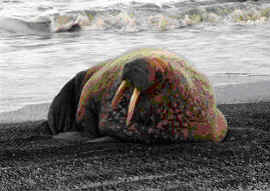 Thousands of walrus have appeared on Alaska's northwest coast in what
conservationists are calling a dramatic consequence of global warming
melting the Arctic sea ice.
Thousands of walrus have appeared on Alaska's northwest coast in what
conservationists are calling a dramatic consequence of global warming
melting the Arctic sea ice.
 Since
Since
