Arctic Ice Retreat Continues
MarineLink.com
Friday, October 26, 2007
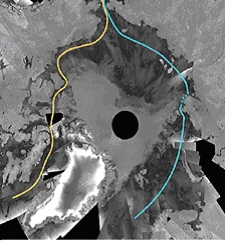
Yellow line: Northwest Passage. Blue line: Northern Sea Route
The International Ice Charting Working Group (IICWG),
meeting at ESRIN in Frascati, issued the following statement on October
26, 2007: "In September 2007, the Arctic sea ice reached the
minimum extent in the history of ice charting based on satellite,
aircraft and surface observations, continuing a recent trend of
diminishing sea ice that began in the 1980's and has accelerated. While
there will still be natural inter-annual variability, the decline is
likely to continue.
"The Arctic is already experiencing an increase in shipping,
primarily for oil and gas development and tourism, and we can expect to
see further increases as diminishing ice extent makes Arctic marine
transportation more viable. The IICWG members are working with national
and international authorities to help ensure that Arctic navigation
develops with the utmost regard for the safety of people, property and
the environment.
"The IICWG cautions that sea ice and icebergs will continue to
present significant hazards to navigation for the foreseeable future.
The Arctic will still have a winter ice cover that will linger into
summer for varying lengths of time depending on a range of
conditions."
Highlights for summer 2007:
o The minimum Arctic ice extent of 4.1 million square km was reached on
September 16. This shattered the previous record low of 5.3 million sq.
km. in 2005. The long term average minimum is 6.7 million sq. km.
o The area covered by ice within this extent is also at an all-time low,
reflecting a thinner, weaker ice pack.
o The major ice retreat was away from the Siberian Arctic coastline
towards Canada and Greenland, although the Taymyr ice massif persisted
throughout the summer in the Laptev 2007 Envisat Mosaic of Arctic Ocean.
With the exception of this short but critical area, the Northern Sea
Route was completely ice free from August 22 until mid-October.
o This is the second year in a row that sea ice conditions in the
Canadian Arctic have been extremely light and navigation in the
Northwest Passage has been virtually unhindered by sea ice from the
middle of August until well into October.
o This year's reduction in sea ice extent has been much larger than
expected. Given recent trends in the reduction in summer sea ice extent,
the 2007 extent would not have been expected for decades.
o However, increased export of sea ice from the Arctic Ocean caused a
return to near-normal conditions around Greenland after several years of
low ice concentrations. Sea ice also reached the coast of Iceland, an
infrequent occurrence.
o A decrease in Arctic sea ice is consistent with what scientists expect
as a result of global climate change.
For more information on the IICWG, see http://nsidc.org/noaa/iicwg/.
|


 Since
Since
