Record heat sweeps Arctic Sea, ice in 2007
C/NetNews.com
December 12, 2007 12:02 PM PST
Posted by Stephen Shankland
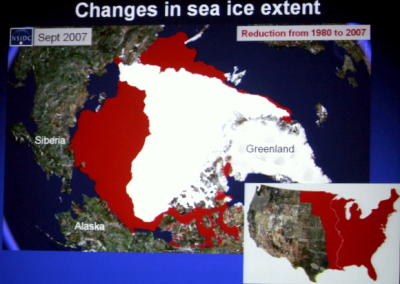
This graphic shows in red the area of arctic ice that
was present in the summer of 1980 but missing this summer. At lower
right is the equivalent surface area in terms of the size of the United
States. (Credit: Credit: Don Perovich, U.S. Army Cold
Regions Research and Engineering Laboratory)
SAN FRANCISCO--Warmth may not be an attribute you
associate with a place where the sun doesn't shine in the winter and the
sea freezes over, but all things are relative. And compared to earlier
years, the Arctic was downright sweltering this year.
According to new research presented here at the the American Geophysical
Union conference, the Arctic Ocean reached record high temperatures,
arctic ice diminished to a record low, and ice melted on Greenland for a
record number of days.
"In 2007, we had off-the-charts warming" of the Arctic Sea in
the summer, said Mike Steele, an oceanographer with the Polar Science
Center at the University of Washington.
Specifically, he said the Arctic Sea surface temperature was 3.5 degrees
Celsius (6.3 degrees Fahrenheit) warmer than the 100-year historical
average and 1.5 degrees Celsius (2.7 degrees Fahrenheit) warmer than the
historical maximum. Two factors were at play in the heating: the sun
and, to a lesser degree, warmer ocean currents, he said. In one area
north of Russia, temperatures were 5 degrees Celsius (9 degrees
Fahrenheit) above average.
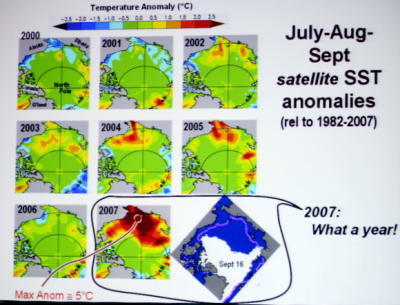
This comparison shows the 'off-the-charts' relative warmth of the
Arctic Ocean in the summer of 2007. (Credit: Mike Steele,
University of Washington)
There's a feedback loop that connects the ocean temperature and the
melting of sea ice. "The ocean absorbs heat, which melts the ice,
which means there's more open ocean, which means more heat is
absorbed," said Don Perovich, an arctic ice scientist at the U.S.
Army Cold Regions Research and Engineering Laboratory. "It's a
classic positive feedback."
It's no surprise that the arctic ice is shrinking. But the new data
gives a specific measurement for how much is gone.
Between September 1980 and September 2007, the Arctic Sea ice dropped
from 7.8 million square kilometers to 4.2 million square kilometers,
Perovich said. "You can see the Northwest Passage, the shortcut
across the top of the world, was ice-free at the end of the
summer."
For comparison, the area of ice is the same as all the states east of
the Mississippi River and a broad swath of those to its west, he said.
The math behind the feedback loop involves a property called albedo,
which measures the fraction of sunlight that's reflected. The albedo of
ice is about 85 percent, compared to 7 percent for the ocean.
What got the feedback loop started is a subject of some debate.
"The ice-albedo feedback needs a trigger," Perovich said.
Culprits include a surge of warm water from the Pacific Ocean and
anomalous winds that may have pushed ice to create more open ocean. And
global warming in general means warmer air, which means a later start to
winter ice freezing and less freezing when it does begin, Steele said.
Steele estimates that 2007's warm summer will reduce ice thickness by
about a meter, Steele added.
With thinner ice, it's easier to start the feedback loop again.
"The ice is more vulnerable to a short-term wind event,"
Perovich said.
Greenland, too, is showing signs of warming.
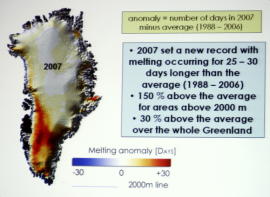
Red areas here show areas of Greenland where ice melting in 2007
lasted unusually long--the darkest being 30 days more than the average
of the years from 1988 through 2006.(Credit: Credit Marco
Tedesco, University of Maryland)
"2007 set a new record, with melting occurring for 25 to 30 days
longer than the average of 1980 to 2006," said Marco Tedesco of the
University of Maryland.
The rate of increase in melting since 1988 is about 19,000 additional
square kilometers each year, about 1.5 times the size of Maryland,
Tedesco said.
Greenland, too, has an albedo-related feedback loop. When less snow
falls, older and darker snow is more exposed, and this older snow
absorbs more heat, Tedesco said. That albedo effect, combined with
unusually high temperatures, were responsible for the increased melting,
Tedesco said.
Arctic Sea ice melting doesn't increase sea level, but Greenland is
another matter: all its water is on land today, so thawing will increase
oceans.
|


 Since
Since
