Why is Arctic ice melting 50 years too fast?
by Jacob Silverman
Inside This Article
1. Why is Arctic ice melting 50 years too fast?
2. Consequences of Melting Arctic Ice
3. Lots More Information
4. See all Geophysics articles
On Aug. 19, 2007, a joint survey by the Japan Agency for Marine-Earth
Science and Technology and the Japan Aerospace Exploration Agency
revealed that Arctic ice was melting at a far quicker rate than
anticipated. What's particularly alarming about this discovery is that
the United Nations' scientific models anticipated that the ice levels
measured by the Japanese team would not be reached until after 2040 --
and possibly not until 2050.
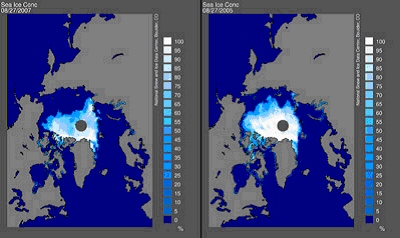
Image courtesy National Snow and Ice Data Center This satellite image
shows that Arctic ice levels in 2007 (left) were less than even the
record low levels of 2005 (right). See more global warming images.
A researcher at the Colorado Center for Astrodynamics said that
Arctic ice is melting at previously unseen rates [source: Science
Daily]. The melting has caused coastal ice in parts of Canada and
Alaska to become quite brittle. That ice easily breaks away in large
chunks (a process known as calving) and melts in the open ocean. There's
also less sea ice in the Arctic Ocean because ice has floated into the
Atlantic Ocean. The previous record low for Arctic sea ice was recorded
on Aug. 15, 2005, though scientists said there was a high probability
that the record would be breached in 2007.
The Arctic saw another milestone in the summer of 2007. In August, the
Northwest Passage had almost no floating ice. It was the first time the
Passage had been completely open to shipping since people started
keeping records in 1972. Scientists say that the lack of ice represents
clear proof that the planet is warming. The now-open sea lane means that
someone could sail from New York to Korea without encountering any ice,
though bad weather is always possible. In comparison, the first explorer
to navigate the Northwest Passage successfully, Roald Amundsen, took
three years to get through the waterway's thick ice.
Sea ice is measured primarily through three methods: microwave scanners
on orbiting satellites, buoys and observation platforms. The latter two
are generally equipped with several types of measuring devices.
Scientists focus their measurements on the extent of sea ice, rather
than the thickness, since it's easier for satellites to measure extent.
When examining sea ice, scientists look at the minimum and maximum
extent, thickness, environmental conditions and changes in the melting
season. The Arctic sea ice melting season usually lasts from March to
the middle of September.
This record pace of Arctic ice melt has scientists concerned about
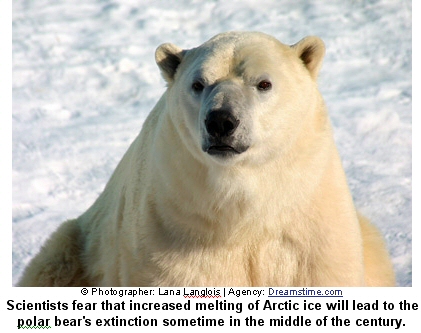
rising sea levels, diminished habitats for polar bears and other animals
and an impending rush for fossil fuels in the region. Increased traffic
through the Northwest Passage and the Northeast Passage (which runs by
Siberia) may increase pollution in the area.
Ice re-forms during winter, but due to warmer waters the amount of
re-formed ice appears to be decreasing. Ice that was previously
considered "permanent" is now melting. That leaves an
ever-decreasing base of ice at the beginning of each melting season.
Sea ice plays an important role in keeping temperatures down around the
world. Whereas sea ice reflects 80 percent of sunlight back into the
atmosphere, ocean water absorbs 90 percent of sunlight [source: National
Snow and Ice Data Center]. As melting ice exposes more ocean to direct
sunlight, scientists expect water temperatures to rise, accelerating the
ice melt.
Consequences of Melting Arctic Ice
The opening of the Northwest Passage and melting of Arctic ice has
allowed access to parts of the Arctic Ocean and the seabed that have
been blocked for centuries. Consequently, several countries are trying
to lay claim to parts of the newly opened Arctic in hopes of getting at
some of the oil and natural gas reserves that are buried under the ocean
floor. Experts estimate that 25 percent of the world's remaining fossil
fuel reserves lies under the Arctic seabed [source: Guardian
Unlimited]. Commentator Jeremy Rifkin noted with irony that it's the
burning of fossil fuels and the subsequent rise of global temperatures
that has made it possible to access these long-blocked stores of oil and
gas [source: Houston Chronicle].
The 1982 Law of the Sea Treaty gives countries an economic zone
extending 200 miles from their coasts, and it's under the provisions of
this treaty that some countries are trying to lay claim to parts of the
Arctic. In August 2007, Russia planted a flag on the Arctic seabed,
following a claim that part of the ocean floor is an extension of their
country's continental shelf. Canada, Norway and Denmark (via Greenland)
are making similar claims. The United States and Canada still dispute
who has the right to claim the Northwest Passage while both Denmark and
Canada claim sovereignty over Hans Island.
Some commentators say that a new oil rush is underway that will further
imperil the region's delicate environment. Despite the controversy,
Russia and Canada, in particular, appear to be aggressively pursuing
their claims in the region. Russia is expanding its drilling operations
in the waters off Siberia. Canada is spending several billion dollars to
add a deep-water seaport and new patrol ships to their Arctic territory.
Canada's Prime Minister, Stephen Harper, said that "Canada's
position is that we intend our position in the Arctic area"
[source: CanWest News Service].
Scientists call this rush for fossil fuels and the melting of permafrost
in Siberia and other areas a "ticking time bomb" [source:
Houston Chronicle]. If Siberia's vast permafrost continues to melt,
massive amounts of methane, now trapped beneath the ice, may be
released. Methane is a highly potent greenhouse gas, more than 20 times
stronger than carbon dioxide. Scientists fear that the release of so
much methane may initiate a sort of feedback loop, wherein methane
release increases the rate of global warming, in turn spurring more
permafrost melt and more methane release [source: Houston Chronicle].
One of the more visible effects of Arctic ice melt is the calving of
large pieces of ice from glaciers and ice shelves. In 2005, the Ayles
Ice Island, a 30-square mile chunk of ice, broke away from Canada's
Ayles Ice Shelf and began drifting through the Arctic. Some people
worried that the ice island would crash into Alaskan oil rigs in the
Beaufort Sea, but as of late August 2007, it was stuck in a channel in
the Canadian High Arctic, 300 miles from its original location.
|


 Since
Since
