Ribbon Seals Endangered by loss of Arctic Sea Ice
January 6, 2008
Exit Stage Right - mass extinction
Posted by michaelgreenwell in arctic, biodiversity, wildlife, zoology.
December 2007. The rare ribbon seal may be one of the first species to
lose its habitat to global warming, according to the Center for
Biological Diversity. The ribbon seal is dependent on Arctic sea ice for
survival - but that sea ice is shrinking fast.
 The
group has filed a scientific petition with the US National Marine
Fisheries Service to protect the ribbon seal under the federal
Endangered Species Act due to decline of its habitat in a warming
climate. The
group has filed a scientific petition with the US National Marine
Fisheries Service to protect the ribbon seal under the federal
Endangered Species Act due to decline of its habitat in a warming
climate.
Artic Crisis
'The Arctic is in crisis state from global warming,' said Shaye Wolf, a
biologist with the Center for Biological Diversity and lead author of
the petition. 'An entire ecosystem is rapidly melting away and the
ribbon seal is poised to become the first victim of our failure to
address global warming,' he said.
Ribbon Seals
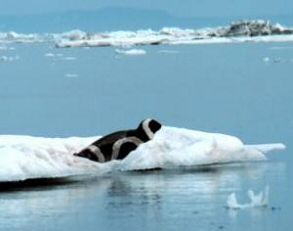
The ribbon seal is the most decoratively patterned of all seals. While
the pups are pure white, the adults have black fur wrapped in white
circles.
'Why does the ribbon seal have its stripes? Probably to make it less
visible to underwater predators,' explains ribbon seal biologist
Carleton Ray from the University of Virginia. 'But this beautiful,
charismatic species may soon become totally invisible should its spring
reproductive habitat of sea ice continue to diminish, as climate models
predict,' he said.
During the late winter through early summer, ribbon seals rely on the
edge of the sea ice in the Bering and Okhotsk Seas off Alaska and Russia
as safe habitat for giving birth and as a nursery for their pups.
But Wolf says that this winter the sea-ice habitat is rapidly
disappearing. 'If current ice-loss trends due to global warming
continue, the ribbon seal faces likely extinction by the end of the
century,' he says.
 The
ribbon seal's winter sea ice habitat is projected to decline by 40
percent in the next 40 years, Wolf says. He believes that any remaining
sea ice will be much thinner and unlikely to last long enough for the
ribbon seals to finish rearing their pups, leading to widespread pup
mortality. The
ribbon seal's winter sea ice habitat is projected to decline by 40
percent in the next 40 years, Wolf says. He believes that any remaining
sea ice will be much thinner and unlikely to last long enough for the
ribbon seals to finish rearing their pups, leading to widespread pup
mortality.
In addition to loss of its sea-ice habitat from global warming, the
ribbon seal faces threats from increased oil and gas development in its
habitat and the proliferation of shipping routes in the increasingly
ice-free Arctic.
Arctic Warming
He points out that warming in the Arctic now is occurring at a pace so
rapid that is exceeding the predictions of the most advanced climate
models.
'Summer sea-ice extent in 2007 plummeted to a record minimum which most
climate models forecast would not be reached until 2050,' Wolf observed.
'Winter sea ice declined to a minimum in 2007 that most climate models
forecast would not be reached until 2070.'
|


 Since
Since
