Global meltdown: scientists isolate areas most at
risk of climate change
This article appeared in the Guardian on Tuesday February 05 2008
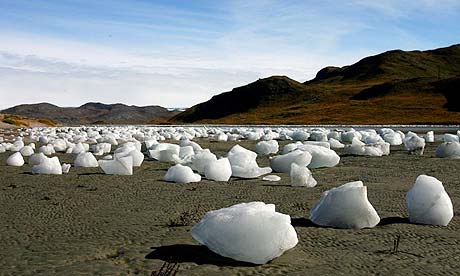
Ice boulders left behind after a flood caused by the overflowing of a
lake in Greenland. Photograph: Uriel Sinai/Getty images
Scientists have long agreed that climate change could have a profound
impact on the planet; from melting ice sheets and withering rainforests,
to flash floods and droughts.
Now a team of climate experts has ranked the most fragile and vulnerable
regions on the planet, and warned they are in danger of sudden and
catastrophic collapse before the end of the century.
In a comprehensive study published today, the scientists identify the
nine areas that are in gravest danger of passing critical thresholds or
"tipping points", beyond which they will not recover.
Although the scientists cannot be sure precisely when each region will
reach the point of no return, their assessment warns it may already be
too late to save Arctic sea ice and the Greenland ice sheet, which they
regard as the most immediately in peril. By some estimates, there will
not be any sea ice in the summer months within 25 years.
The next most vulnerable area is the Amazon rainforest, where reduced
rainfall threatens to claim large areas of trees that will not
re-establish themselves. The scientists also expressed concerns over the
Boreal forests in the north, and have predicted that El Ni�o, the
climate system which has a profound impact on weather from Africa to
North America, will become more intense. The scientists are so concerned
they have called for an early warning system to monitor each of these
fragile ecosystems.
The international team, whose study appears in the Proceedings of the
National Academy of Sciences, represents some of the world's most
prestigious organisations, including the Potsdam Institute for Climate
Impact Research in Germany, the University of East Anglia and Oxford
University's Environmental Change Institute. The scientists polled 52
environmental experts and combined their responses with discussions
among 36 leading climate researchers at a workshop at the British
embassy in Berlin. Each was asked to rank regions at greatest risk of
climate change in the next century.
"There's a perception that global warming is something that will
happen smoothly into the future, but some of these ecosystems go into an
abrupt decline when warming reaches a certain threshold," said Tim
Lenton, an environmental scientist at the University of East Anglia and
lead author of the study.
"If we know when the different tipping points are, we can use them
to inform targets to limit global warming. It gives us something to aim
for," he added.
Last year, the UN's expert panel of climate scientists warned average
temperatures could increase by as much as 6.4C by the end of the
century, with a rise of 4C most likely. Such a rise would bring food and
water shortages to vulnerable parts of the world, displace millions of
people and wipe out hundreds of species.
In the latest study, the scientists calculate Arctic sea ice will go
into irreversible decline once temperatures rise between 0.5C to 2C
above those at the beginning of the century, a threshold that may
already have been crossed. There is already a 50% chance that the
Greenland ice sheet will soon begin melting unstoppably, although it
could take hundreds of years to melt completely. The meltwater would
raise global sea levels by seven metres.
A temperature rise of 3C could see more intense El Ni�os, with profound
effects on the weather from Africa to North America.
Warming of 3C to 5C could reduce rainfall in the Amazon by 30%,
lengthening the dry season. The Boreal forests could also pass their
tipping point, with large swaths dying off over the next 50 years. In
Africa, more rainfall may regreen the Sahel region, but the west African
monsoon could collapse, leading to twice as many unusually dry years by
the end of the century. The Indian summer monsoon is predicted to become
erratic and in the worst case scenario, begin to flip chaotically,
unleashing flash floods one year and droughts the next.
Measurements of the western Antarctic ice sheet show the balance of
snowfall and melting has shifted and it is now shrinking. According to
the study, a local warming of more than 5C could trigger uncontrollable
melting, adding five metres to sea levels within 300 years. Under the
same warming, Atlantic currents that power the Gulf Stream could be
severely disrupted.
"If you can get some warning that you're nearing one of these
thresholds, you can get to work on adapting to it. You could work harder
on reducing emissions, or you might use it as impetus to try other
options," said Lenton.
Explainer: What could happen next
If greenhouse gas emissions continue unchecked, the global average
temperature will reach 2C above pre-industrial levels by 2050, according
to the government's 2006 Stern report on climate change.
One of the first impacts will be droughts and floods, as rainfall
increases at high latitudes and drops in the tropics. Some glaciers will
disappear, though crop yields in some countries could rise, scientists
believe.
Last year, a report from the Intergovernmental Panel on Climate Change,
concluded that human activity was "very likely" to be behind
most of the warming seen in recent decades. It predicted a rise of
between 2.4C and 6.4C by 2100.
The most likely rise, of 4C by the end of the century, would cause
droughts across Africa, and a fall in harvests of 15% to 35%. Globally,
crop yields would fall 10%.
Sea levels would rise by up to 59cm, with Bangladesh and Vietnam among
the worst hit, along with coastal cities such as New York, London,
Tokyo, Kolkata and Karachi. In Britain alone, there would be 1.8 million
people at risk of flooding. The western Antarctic and Greenland ice
sheets would begin to melt irreversibly and Europe would lose 80% of its
Alpine glaciers. Across the Arctic, half of the tundra is at risk.
A 4C rise is predicted to drive 20% to 50% of land species to extinction
and put 80m more Africans at risk of malaria as mosquitoes thrive.
|


 Since
Since
