A Meat and Dairy Article used with permission from All-Creatures.org
Jon Hochschartner reviews and critiques John Sanbonmatsu’s excellent new book, The Omnivore’s Deception, which he finds almost lives up to the unattainable hype.
The Omnivore’s Deception and cultivated meat
From Jon Hochschartner, Slaughter-Free America, slaughterfreeamerica.substack.com
March 2026
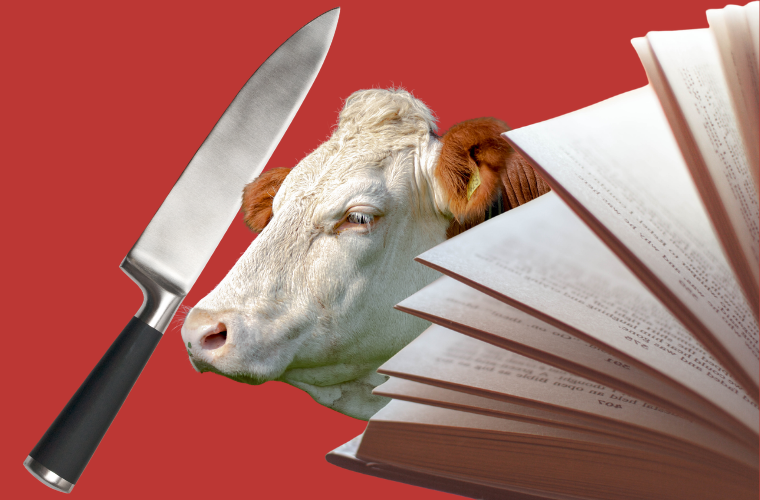
Images from Canva
I was initially reluctant to read John Sanbonmatsu’s new book, The Omnivore’s Deception: What We Get Wrong about Meat, Animals, and Ourselves. This was for a number of reasons, one of which was his past, strong opposition to cultivated meat, the development of which I view as one of the most promising, long-term methods of reducing nonhuman suffering and premature death. Honestly, I was always a little disappointed never to have been denounced on his website dedicated to the topic, Clean Meat Hoax.
Another reason was the praise for the book seemed so impossibly over the top. Angela Davis said The Omnivore’s Deception “offers the most compelling arguments yet for abolishing capitalist animal agriculture.” Jeffrey Moussaief Masson claimed it is “perhaps the single best book ever written about animal suffering and why the world needs to go vegan.” I’m not sure to what extent contrarianism and authorial jealousy motivated my reluctance to pick up Sanbonmatsu’s text, but these less than honorable emotions played a role.
The biggest reason I put off reading The Omnivore’s Deception, though, was I thought I knew all of what it had to say. In the past 20 years, the animal movement has produced many ethical critiques of smaller-scale, nominally-gentler forms of nonhuman exploitation. As someone who grew up in what might be termed a locavore or back-to-the-land community, many of these critiques were very important to my political development. However, I’d long since become familiar with and accepted the moral arguments behind these.
While broadly making the same points as previous writers on the subject, like Gary Francione, Sanbonmatsu marshalls a dizzying array of scientific facts, figures, historical anecdotes, as well as literary and cinematic references, to explain his view. While I wouldn’t go so far as to call The Omnivore’s Deception one of the best critiques of animal exploitation ever written — there’s just so much competition in that regard, dating back to ancient human history, as Sanbonmatsu notes — it’s certainly one of the best I’ve read in years.
Indeed, the book is so good, part of me wishes the author didn’t focus so much attention on the locavore movement of the early 2000s. While, given my background, I appreciate his forceful condemnations of this particular belief system, I suspect the focus will limit his audience and make his text feel less relevant sooner than it would otherwise. Arguably, locavorism continues to play an important ideological role, providing a more benevolent model of nonhuman exploitation, but it was never a scalable alternative to factory farming.
Sanbonmatsu is at his best, in my view, when he’s condemning animal exploitation as a whole — across human history. That’s when the author really gets to demonstrate the breadth of his knowledge and communicate in timeless terms. It felt at various points like that was the book Sanbonmatsu wanted to write, as large sections of the text would pass without any mention of Michael Pollan, Barbara Kingsolver or the like. I wondered if, during the writing process, he ever considered dividing his work into two separate projects.
However, my biggest critique of The Omnivore’s Deception is a problem I’ve found is typical of philosophers’ books, which is it’s very good at diagnosing a contemporary problem and saying what a better society would look like, but provides little if any guidance of how to get from here to there. In fact, for many philosophers, the messiness of real-world strategy feels like a threat to the purity of abstract, moral theory. While I share much of Sanbonmatsu’s concern about utilitarianism, a touch of tactical flexibility is helpful.
The closest thing I could find to guidance for achieving animal liberation, on first reading of The Omnivore’s Deception, was a discussion of the abolitionist William Lloyd Garrison, with special attention to his opposition to incrementalism. Needless to say, the animal movement is infinitely less advanced than the anti-slavery cause was during Garrison’s life. I’m not entirely sure what Sanbonmatsu is arguing, but I don’t believe activists’ insufficient ethical clarity is what’s currently holding back the animal movement.
The author makes what I think is an astute observation in his introduction, writing: “Robust, principled arguments against our killing of other animals for food have existed for nearly 3,000 years, yet our treatment of animals today is worse than ever. Evidently, then, whatever else might be at the root of our systemic cruelties against other beings, it’s unlikely to be a dearth of sound moral theories.” The question then is — if the ethical case against animal exploitation is ancient — what changing factors could make humanity more receptive to it?
Perhaps Sanbonmatsu would say animal activists need to be less compromising, more committed or more numerous. Of course, I’d welcome all of these developments, but, in my view, they just bring you back to the original question. The changing factors that would make humanity as a whole more receptive to the ethical case against animal exploitation are likely the same ones that would make animal activists less compromising, more committed and more numerous. I believe one such factor is technological progress.
There are various technologies that, if successfully realized, might help the nonhuman cause, but surely the most important is cultivated meat. Flesh grown from livestock cells, that could one day be indistinguishable from slaughtered offerings and cheaper to produce, has the potential to severely undermine traditional animal farming on an economic and ideological level. If fully refined, the technology would make humans more receptive to the ethical case against animal exploitation, as well as embolden and inspire activists.
I was pleased to see, in The Omnivore’s Deception, Sanbonmatsu doesn’t appear to make a moral case against cultivated meat, as he did on his aforementioned website. Rather his objections seem focused on whether the promises of the technology will ever come to pass, which is much more reasonable in my view, and something I occasionally wonder myself. Ultimately, though, I recognize cultivated meat is relatively new and it took technologies we’re just beginning to enjoy the benefits of, like electric vehicles, decades to develop.
Viewing technology, and specifically cultivated meat, as a crucial means of reducing nonhuman suffering and premature death isn’t an excuse to retreat from activism. Instead, it helps campaigners focus their activism where it might be most effective in the long term. State and federal budgets should be seen as a battleground. Every dollar directed to, say, the American military is a dollar that could instead be put toward cultivated-meat research at facilities like the Tufts University Center for Cellular Agriculture.
I hope my criticism here doesn’t overshadow the praise I mean to express for Sanbonmatsu’s phenomenal work. While The Omnivore’s Deception can’t quite live up to the unattainable expectations set by some of the book’s early reviewers, it truly is excellent. I also hope I’m not mistaken for such a technological determinist that readers assume I don’t think there is value in the kind of moral argument Sanbonmatsu specializes in. While the ethical case against animal exploitation is ancient, it always needs to be updated, perfected and further publicized.
Posted on All-Creatures.org: March 16, 2026
Return to Meat and Dairy Articles
Read more at Book Recommendations
Follow us on:


- Home Page
- What's New
- Contact Us
- Action Alerts
- Animal Exploitation
- Animal Issues
- Animal Rights Activism
- Archives
- Art & Photography
- Articles Directory
- Bible
- Bible Commentary Blog
- Books
- Campaigns
- Church & Religion
- Discussions
- Events / Podcasts / Media
- Health
- Hosted Web Sites
- Humor
- Kids' Korner
- Letters
- Links
- Nature Studies
- Newsletter
- Poetry & Stories
- Prayers
- Quotations
- Recipes with Photos
- Recipes Without Photos
- Sermons
- Stop Cruelty in Churches
- Video Library
- The Mary T. and Frank L. Hoffman Family Foundation
- Email: [email protected]
A web site sponsored by The Mary T. and Frank L. Hoffman Family Foundation and all-creatures.org
Copyright © 1998-2026 The Mary T. and Frank L. Hoffman Family Foundation. All rights reserved. May be copied only for personal use or by not-for-profit organizations to promote compassionate and responsible living. All copied and reprinted material must contain proper credits and web site link www.all-creatures.org.
Fair Use Notice: This document, and others on our web site, may contain copyrighted material whose use has not been specifically authorized by the copyright owners. We believe that this not-for-profit, educational use on the Web constitutes a fair use of the copyrighted material (as provided for in section 107 of the US Copyright Law). If you wish to use this copyrighted material for purposes of your own that go beyond fair use, you must obtain permission from the copyright owner.
Thank you for visiting all-creatures.org.
