An Animal Rights/Vegan Activists' Strategies Article used with permission from All-Creatures.org
Jon Hochschartner reflects on lessons learned in his youth at summer camp about what we consider food and why.
Mildred Brooks and the social construction of food
From Jon Hochschartner, Slaughter-Free America, slaughterfreeamerica.substack.com
May 2024
Images from Canva
On a recent trip to my parents’ house, I was looking through old photos and came across one of me when I must have been nine or ten. I’m smiling, proudly holding a fish I’ve caught on a line. Beside me is an elderly woman whose name is Mildred Brooks. I’m at summer camp and she is my favorite counselor.
Brooks was head of the nature program at the seven-week sleep-away camp I attended in the Adirondacks. She had a master’s degree in zoology from the University of Michigan at Ann Arbor and was best known for her ‘live-off-the-land’ trips. I imagine it was on one of these trips where the picture was taken.
As the name suggests, these were multi-day excursions in which campers attempted to survive on food they caught or foraged. Brooks would have been in her early 80s by that point, so a younger counselor came along as her assistant. I assume they also brought a backup supply of food in case our efforts were unsuccessful.
As an animal liberationist, obviously I don’t support this. However, in retrospect, I think there was something a little transgressive about the trips. Not only did we fish and pick wild fruit, we caught insects which we fried and ate. For sure, it was a survival exercise, but I also think Brooks was trying to teach us a lesson.
Specifically, and I don’t think I’m projecting here, I think she was trying to educate us about the social construction of food. You see, frying and eating crickets was an activity Brooks did with some frequency. She even did it on parents visiting day. As I recall, she took a special joy in shocking visitors with her culinary offerings.
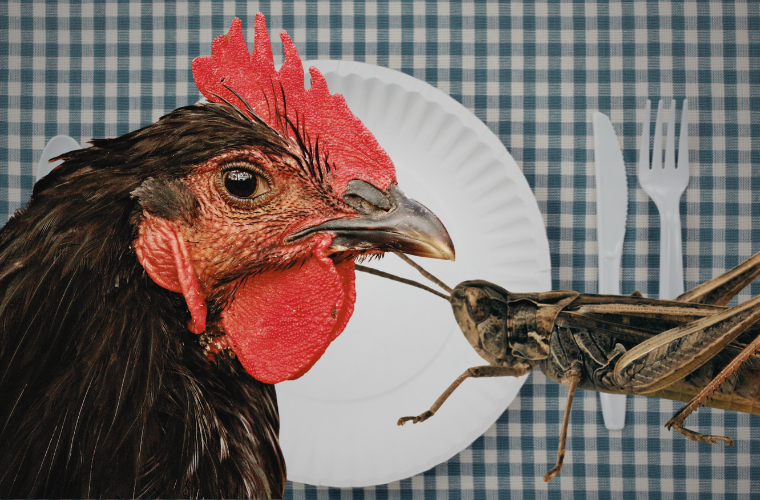
So on these live-off-the-land trips, as we collected insects in trash bags, I think she was trying to demonstrate how some things come to be regarded as food and other things aren’t, and how that differs from culture to culture. Clearly, Brooks was no vegan. I believe this insight led her to see everything as protein, whether it was a chicken or a cricket.
However, that fundamental understanding is crucial to animal-rights critique. We just take it in the opposite direction. Instead of saying food is a social construction and thus we can eat all animals, we say food is a social construction and thus we shouldn’t eat any animals. In both cases, the starting point is the same.
Looking at that photograph of Brooks and me, I missed her. For whatever reason, perhaps because she knew my parents, she trusted me with things she didn’t trust with others. Brooks, who was black, told me about the racism she faced in the Adirondacks. As a young, white boy, it was startling to hear her pain and vulnerability.
I was happy to read in her New York Times obituary that she lived to see the inauguration of President Barack Obama, passing later that day. I was a leftist, who was perhaps a little more interested in distinguishing myself from liberals than fighting the right wing. So I had a lot of criticisms of the 44th president.
Now, I can only imagine how much he must have meant to Brooks, who was 94 years old. May she rest in peace.
Posted on All-Creatures.org: July 31, 2025
Return to Animal Rights/Vegan Activist Strategies
Follow us on:


- Home Page
- What's New
- Contact Us
- Action Alerts
- Animal Exploitation
- Animal Issues
- Animal Rights Activism
- Archives
- Art & Photography
- Articles Directory
- Bible
- Bible Commentary Blog
- Books
- Campaigns
- Church & Religion
- Discussions
- Events / Podcasts / Media
- Health
- Hosted Web Sites
- Humor
- Kids' Korner
- Letters
- Links
- Nature Studies
- Newsletter
- Poetry & Stories
- Prayers
- Quotations
- Recipes with Photos
- Recipes Without Photos
- Sermons
- Stop Cruelty in Churches
- Video Library
- The Mary T. and Frank L. Hoffman Family Foundation
- Email: [email protected]
A web site sponsored by The Mary T. and Frank L. Hoffman Family Foundation and all-creatures.org
Copyright © 1998-2026 The Mary T. and Frank L. Hoffman Family Foundation. All rights reserved. May be copied only for personal use or by not-for-profit organizations to promote compassionate and responsible living. All copied and reprinted material must contain proper credits and web site link www.all-creatures.org.
Fair Use Notice: This document, and others on our web site, may contain copyrighted material whose use has not been specifically authorized by the copyright owners. We believe that this not-for-profit, educational use on the Web constitutes a fair use of the copyrighted material (as provided for in section 107 of the US Copyright Law). If you wish to use this copyrighted material for purposes of your own that go beyond fair use, you must obtain permission from the copyright owner.
Thank you for visiting all-creatures.org.
