An Animal Rights/Vegan Activists' Strategies Article used with permission from All-Creatures.org
Marc Bekoff interviews author Bruce Friedrich on his hopeful new book, Meat, which examines the future of alternative meats as a solution to some of the greatest challenges we face today.
What Is Meat? It’s Probably Not What You Thought
From Marc Bekoff, Ph.D., PsychologyToday.com
February 2026
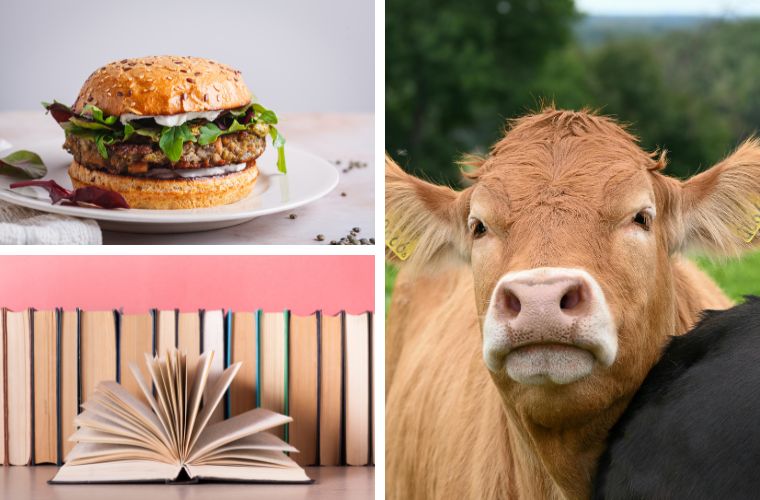
Photos from Canva
Key points
- A new mindset for how new sources of meat are better for people and the planet will be a win-win for all.
- Cultivated meat is real animal meat, but produced from a tiny sampling of animal muscle or fat.
- Animal farming contributes to global emissions, deforestation, water scarcity, and antimicrobial resistance.
When I first learned of a new and highly anticipated book titled Meat by Good Food Institute founder and president Bruce Friedrich, I couldn't wait to read it.
I'm thrilled I did, and my learning curve was vertical in this page-turning work that "offers a hopeful and rigorously researched exploration of how science, policy, and industry can work together to satisfy the world’s soaring demand for meat, while building a healthier and more sustainable world."
There is nothing "radical" about what likely will become a classic, one that is already endorsed by experts in global hunger, global health, climate change, and food security. Bruce’s book comes highly recommended by Nobel Laureate in economics Michael Kremer, father of synthetic biology George Church, nutrition expert Michael Greger, and Jane Goodall, who wrote: “Please read this book: it is engaging, informative, and gives us hope for a kinder future.”
There is also an important psychological aspect associated with a change in diet for both humans and nonhumans. As people form the mindset for understanding how accessible, affordable, economical, environmentally friendly, and healthy new sources of meat are, it will be better for them, their companion animals, and the planet—a win-win for all. To facilitate these changes, here's what Bruce had to say about his long-time journey into food production and what needs to be done right now to improve our planet's well-being and that of countless residents—human and nonhuman, alike.
Marc Bekoff: First up, what are alternative meats?
Bruce Friedrich: Specifically, I’m talking about plant-based and cultivated meat. Plant-based meat is what you’d think: Meat made from plants. The goal is products that are quite literally indistinguishable from conventional animal meat, but at a lower price. Cultivated meat is real animal meat, but produced without the inefficiencies of animal farms and slaughterhouses: Just like you can grow a plant from a seed or a cutting, you can grow real animal meat from a tiny sampling of animal muscle or fat.
MB: You present alternative meats as a solution to nearly every major disaster harming our planet and its people, from preventing pandemics to reducing hunger and malnutrition, safeguarding the environment, and even strengthening national security. How is this possible?
BF: Yes, that’s chapters 1-4 of the book. Industrial animal agriculture is responsible for about one-fifth of global emissions and is a top cause of deforestation, water scarcity, and biodiversity loss. It's also one of the two primary drivers of antimicrobial resistance, which threatens to make routine surgeries life-threatening again. And industrial animal farms are pandemic powder kegs—75 percent of emerging pathogens are linked to animals.
Plant-based and cultivated meat solve for all of this, and, in fact, a 15 percent shift to alternative proteins would reduce emissions more than electrifying every bus, light truck, and passenger car on Earth—while also reducing food prices, improving food security, and freeing up land for restoration.
That’s not to say that alt meats are a silver bullet that can solve everything that’s wrong with our food system. They also don’t automatically do anything about income inequality or food systems consolidation, for example. They probably make addressing those issues easier, but it’s also not hard to imagine a food system based on alternative meats that didn’t address those and a host of other issues.
MB: In Chapter 8 of Meat, you liken the rise of alternative meats to breakthroughs like cars, cell phones, AI, and even ice cubes, everyday innovations we now take for granted. What makes you so optimistic that alternative meats will follow the same path to ubiquity?
BF: History shows us that once the kinks get worked out and prices come down, adoption of transformative technologies moves far faster than anyone expects. More than 500 car companies went bankrupt before the cheaper and easier-to-operate Model T was introduced, but once that happened, cars took over from horse-drawn carriages in about 15 years.
There are a slew of other examples, from artificial ice to artificial intelligence.
The scientists closest to the work on alternative meats are incredibly optimistic about success, and I dive into the reasons for their optimism in Chapters 6, 7, and 11. The challenges are nowhere near what we overcame to control nuclear fission, put humans on the Moon, and invent high-efficiency solar power.
We already know where we're trying to go, and the path to success is reasonably clear. Plus, both plant-based and cultivated meat use a fraction of the inputs of conventional meat, so first principles point to far lower costs at scale.
MB: You say in the book that successful innovation rests on a “three-legged stool” of science, industry, and government. What does true collaboration among these three pillars look like?
BF: Most major technological leaps have relied on coordinated support from science, government, and industry: Scientists do the fundamental research, governments provide funding and create favorable regulatory environments, and industry brings products to market at scale. Think penicillin—discovered by Fleming, developed with support from the U.S. government, and then scaled by industry to save millions of lives.
For alternative meats, that means government-funded basic research and government support for industry-led scale-up. In today's world of global markets, countries that don't support their industries risk falling behind. I go deep on this concept in Chapter 9.
MB: You go out of your way in the book to cite Republicans and executives from the world’s largest meat companies who are in favor of the work that GFI is doing. Can you say more about that?
BF: I spend quite a bit of time on this issue in Chapters 9 and 10 of the book: Chapter 9 focuses on economic opportunity, and Chapter 10 focuses on food and national security. In the United States, many Republicans and Democrats recognize the economic opportunity and the job creation potential of alt meats, and they also see them as critical for competing with China and strengthening national security.
I’m really pleased to report that my foreword was written by Caitlin Welsh, who spent a decade working at the Department of State and then National Security Council for presidents Obama and Trump before taking her current role as director of global food and water security for one of the world’s top national security think tanks: The Center for Strategic and International Studies.
About the Author
Marc Bekoff, Ph.D., is professor emeritus of ecology and evolutionary biology at the University of Colorado, Boulder.
Online: marcbekoff.com, X
Article originally published on PsychologyToday.com:
https://www.psychologytoday.com/us/blog/animal-emotions/202601/what-is-meat-its-probably-not-what-you-thought
Posted on All-Creatures.org: February 16, 2026
Return to Animal Rights/Vegan Activist Strategies
Read more at Meat and Dairy Articles
Read more at Book Recommendations
Follow us on:


- Home Page
- What's New
- Contact Us
- Action Alerts
- Animal Exploitation
- Animal Issues
- Animal Rights Activism
- Archives
- Art & Photography
- Articles Directory
- Bible
- Bible Commentary Blog
- Books
- Campaigns
- Church & Religion
- Discussions
- Events / Podcasts / Media
- Health
- Hosted Web Sites
- Humor
- Kids' Korner
- Letters
- Links
- Nature Studies
- Newsletter
- Poetry & Stories
- Prayers
- Quotations
- Recipes with Photos
- Recipes Without Photos
- Sermons
- Stop Cruelty in Churches
- Video Library
- The Mary T. and Frank L. Hoffman Family Foundation
- Email: [email protected]
A web site sponsored by The Mary T. and Frank L. Hoffman Family Foundation and all-creatures.org
Copyright © 1998-2026 The Mary T. and Frank L. Hoffman Family Foundation. All rights reserved. May be copied only for personal use or by not-for-profit organizations to promote compassionate and responsible living. All copied and reprinted material must contain proper credits and web site link www.all-creatures.org.
Fair Use Notice: This document, and others on our web site, may contain copyrighted material whose use has not been specifically authorized by the copyright owners. We believe that this not-for-profit, educational use on the Web constitutes a fair use of the copyrighted material (as provided for in section 107 of the US Copyright Law). If you wish to use this copyrighted material for purposes of your own that go beyond fair use, you must obtain permission from the copyright owner.
Thank you for visiting all-creatures.org.
