Human Tissue Research
An Alternatives to Animal Testing, Experimentation and Dissection Article from All-Creatures.org
FROM Copyright Physicians Committee for Responsible Medicine (PCRM). Used by permission.
October 2021
By donating tissue, donors increase the number of human samples available for research that could help prevent and treat human diseases and also help to reduce the number of animals used in scientific and medical testing.
A great number of different factors combine to create a patient
profile. Humans are genetically unique, lead different lifestyles,
eat different diets, and present different health issues; they may
be on different treatment combinations or develop diseases at
different ages.
For all these reasons and more, using human tissue in research is
critically important to advance our knowledge of disease pathways
and mechanisms. Research using human tissue can expand our
fundamental understanding of human biology and can help us develop
disease diagnosis techniques, future therapies, and treatment
protocols. Conducting research with human tissues enables faster
development of more effective, safer drugs and an enhanced
understanding of the basic disease processes that affect humans.
By donating tissue, donors increase the number of human samples
available for research that could help prevent and treat diseases
such as cancer, diabetes, and Alzheimer’s disease, and help to
reduce the number of animals used in scientific and medical testing.
By simply registering to become an organ and tissue donor (which you
can often do online through your state’s motor vehicle department),
you can help scientists save human lives and reduce and replace
animals used in research.
Register to be a tissue donor at OrganDonor.gov, operated by the
U.S. government’s Division of Transplantation within the U.S.
Department of Health and Human Services, or at
Donate
Life here.
Other organizations such as the National Disease Research
Interchange and International Institute for the Advancement of
Medicine also accept tissue from both living and post-mortem donors.
Individuals can donate blood, tissue from surgery (such as tumors or
diseased organs), or organs after death, including those that cannot
be used for transplant.
Once you have registered to be a donor, it is important to discuss
this decision with your family to ensure that they are aware of your
wishes.
The Tissue Issue
The use of human tissues in scientific research has improved health
care by leading to discoveries in disease progression, drug
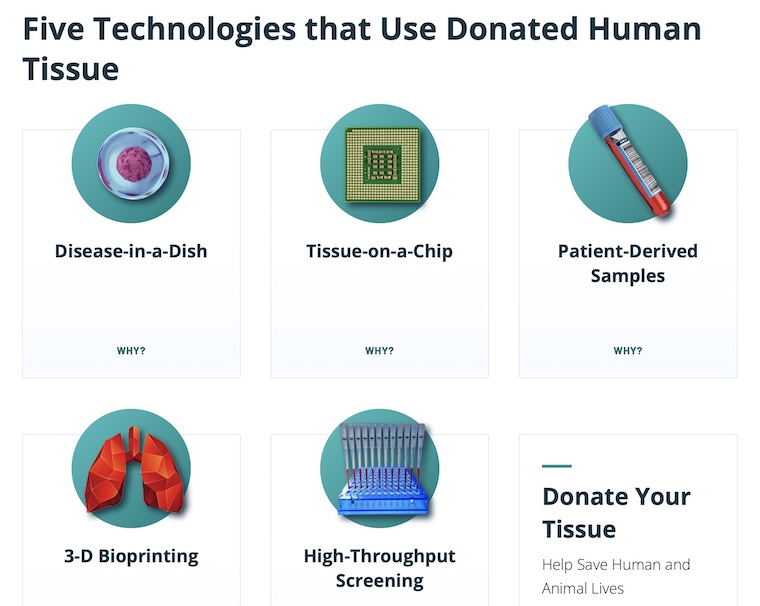
development, and medical procedures. Organs-on-chips, 3D
bioprinting, and other methods that use human tissues instead of
animals produce results that better translate to human health.
Human tissue is typically obtained post-mortem from people who are
organ donors, as surgery remnants, and via blood or other bodily
fluids. But accessibility is often cited as one of the main barriers
of using human tissues and cells for scientific advancement.
We’ve put together a resource for scientists who need more
information about accessing human tissue for research.
The Physicians Committee convened The Human Tissue Roundtable to
address the issue. The roundtable speakers—scientists, policy
experts, physicians, and leaders from U.S. federal agencies and
nongovernmental organizations—covered the full spectrum of human
tissue donation, from a transplant surgeon who initiates the cycle
of tissue recovery in the operating room to a scientist who uses
human cells to study drug development for preclinical trials.
The Human Tissue Roundtable led to the development of the following
recommendations and the Physicians Committee is working to achieve
them.
- Simplify language and streamline donation consent forms.
- Improve communication between medical professionals, scientists, donors, and the public so that everyone has a better understanding of the value of human tissue for research purposes and the need for quality tissues.
- Increase continuing education opportunities to improve the process of collecting human organs and tissues for research.
- Create a database to match tissue providers with researchers based on specific tissue needs, such as the quantity, time parameters, and processing technique.
- Establish a set of quality control criteria, well-defined minimum performance metrics, and parameter specifications for each tissue or cell type.
- Create standardized criteria of use, language, characterization, cell type, recovery, and procurement practices to be widely adopted as best practices.
- Revise current U.S. federal regulations favoring research or tests using animals.
- Work with the U.S. Congress and all stakeholders to prioritize human tissue research.
Human Tissue Health Breakthroughs
Scientists have recently used human lung tissue derived from
patients affected by chronic obstructive pulmonary disease to
discover a method for repairing lung tissue. Researchers have also
used human skin cells leftover from surgeries to develop a test that
more accurately identifies skin irritants than animal tests. There
have also been advancements in brain, heart, vision, and other areas
of health research.
Donate Your Tissue
Register to be a tissue donor at OrganDonor.gov, operated by the
U.S. government’s Division of Transplantation within the U.S.
Department of Health and Human Services, or Donate Life.
The National Disease Research Interchange also accepts tissue from
both living and post-mortem donors. Individuals can donate blood,
tissue from surgery (such as tumors or diseased organs), or organs
after death, including those that cannot be used for transplant.
Once you have registered to be a donor, it is important to talk to
your family members about your decision so they will know your
wishes.
Return to Alternatives to Animal Testing, Experimentation and Dissection Articles
Follow us on:


- Home Page
- What's New
- Contact Us
- Action Alerts
- Animal Exploitation
- Animal Issues
- Animal Rights Activism
- Archives
- Art & Photography
- Articles Directory
- Bible
- Bible Commentary Blog
- Books
- Campaigns
- Church & Religion
- Discussions
- Events / Podcasts / Media
- Health
- Hosted Web Sites
- Humor
- Kids' Korner
- Letters
- Links
- Nature Studies
- Newsletter
- Poetry & Stories
- Prayers
- Quotations
- Recipes with Photos
- Recipes Without Photos
- Sermons
- Stop Cruelty in Churches
- Video Library
- The Mary T. and Frank L. Hoffman Family Foundation
- Email: [email protected]
A web site sponsored by The Mary T. and Frank L. Hoffman Family Foundation and all-creatures.org
Copyright © 1998-2026 The Mary T. and Frank L. Hoffman Family Foundation. All rights reserved. May be copied only for personal use or by not-for-profit organizations to promote compassionate and responsible living. All copied and reprinted material must contain proper credits and web site link www.all-creatures.org.
Fair Use Notice: This document, and others on our web site, may contain copyrighted material whose use has not been specifically authorized by the copyright owners. We believe that this not-for-profit, educational use on the Web constitutes a fair use of the copyrighted material (as provided for in section 107 of the US Copyright Law). If you wish to use this copyrighted material for purposes of your own that go beyond fair use, you must obtain permission from the copyright owner.
Thank you for visiting all-creatures.org.
