 Art and Photo Presentations from All-Creatures.org
Art by Barry Kent MacKay
In this section are copies of original works of art. All of them are dedicated to helping us live according to unconditional love and compassion, which is the foundation of our peaceful means of bringing true and lasting peace to all of God's creatures, whether they are human beings or other animals.
Green Heron (Butorides virescens)
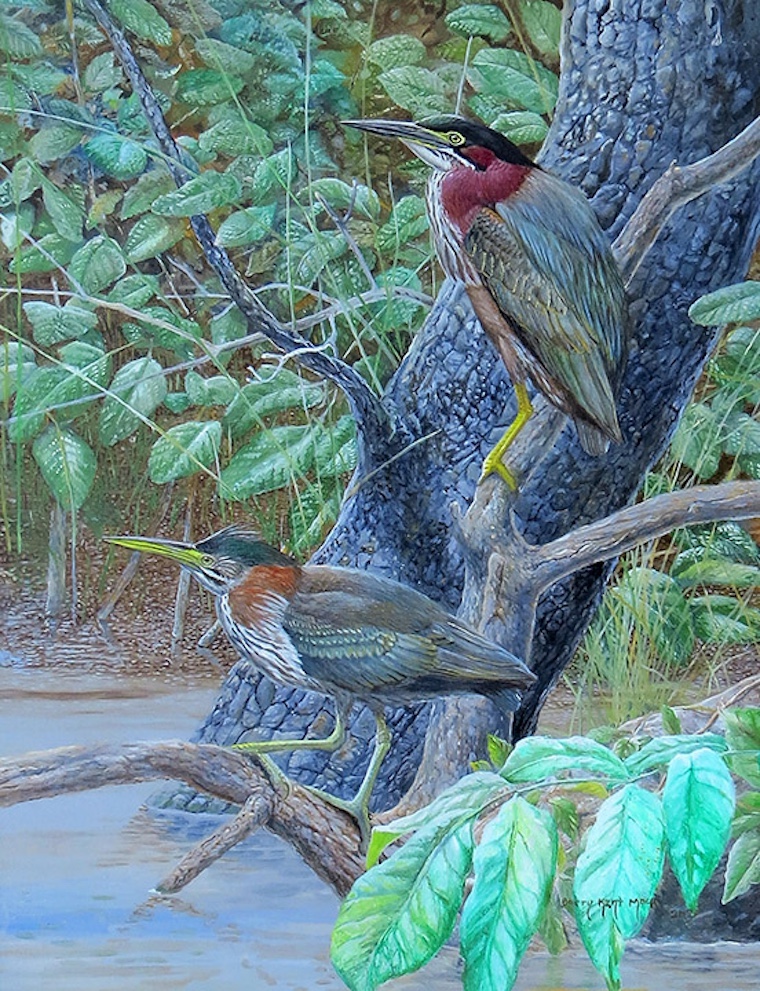
(Artwork - 263)
Green Heron (Butorides virescens)
Green Heron (Butorides virescens)
The Green Heron (Butorides virescens) has often been described as “crow-sized,” and I think that is a fair comparison, although it is a crow with a disproportionately large front end, a long dagger-like bill, and long legs. Like all herons, it is something of a shape-changer. When resting it draws its neck tightly into the shoulders, giving the bird a compact, hunched appearance, but when alert it can extend that surprisingly long neck in an instant to strike at prey.
It is also a bit of a colour-changer. While I think "green" is an appropriate name for much of the upper plumage, it is an elusive, subtly iridescent green that often shifts toward blue depending on the light. More than once I have heard someone exclaim, "But it's blue!"
I have shown an adult with a fully fledged juvenile. Although less colourful than the adult, the young bird is readily recognizable. Adults weigh about 240 grams (8½ ounces). The mature bird has a glossy black cap and rich chestnut neck, contrasting beautifully with the greenish upperparts.
Green Herons are generally more solitary than most other North American herons. They favour quiet waters—ponds, marshes, swamps, sluggish streams, and sheltered shorelines—where they hunt patiently from the water's edge or from low branches overhanging the water. At other times they stalk their prey one deliberate step at a time through the shallows.
Their diet includes almost anything small enough to swallow and profitable enough to pursue: fish, frogs, salamanders, small reptiles, crayfish, aquatic insects, worms, leeches, and many other invertebrates. They will also take small terrestrial animals such as mice, lizards, and grasshoppers if the opportunity presents itself.
As described in the accompanying essay, Green Herons are among the relatively small but growing number of animals known to use tools. They may deliberately place insects, bread, feathers, or other floating objects on the water's surface as bait to attract fish within striking distance.
Green Herons are seasonally monogamous. Although they usually nest as isolated pairs, they occasionally join loose colonies with other herons. The nest is a rather bulky platform of sticks, usually placed in shrubs or trees over or near water, although occasionally on the ground. Typically two to six pale greenish-blue eggs are laid, and both parents share incubation and the care of the young. The juvenile in my painting is approximately one month old.
This painting, done in oils on compressed hardboard, is approximately life-size. I donated the original to a charity before recording its exact dimensions.
Green Heron, Tool Use, and Other Clever Birds
In 1960, when the 26-year-old Jane Goodall telegraphed her mentor, the great paleoanthropologist Louis Leakey, that she had observed chimpanzees making and using tools in Africa, he famously replied:
"Now we must redefine tool, redefine Man, or accept chimpanzees as human."
We have certainly done the first two. Definitely, not the third.
For a very long time humans went to considerable lengths to convince themselves that we were fundamentally different from every other animal—not merely more intelligent, but uniquely intelligent. We pointed to language, reasoning, culture, and especially tool use as evidence that we occupied a category entirely our own.
Other species certainly possessed remarkable adaptations. The giraffe had its long neck, the elephant its remarkable trunk, the Blue Whale its immense size, and the Wood Thrush its hauntingly beautiful song—although "beautiful" is admittedly a human judgement. But making and using tools? That, we believed, belonged exclusively to us.
Leakey immediately recognized the importance of Goodall's discovery and alerted National Geographic. The magazine sent photographer Hugo van Lawick to document Goodall's work, and together Goodall, Leakey, and the chimpanzees she studied permanently altered the way scientists viewed our closest relatives.
More importantly, they encouraged scientists to begin looking much more carefully at other animals.
One of the most influential examples for birds appeared in the January 1974 issue of National Geographic magazine, in an article entitled "Aha! It Really Works!" Beautifully photographed by Robert F. Sisson, it showed a Green Heron deliberately dropping fish pellets onto the water's surface. Small fish approached the floating bait—and the heron promptly speared them. The bird was not simply taking advantage of an accidental opportunity. It was deliberately manipulating its environment to increase its hunting success.
That changed the way many people looked at Green Herons.
About five years earlier I had travelled to the Galápagos Islands, where I watched a Lava Heron—a very close relative of the Green Heron—in what appeared to be a tug-of-war with a Sally Lightfoot Crab. The bird held one end of the elongated skin of a dead moray eel while the crab held the other.
At the time I dismissed the incident as simply curious. Today I'm less certain.
The heron presumably recognized that the crab would be attracted to such food, and the crab was equally determined not to surrender it. Was the bird deliberately trying to lure the crab within striking distance? I think not—the crab was too large to swallow. Was it simply trying to steal the food? That also seems unlikely. Green Herons rarely eat carrion unless it is very fresh, and most of the eel's softer tissues had already disappeared. It was definitely not fresh. Or—and this seems almost heretical—was the bird actually playing?
I honestly don't know.
At the time, many scientists, including mentors I respected, still tended to explain almost all bird behaviour as instinct. I had no photographs and assumed no one would believe my account, so I never reported it.
Perhaps I should have.
The Galápagos also gave us another famous example of avian tool use. The Woodpecker Finch, which is neither a woodpecker nor a true finch, and uses cactus spines and small twigs to probe into crevices for insect larvae hidden beyond the reach of its bill. Closely related Mangrove Finches have been shown to do much the same thing, although tragically that species is now critically endangered.
My dear friend Dr. Ronald Orenstein was the first to describe tool use in the New Caledonian Crow in a scientific paper that I had the pleasure of illustrating. Since then the floodgates have opened. Many members of the crow and raven family are now known not only to manufacture and use tools, but also to solve complex problems, recognize and remember individual people, anticipate future needs, and engage in what appears to be play. Jays, members of the same family, can remember the locations of thousands of seeds they have cached, retrieving many of them months later.
Green Herons are no longer alone, either. At least four heron species have now been recorded using bait, sometimes selecting insects, feathers, bread, or other floating objects to attract fish within striking distance.
Other birds employ entirely different strategies.
Song Thrushes use favourite stones as "anvils," repeatedly smashing snails against them until the shells break. Gulls often carry clams into the air before dropping them onto roads or rocks, clearly preferring hard surfaces over nearby grass. Egyptian Vultures and Bearded Vultures similarly use gravity to crack open eggs or bones, and Golden Eagles have occasionally been observed doing much the same thing.
Some Australian raptors—including Black Kites, Whistling Kites, and Brown Falcons—have even been reported carrying smouldering sticks from active grass fires and dropping them into unburned vegetation. As the flames spread, insects, reptiles, and small mammals flee into the open, where the birds capture them. For generations we were told that the use of fire distinguished humans from every other species. Apparently not.
One of my favourite examples involves the little Burrowing Owl. These charming owls often place mammal dung around the entrance to their nesting burrows. The dung attracts dung beetles and other insects, creating a convenient food supply immediately outside the nest. It may also help disguise the scent of the young from predators.
Then there is the tiny Brown-headed Nuthatch of the southeastern United States. Like other nuthatches it climbs tree trunks head-first in search of insects, but it has also been observed carrying suitable pieces of bark from tree to tree and using them as little pry-bars to lift loose bark hiding insect larvae beneath.
Where instinct ends and deliberate thought begins is not always easy to determine. Nor is the distinction necessarily as important as we once believed.
The more closely we observe other animals, the more remarkable they become.
We humans are undeniably clever. We have carried technology farther than any other species we know.
But we are no longer alone in the tool box.
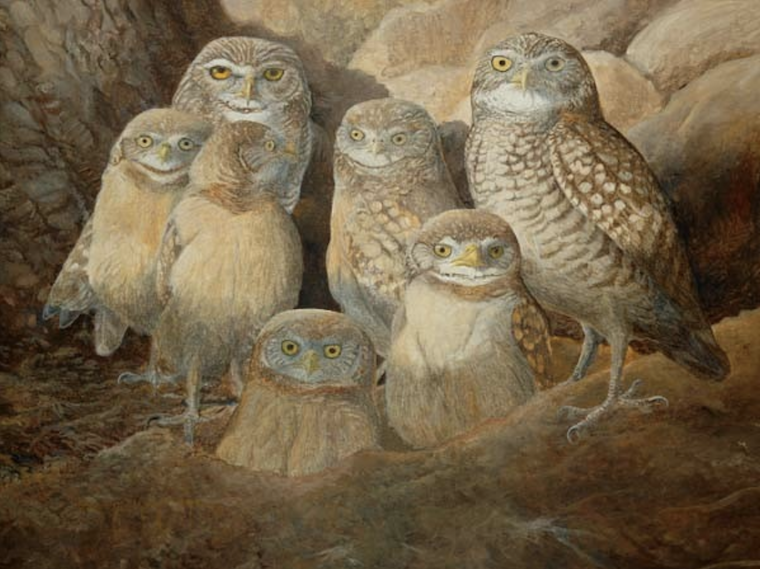
My oil painting of a family of Burrowing Owls
 Previous |
Art by Barry Kent MacKay |
Next
Previous |
Art by Barry Kent MacKay |
Next
Return to Art by Barry Kent MacKay - Page 5
Copyright © Barry Kent MacKay
Barry describes himself as a Canadian artist/writer/naturalist.
See his website: www.barrykentmackay.com
For purchasing of original art, prints and other products GO HERE.
Return to Art by Barry Kent MacKay
Return to Art By Various Artists
Return to Art and Photo Journals and Galleries
Posted on All-Creatures: July 13, 2026
Follow us on:


- Home Page
- What's New
- Contact Us
- Action Alerts
- Animal Exploitation
- Animal Issues
- Animal Rights Activism
- Archives
- Art & Photography
- Articles Directory
- Bible
- Bible Commentary Blog
- Books
- Campaigns
- Church & Religion
- Discussions
- Events / Podcasts / Media
- Health
- Hosted Web Sites
- Humor
- Kids' Korner
- Letters
- Links
- Nature Studies
- Newsletter
- Poetry & Stories
- Prayers
- Quotations
- Recipes with Photos
- Recipes Without Photos
- Sermons
- Stop Cruelty in Churches
- Video Library
- The Mary T. and Frank L. Hoffman Family Foundation
- Email: [email protected]
A web site sponsored by The Mary T. and Frank L. Hoffman Family Foundation and all-creatures.org
Copyright © 1998-2026 The Mary T. and Frank L. Hoffman Family Foundation. All rights reserved. May be copied only for personal use or by not-for-profit organizations to promote compassionate and responsible living. All copied and reprinted material must contain proper credits and web site link www.all-creatures.org.
Fair Use Notice: This document, and others on our web site, may contain copyrighted material whose use has not been specifically authorized by the copyright owners. We believe that this not-for-profit, educational use on the Web constitutes a fair use of the copyrighted material (as provided for in section 107 of the US Copyright Law). If you wish to use this copyrighted material for purposes of your own that go beyond fair use, you must obtain permission from the copyright owner.
Thank you for visiting all-creatures.org.
