An Animal Rights Article from All-Creatures.org
Animals as Tools
FROM Be Fair Be Vegan
October 2023
Police Dogs – Military Dogs – Farm Labor – Carrying Cargo – Guard Dogs – Service Animals... While our human population might benefit from the remarkable abilities and heightened physical senses of certain nonhuman animals when put to use in the context of aiding us in certain situations, it is simply impossible to justify the emotional, psychological and physical burden this places on individuals for whom these purposes simply cannot be comprehended and for whom our use of them very frequently ends up leading to very real physical and psychological harm that cannot be undone.
For those who are owned by humans and, by extension, unprotected by legal rights, the realities of their daily existence depend largely on the personality and moral character of the person in whose care they are placed.
While animals used as workers are sometimes treated well by their owners,
this is often not the case. Many are forced to undergo tremendously
demanding and psychologically debilitating training, and even in situations
where they are fortunate enough to be in the service of someone who cares
for their well-being, the fact remains that, like children, they are not
able to consent to the purpose for which they are being used.
For example, not only are working dogs completely dependent on humans, they
are often not allowed to freely develop psychologically or emotionally, as
many are constantly either being trained or obeying orders, and some are
never allowed to engage in activities for their own reasons. In essence,
many working animals are expected to be living machines. In certain cases,
they are sent into high-risk situations and even to their deaths so that
human lives will be saved; in others, they can be killed for doing what they
were taught to believe was the right thing to do.
While our human population might benefit from the remarkable abilities and
heightened physical senses of certain nonhuman animals when put to use in
the context of aiding us in certain situations, it is simply impossible to
justify the emotional, psychological and physical burden this places on
individuals for whom these purposes simply cannot be comprehended and for
whom our use of them very frequently ends up leading to very real physical
and psychological harm that cannot be undone.
Police Dogs
Dogs used by law enforcement are under constant stress, and their lives are
frequently put at risk, not only because of the dangerous situations they
are expected to endure as a matter of course, but sometimes even as a result
of the actions of their handlers and other police officers. “Search and
rescue” dogs often suffer from long-term exposure to toxins in the
environment and as a result they can develop cancer, respiratory problems,
and other health ailments.
When used for criminal work, dogs are expected to chase and attack suspects,
effectively being used as living weapons or “impact weapons,” as referred to
by the police. If a suspect is armed, a dog can be sent to bite and hold
while the suspect is shooting, leading to dogs frequently being shot.
Training and daily treatment depends on the purpose for which the dogs
are being used. For example, “apprehension and attack dogs” are used to
locate and subdue suspects and enemies. They are kept on a leash at all
times, and wear a muzzle unless they are expected to pursue and detain a
suspect.
To obtain dogs for law enforcement, police officers either buy them from
specialized breeders and trainers or, more commonly, have their own kennel
facilities known as “dog units” where those who are bred will subsequently
be trained. Each breeding unit may have as many as 60 female dogs being
bred, resulting in around 200 babies each year. Some countries also have
cloning programs.
The dogs are either trained to meet all the expected criteria for use by the
police units that trained them or they are sold to government agencies and
institutions as well as private organisations (sometimes overseas). Babies
are evaluated through a series of tests at different stages of their
development. When they don’t meet all the expected standards during their
training (or if they can no longer be used for breeding,) they are either
sold or given away privately, relinquished to shelters, or killed via lethal
injection. According to one source, about 98% of “trainees” become
“disqualified” from training.
Training takes place either at a private training facility or with the
onsite police trainers. Some dogs live in kennels at the police units, but
most of them live in kennels at the property of their assigned handler (a
police officer). Handlers are said to be with their dogs almost 24/7, but
the dogs are not allowed to be treated with affection or behave any
differently than during the “working” day. In order to keep being “police
dogs,” they are expected to continue to meet high standards of
“effectiveness,” always obeying the commands of their handler without
hesitation.
With the exception of the times when they are being actively used for law
enforcement, the dogs continue to be trained throughout their “working”
lives, which usually span 6 to 9 years. During training, dogs are expected
to be able to perform under stress and in loud or chaotic environments. They
are not allowed to demonstrate shyness, sadness, or anxiety. Guns are fired,
doors banged and car horns screeched, while apparently hostile people
pretend they are trying to escape. Such simulations are done over and over
again.
Training methods may include prong collars, choke chains, beatings, and
forced submission by the seizing of their testicles. For these dogs, the
whole world is a constant threat and their only relief is by obeying
commands.
The number one cause of death recorded for “police dogs” in the US is
extreme heat while locked inside a handler’s car. This is also common in the
UK (10) (16). Death from heatstroke can also come about after being trained
too harshly, or while tied outside in direct sunlight. No one really knows
how many police dogs die from heatstroke every year, as law enforcement
agencies aren’t required to report it. Other causes of death are many and
varied, but the most common are gunfire, other accidents, being struck by a
vehicle, stabbing, asphyxiation, assault, and drowning. Death in a car crash
is also common.
If a dog is injured and doesn’t completely recover, if he becomes sick, or
if he is aging, he will be “retired.” Up until the year 2000, police and
military dogs in the US were routinely killed by lethal injection when they
were deemed no longer fit for “service.” After 2000, Congress passed a law
permitting “retired” military and police dogs to be adopted by their
handlers. Some handlers are keen to adopt them, while others are not. Some
adopt them only to abandon them to shelters down the line. These canine
veterans are generally between the ages of 6 and 9 when they are retired,
meaning they often require medical treatment to stay healthy. Many handlers
aren’t willing to provide it to them.
Those who are not adopted by their handlers may be put up for adoption
privately, killed by the police force with the excuse that they were not
re-homed soon enough, abandoned or relinquished to shelters. There have been
several documented cases where these dogs were found in deplorable
conditions in shelters or even in dumpsters after having been starved,
stabbed and beaten.
Some retired police dogs come across as “too aggressive” as a result of
their attack training, and this commonly results in their being killed
rather than being put up for adoption. Others suffer post-traumatic stress
disorder (PTSD) as a result of their experiences during “service.”
In some cases, when dogs are put up for adoption, in spite of waiting lists
of people wanting to adopt them, a great number of them are killed by lethal
injection instead, including babies.
Military Dogs
Dogs used by the military have been selectively bred for hundreds of years
to have the desired behaviour and abilities to meet the military’s demands,
but archaeologists suspect that humans have used dogs in warfare since they
were first “domesticated” more than 15,000 years ago. In WWI, the casualty
rate among dogs was so high that many units stopped using them, and about a
million dogs were killed in action. These dogs carried medical packs to
wounded soldiers, sat with those who were dying, and carried messages, food,
and explosives to soldiers in the trenches. They pulled small vehicles
packed with supplies. Sometimes they even transported wounded soldiers.
During WWII the exploitation continued, with dogs used as scouts to detect
ambushes, weapon caches, or the enemy. Many were also used to locate mines.
This task was so stressful that dogs could work no more than 30 minutes at a
time. Mine detection training involved random shocks from underground,
causing dogs to fear electric shocks from the earth at any time. Dogs in
WWII were also the primary animals used in medical experimentation. After
the war, the army killed their dogs via lethal injection, claiming they were
too aggressive for civilian life.
Today, the U.S. military alone uses anywhere from 2,800 to 3,000 dogs in
Japan, Hawaii, Germany, Iraq, Afghanistan, Saudi Arabia, and South Africa,
and elsewhere, with 700 dogs just in Afghanistan. Two thirds of these
individuals are used to detect explosives. In the Middle East, dogs endure
extremely hot weather, including in sandstorms and on rocky terrain.
Just as in the past, dogs are still used as sentries, trackers, scouts,
mascots, and for search, rescue, and mine detection. These dogs are
classified under the U.S. and U.K. law as “equipment” despite the assigned
ranks they are given, which is exactly what should be expected, since if
their lives were respected at all they would not be there in the first
place. Any decisions about their lives are based on their usefulness, and
the financial costs to the military. Many are actively used 60 hours per
week, and are “on call” 24 hours a day, 7 days a week. Nothing can protect a
dog from nuclear, biological, chemical, or nerve agent attacks. Although
research is being done to develop pills that will allow them to survive the
latter, this is because a great amount of money (about $40,000) is invested
in the training of each dog.
After dogs are born in a US base, “puppy development specialists” select
only a few of them and try to mold them to accept their future training,
which starts at around six months of age. Others are purchased from abroad
between the ages of one and three. Training methods differ from base to base
and from dog to dog, but in general they are a mixture of “positive
reinforcement” and “aversive control,” which can involve aggressive and
traumatizing methods. Allowing these dogs to play, tossing a ball at them,
taking them for a walk with no commands, or letting them lie in the sun are
considered luxuries that only a few handlers occasionally relent to.
After learning basic verbal commands and hand signals, training involves
obedience and/or bomb detection. Later they are exposed to arms fire and
exploding shells. Some are further trained for other purposes listed above,
especially patrol, and detaining and attacking the enemy. Basic training
lasts for 4 to 6 months, and they get “refresher training” afterward, almost
every day. Only 50% of dogs pass the training stage. A large number of them
are “disqualified” due to the extreme stress they exhibit when they are
ordered to bite a human.
Setting aside their extreme and traumatic training, according to published
research, dogs who are deployed to a war zone “are exposed to harsh
environments and battlefield dangers that increase their risk of disease,
injuries, and death.” Injuries are the primary cause of death, with the most
common being gunshot wounds, followed by explosion blasts and heat stress.
Diseases come second, most commonly gastric dilation and volvulus followed
by pleuritis and sepsis. According to published research, 8.7% of case
reports did not disclose the cause of death.
As a result of the strain caused by their extremely harsh treatment, even
dogs who are not sent into battle have a higher chance of developing medical
issues than they would normally. The most common conditions are tearing of
their tendons, wearing out of their hips, aggressive spondylosis, and a high
prevalence of cancer.
PTSD
Post-Traumatic Stress Disorder (PTSD) is reported in about 5 to 10% of U.S.
military dogs who have experienced combat settings, but the co-founder of a
rescue and rehabilitation group that tries to rehome the “retired” dogs of
the military says that “almost every dog we get in has some sort of PTSD”.
These dogs either become over-vigilant, jumpy, or unusually aggressive with
their handlers, or they become shy and needy. They stop doing the tasks they
were trained to do, or they avoid buildings and other areas they used to
seem comfortable with. Although these dogs may receive treatment to make
their symptoms less evident, according to specialists in canine PTSD, they
can’t be cured because they can never forget what they’ve experienced.
“Retirement”
After a U.S. law was passed in the year 2000, dogs who can no longer be used
by the military may be adopted by their handlers. Prior to that law all
“retired” dogs were killed. However, since a handler has to not only be
willing, but also be retired and living in a suitable situation, the fate of
the majority of these dogs is to either be left behind “somewhere,” dumped
into kennels in the countries where their “service” ended, abandoned with
unsuitable families, or simply killed.
In Afghanistan, between 2010 and 2014, many of the dogs with the US army
were left in kennels for almost a year with no care or attention. In the end
they were killed. The ones who were adopted were simply given to random
civilians with no screening. Most of the unscreened owners were unfit to
care for the dogs, to the degree that they were abusive or had small
children who could not coexist safely with them. Some who returned to the
U.S. were left in kennels for almost a year while suffering a lack of care
and attention, whereas others were killed by lethal injection. Even when
their handlers try to locate where the dogs have been dumped, the army makes
it almost impossible for them to do so.
In the U.K., on average, half of all “retired” dogs were killed between 2009
and 2017. According to dog rescue charities familiar with the situation, old
age and behavioural problems are just excuses to get rid of the dogs. A case
that gained media attention was when Brus and Blade, who were guarding
Prince William in the RAF, were immediately killed as soon as Prince William
quit his service. An animal behaviour expert called their killing
“euthanasia of convenience”.
Farm Labor
Anyone familiar with the horrors of human slavery can no doubt imagine what
it might be like for a nonhuman suffering the fate of being owned by an
unfeeling master. Many working animals are expected to pull or haul
unbearable loads to the point of debilitating daily exhaustion, and there is
nothing to stop their owners from using physical violence to force them into
subservience. This is the fate of many horses, donkeys, mules, oxen, and
others who exist as living equipment on farms around the world.
Oxen
In many parts of the world, oxen are still among the most common farm
animals used for labor because of their large, powerful build.
Oxen working on farms are required to pull far more than even their strong
bodies are built for, often as much as 12,000 pounds. They’re also required
to work regardless of weather conditions. Under the harsh sun they run the
risk of overheating. In wet conditions, they often contract illnesses.
In addition to daily hard labor in grueling conditions, oxen are often
“trained” with negative reinforcements like whips and beatings, which
continue throughout their lives. When they become too sick, old or injured
to continue working, they’re slaughtered and their flesh is sold as “meat.”
Horses
Horses are commonly deployed as workers on farms, and are used to pull carts
or plows at great expense to their wellbeing.
Horses used for labor are selectively bred for desirable traits such as strong hind leg muscles. Selective breeding practices lead to genetic diseases and shorter lifespans. These horses are more prone to becoming weakened and sickly as they age.
Medical treatment for horses is often expensive, so on many farms, horses
don’t receive the veterinary care they need. This can cause them to develop
painful infections in their hooves and infestations of their mane. Depending
on their age or ability to work, farmers may instead opt to slaughter the
horse instead of treating the illness.
Dogs
Many farmers live a contradiction, compartmentalizing their animal property
according to arbitrary distinctions, including keeping “pet” dogs indoors,
while forcing “farm” dogs to live outdoors or in barns.
Dogs are still common on farms across the globe, including in North America.
They’re often forced to maintain high levels of energy for long days as they
herd or patrol flocks of sheep or cows. They get very little rest and are
forced to continuously traverse terrain not suited for their paws.
Because many farm dogs are required to live outdoors or in a barn, they’re
highly susceptible to lice and fleas. Additionally, their coats are often
not adequately cared for, causing them to become matted and dirty. Matted
fur often leads to sores, lesions and mange.
Farm dogs also suffer from a lack of interaction. Dogs are social animals
who rely on the companionship of humans or other animals. Denied the
emotional and psychological comfort they need, and forced to work long days,
farm dogs frequently suffer from anxiety or depression.
Carrying Cargo
While it’s easy to assume that modern technology should have put an end to
this archaic practice by now, the use of many different species of animals
for transportation and hauling continues in certain countries around the
globe, from Beirut to Barcelona to Boston.
Animals kept as cargo machines live short, hard lives. They’re frequently
subjected to particularly inhumane treatment, provided with inadequate food
and forced to work in stressful and often dangerous conditions.
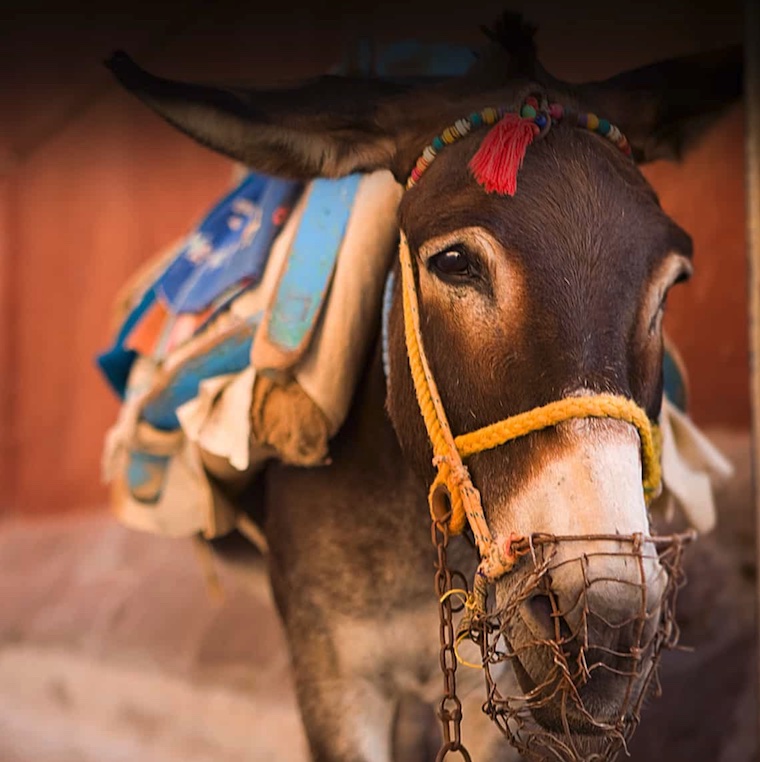
Donkeys
Donkeys are sensitive animals with small, strong bodies. Some people keep
donkeys for the purpose of hauling large loads on their backs. Others use
them to pull heavy, often unbalanced carts through crowded streets, or in
agricultural operations. Regardless of their purpose, these animals are
forced to perform hard labor daily. Some donkeys are cross-bred with horses
to create mules, who suffer from a range of genetic conditions, leading to
significant daily pain.
Donkey taxis are a popular tourist draw in countries like Spain and
Greece. These animals carry loads much heavier than is healthy, while being
exposed to dangerous temperatures and conditions. They’re seen not as living
creatures but as objects, and are often beaten, malnourished and suffering
from mange. They’re used until they break. When they’re unable to carry
tourists or loads, they’re frequently tied to posts and left to die from the
elements.
Camels
Camels are highly evolved creatures capable of withstanding extreme natural
conditions. But they are not capable of withstanding these harsh
environments while simultaneously being whipped, beaten and ridden hard for
long hours every day, without adequate sleep, food and water.
In many tourist attractions—particularly significant North African sites
like the Great Pyramids of Giza in Egypt—camels are kept as tourist
attractions. Camels kept for tourist purposes are subjected to overexposure
in sweltering heat with very little shelter. They are forced to pull
overburdened carts, or to give rides to people far too heavy for them to
carry without physical risk. Their bodies decline rapidly and many die from
exposure and overexertion.
Camels kept as workers are often sick and covered in lesions and sores. When
they become too sick to be useful, they’re slaughtered to be eaten.
Elephants
Elephants are social animals relying on complex relationships and
communities. Tragically, these gentle giants are often used as a tourist
draw in a number of different countries from Kenya to Thailand.
Elephants kept in captivity for the purposes of carrying humans or their
supplies are forced to haul heavy loads on their back, live in cramped
conditions and eat inadequate diets. They’re usually captured from the wild
as babies. After being separated from their mothers, the elephants are
tortured with bullhooks until they’re “trained” to respond to certain
commands. Many are broken mentally and eventually, even these mighty beings
break physically. Elephants used as tourist draws often suffer from serious
spinal conditions, eventually leading to their early and painful death.
Guard Dogs
It’s all too common for people to keep dogs not as companions, but for more
utilitarian purposes, such as to guard their home or property. Many people
fail to realize (or, in many cases, care) that using a dog in this way is
harmful to the dog, and that guard dogs are often subjected to intentional
cruelty as part of their training, so as to generate an extreme fear of
humans. This conditioning programs them to threaten or attack strangers out
of fear, and as a result, they always remain on edge. Dogs who are trained
to be aggressive are also more likely to be the target of other aggressive
dogs, putting their safety constantly at risk.
Domesticated dogs are used to receiving shelter from humans, but many guard
dogs are posted out in the open elements. They may be left without water in
hot sunny conditions or all night during the coldest part of the season. In
nature, wild dogs protect themselves from the elements by burrowing, but for
chained guard dogs, there’s no easy way to protect themselves against the
real physical toll taken by exposure to the elements.
Guard dogs are usually tied or chained to a post at the area they’re
supposed to be guarding. While they’re tied they’re unable to exercise a
full range of motion. This can cause dogs to get entangled and caught,
especially if they perceive an approaching threat. The result can be
anything from broken limbs to tremendous pain, or even choking to death.
Because guard dogs aren’t capable of leaving their post, if a threat does
approach, the dog is unable to protect herself or flee. Armed intruders can
easily injure or even kill a dog who’s unable to fight back. Even people who
don’t have any intent to break and enter may antagonize a guard dog just for
the fun of it, adding to the already high stress and anxiety of a dog “on
duty.”
Service Animals
While guide dogs (and other animals used in service of the disabled) are
generally not placed in life-threatening situations, their training can also
be extremely demanding and there is nothing to protect them from being
placed with human masters who are either cruel by intention, or simply
insensitive to the physical or psychological needs of another thinking,
feeling being.
Service dogs are often bred exclusively for the purpose of meeting the needs
of their owners. This selective breeding causes many dogs to suffer from a
range of genetic issues that can lead to significant physical problems,
particularly as they age.
Many people who own service dogs are not able to adequately care for
them, and the dogs end up suffering from neglect or inadequate nutrition.
Others are expected to accompany their human companions to loud, stressful
places like airports, bars and concerts, where their heightened sense of
smell and sound makes such environments stressful and confusing.
Some people claim they need a “service animal” as a convenient excuse for
owning an exotic pet. The individuals owned by such people are frequently
subjected to mishandling as well as unreasonable expectations, and are often
confused and frightened by situations they haven’t been prepared for.
Whether their handler isn’t physically capable of taking care of them or
doesn’t care enough to, the health and wellbeing of all service animals is
dependent on the integrity of the individual in whose custody they are
placed. And even in cases when the relationship is genuinely one of love and
mutual affection, the reality for service animals is that they are born and
trained to put the needs of a master before their own.
Return to Animal Rights Articles
Follow us on:


- Home Page
- What's New
- Contact Us
- Action Alerts
- Animal Exploitation
- Animal Issues
- Animal Rights Activism
- Archives
- Art & Photography
- Articles Directory
- Bible
- Bible Commentary Blog
- Books
- Campaigns
- Church & Religion
- Discussions
- Events / Podcasts / Media
- Health
- Hosted Web Sites
- Humor
- Kids' Korner
- Letters
- Links
- Nature Studies
- Newsletter
- Poetry & Stories
- Prayers
- Quotations
- Recipes with Photos
- Recipes Without Photos
- Sermons
- Stop Cruelty in Churches
- Video Library
- The Mary T. and Frank L. Hoffman Family Foundation
- Email: [email protected]
A web site sponsored by The Mary T. and Frank L. Hoffman Family Foundation and all-creatures.org
Copyright © 1998-2026 The Mary T. and Frank L. Hoffman Family Foundation. All rights reserved. May be copied only for personal use or by not-for-profit organizations to promote compassionate and responsible living. All copied and reprinted material must contain proper credits and web site link www.all-creatures.org.
Fair Use Notice: This document, and others on our web site, may contain copyrighted material whose use has not been specifically authorized by the copyright owners. We believe that this not-for-profit, educational use on the Web constitutes a fair use of the copyrighted material (as provided for in section 107 of the US Copyright Law). If you wish to use this copyrighted material for purposes of your own that go beyond fair use, you must obtain permission from the copyright owner.
Thank you for visiting all-creatures.org.
