Combating the world’s deadliest viruses without animals
From All-Creatures.org Animal Rights/Vegan Activist Strategies Articles Archive
FROM CAARE Citizens for
Alternatives to Animal Research and Experimentation
July 2019
Human-based methods are more likely to produce successful results for studying treatments for deadly viruses than experiments on mice or monkeys..... Most Zika research involves pregnant animals forced to undergo frequent miscarriages and cesarean births.

DNA samples...
A new study conducted by an international conglomeration of scientists has
found that human-based methods are more likely to produce successful results
for studying treatments for deadly viruses than experiments on mice or
monkeys.
The study, led by Dr. David Pamies at University of Lausanne in Switzerland,
focused on a class of viruses known as mosquito-borne flaviviruses (MBF).
These viruses are responsible for lethal and devastating diseases like
dengue fever and Zika virus, which can cause catastrophic deformities in
newborns.
The scholarly report examined human-mimetic approaches that include
innovative technologies like induced pluripotent stem cell models,
brain-specific organoids, in silico mathematical modeling, and others, all
without the use of animals.
The need to develop a vaccine to prevent these diseases is crucial and
urgent. Yet animal studies have repeatedly failed in human trials as the
publication describes through a comprehensive review of various animal
species.
When it comes to viral diseases, the problem is host specificity. Vaccines
that work on monkeys, for example, fail miserably when applied to humans.
Scientists have tried to compensate by creating “transgenic mice” – mice
that have some human genes – but these experiments too have failed because
infected mice did not exhibit many key symptoms seen in humans.

Mice in cages about to be injected...
The inefficacy of animal testing for flaviviruses isn’t the only reason
it’s problematic. An enormous amount of suffering is inherent in infectious
diseases research. Current research on dengue and Zika uses baboons, macaque
monkeys and mice.
Although these animals rarely express the same symptoms of the disease as
people do – a strong indication of interspecies differences – they are
nevertheless subjected to a life of invasive tests like spinal punctures and
uterine implants. Most Zika research involves pregnant animals forced to
undergo frequent miscarriages and cesarean births. One scientist told NPR
that he feels “sad and heartbroken” by the impact of the experiments on the
monkeys he studies. [Scientists
Report In Real Time On Challenging Zika Research]
Dr. Pamies’s recommendation is for "a future of MBF research with less
reliance on primate and rodent models and an increase in in vitro and in
silico studies.”
This will not only result in a better chance at discovering vaccines and
treatments for these deadly viruses but will also spare countless animals a
life of immense suffering.
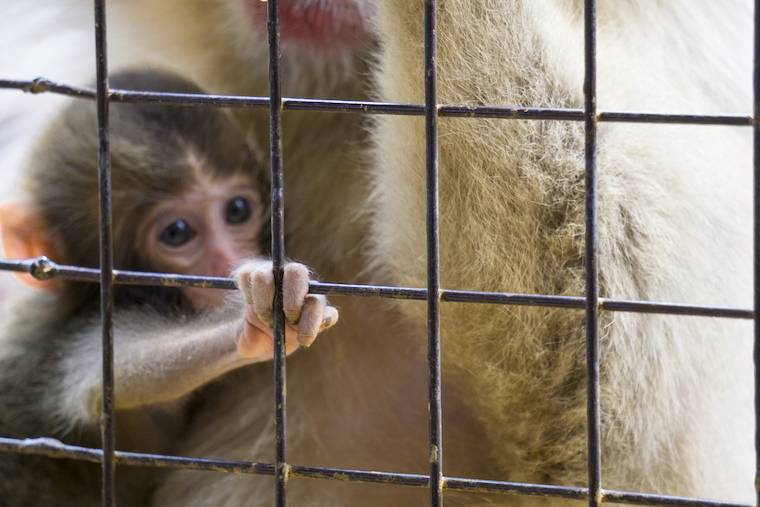
Lab caged baby monkey and mother
Return to: Animal Rights/Vegan Activist Strategies
Follow us on:


- Home Page
- What's New
- Contact Us
- Action Alerts
- Animal Exploitation
- Animal Issues
- Animal Rights Activism
- Archives
- Art & Photography
- Articles Directory
- Bible
- Bible Commentary Blog
- Books
- Campaigns
- Church & Religion
- Discussions
- Events / Podcasts / Media
- Health
- Hosted Web Sites
- Humor
- Kids' Korner
- Letters
- Links
- Nature Studies
- Newsletter
- Poetry & Stories
- Prayers
- Quotations
- Recipes with Photos
- Recipes Without Photos
- Sermons
- Stop Cruelty in Churches
- Video Library
- The Mary T. and Frank L. Hoffman Family Foundation
- Email: [email protected]
A web site sponsored by The Mary T. and Frank L. Hoffman Family Foundation and all-creatures.org
Copyright © 1998-2026 The Mary T. and Frank L. Hoffman Family Foundation. All rights reserved. May be copied only for personal use or by not-for-profit organizations to promote compassionate and responsible living. All copied and reprinted material must contain proper credits and web site link www.all-creatures.org.
Fair Use Notice: This document, and others on our web site, may contain copyrighted material whose use has not been specifically authorized by the copyright owners. We believe that this not-for-profit, educational use on the Web constitutes a fair use of the copyrighted material (as provided for in section 107 of the US Copyright Law). If you wish to use this copyrighted material for purposes of your own that go beyond fair use, you must obtain permission from the copyright owner.
Thank you for visiting all-creatures.org.
