
Articles
Birds with a Purpose
One of my favorite birds that I really love is the American kestrel, a sparrow hawk and member of the falcon family. They keep the destructive insects in check across much of American but they are becoming extremely rare where I live probably due to the use of treated seeds that are chemically poisoned for most creatures to eat. If they eat anything that has come in contact with these seeds they can die. Sometimes they die with their young waiting in the nest for mama to bring home a meal. That and small rodent poisons in barns, fields and gardens can eliminate the species in an area.
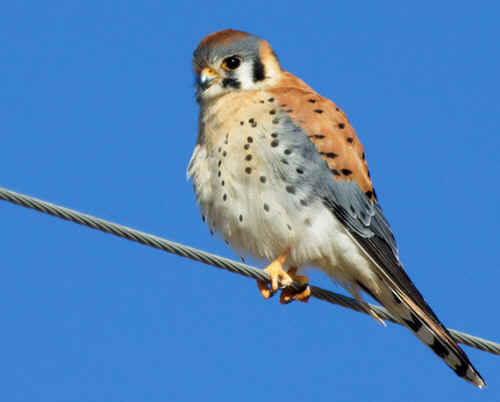
Photo courtesy of Robert Shantz
Many people feel they have a right to destroy birds that have no purpose. I do not support that concept and anticipate that other solutions will be made available to those that seek them. I read somewhere that if we seek and keep on seeking we will find. I include a photo of an American kestrel for help in identifying the species. I once helped them by providing nesting boxes after the hollow white oak trees that they called home were burned down. They take readily to nesting boxes and I have seen them dive into a 20-foot tall elm tree and all that became visible was a cloud of feathers surrounding the tree where they had struck a house sparrow. It was like an explosion caused by a bird striking a house sparrow at the speed of a bullet (I speak figuratively).
American kestrels are 10-1/2 inches long and are the smallest American falcon. Most people see a brown bird and never recognize the incredible coloring of this creature. It is awesome! In the days when falconry was not well regulated, the sparrow hawk was a joy to fly and return to your gloved hand. But I will comment on its purpose at the end of this article.
The second bird that will always remain in my heart even if it experiences what the passenger pigeon experienced in 1914: extinction! This bird is under the taxonomy of Scolopax minor and only 11 inches long with a bill that looks far too long for the bird’s size. The American woodcock is another native to our country. It is nocturnal and therefore is not usually seen by anyone except ornithologists and the surprise midnight walker. They tend to land on the ground, not in trees and feed on earthworms to a large degree. During mating season, males perform an elaborate dance in the sky and their flight feathers cause them to sound like a creature from outer space. It loves moist woodlands often under such trees as the flowering crabapple and willow, actually anywhere where worms are plentiful. Its eyes are huge compared to its head size and are set high up. During mating season when one is flushed you can run to the spot where it circled into the heavens and wait quietly. Within moments it usually descends to the ground within a few feet of where it took off from. If you are fortunate you might even catch a late evening photograph.
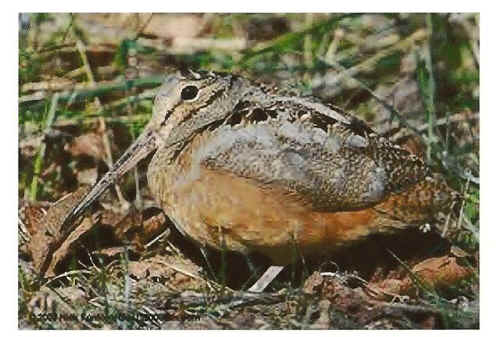
Photo courtesy of Nick Kontonicolas
The terrible situation the American woodcock has to
survive is the suburban sprawl. Country folks try to have citified lawns and
small cities themselves have their lawn visited after dark by the woodcock.
Both of these places normally and extensively use weed killers, insecticides
and other poisons which stimulated the publication of the book, Silent
Spring by Rachel Carson. Most city
dwellers and even people who live in the country fail to realize that while
they sleep American woodcocks, sometimes called timberdoodles, and are
feeding on the worms deep in their lawn and subsequently dying slow deaths
due to the poisoning of their grass covered soils. One thing those who live
in the country can do is suffer by allowing a few weeds to grow in their
“country lawn” thereby sparing birds struggling to survive. The woodcocks
often are experiencing horrible difficulty in maintaining their numbers
across the eastern half of the
Finally, I want to write about the Blue Jay. In the United States of America, we have the Blue Jay, Steller’s Jay, Gray Jay as well as Mexican Jay, Green Jay, Brown Jay, Western Scrub-Jay, Florida Scrub-Jay, Pinyon Jay and occasional others. I have seen a number of these kinds of Jays and the Blue Jay is my favorite. I recently read a website which said that, “Blue jays were worse than rats, starlings and many other species and admitted to shooting them every opportunity they get.” I say thank God they are protected where I live.
When I was a child, blue jays were one of the frequent visitors to hikers in the woods. They were prolific. Upon returning to the area after many years, I noticed that the blue jay population was almost non-existent. What a large hole in the ecology that seemed to leave. As I write, I am watching a dozen of them flittering from a flowering cherry to a large wild bird feeder outside my office window. It is quite a carnival and free entertainment center to see their striking colors and playful vigor interacting with red cardinals, morning doves, red bellied woodpeckers and chickadees and various other species. That is not the reason I care about blue jays.
Blue jays are accused of eating birds’ eggs and baby birds but in a statistical analysis of many blue jays, it was noted that only 1% of the study group of jays showed any evidence of this behavior. What studying blue jays has shown is that blue jays eat acorns, but more than eating them, they plant acorns and this behavior greatly helps with the range expansion of many species of oaks. Eleven species of oak trees have become dependent on jays for the dispersal of their acorns. The same thing is true of the stellar jay with pine nuts. Several species of pine trees have also become dependent on jays for the dispersal of their seeds. Blue jays often bury their acorns many miles from the source and thus have created, over the ages, great forests. But that is not my reason, although it could be, for loving blue jays.
The American kestrel, the American woodcock and the jay
from the
