Egg Production Articles from All-Creatures.org
Meet the 'Catcher Gangs' Hired to Round Up Spent Hens
From Grace Hussain,
SentientMedia.org
October 2023
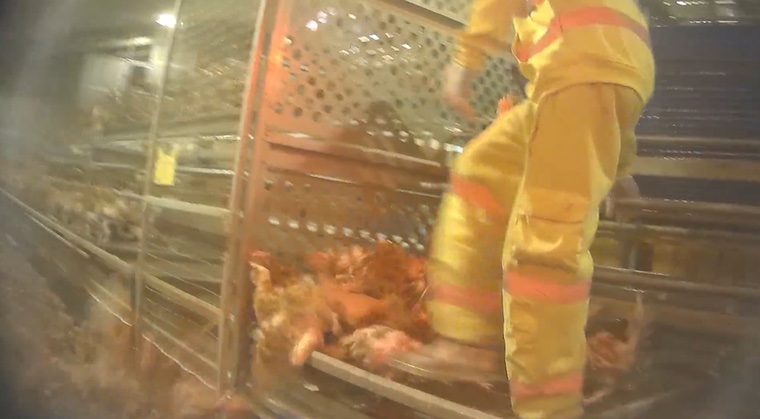
Under the cover of night, each catcher gang captures thousands of birds. According to the investigator, a night of hen catching starts with corralling a large portion of the birds into one corner, primarily to make it easier for workers to grab multiple birds per hand. They often leave them swinging upside down by just one leg as they await their turn to load them in for transport.
Lit only by infrared lights, employees of corporate poultry
processor A.D. Harvey were caught on video throwing, kicking and
rough handling end-of-lay hens — that is, birds who are no longer
laying eggs. Now a new investigation spearheaded by Animal Justice
Project is shedding light on how “catcher gangs” round up these
birds for slaughter, including hens on cage-free egg farms - see
video HERE.
Under the cover of night, each catcher gang captures thousands of
birds. According to the investigator, a night of hen catching starts
with corralling a large portion of the birds into one corner,
primarily to make it easier for workers to grab multiple birds per
hand. They often leave them swinging upside down by just one leg as
they await their turn to load them in for transport.
The footage documents upwards of 20 hens being shoved into cages
before the whole contraption is shaken in an apparent attempt to
push the birds toward the bottom and make room for more.
Hens who lay so-called “cage-free” or “free-range” eggs aren’t
spared from this treatment. The investigation features footage from
several farms that produce eggs for these labels. Among them, the
footage included images from Sunrise Poultry-owned Kettleby Farm, a
major supplier to British grocery chains Co-op and Morrisons.
The processing company, A.D. Harvey, bills themselves as
“specialists in the depopulation, transportation and processing of
British end of lay hens, with an unwavering dedication to the
highest quality standards in animal welfare, biosecurity and food
safety.” Their “RSPCA Assured”-certified animal welfare status has
been suspended in the wake of the new footage.
Labels Like Cage-Free Fail to Address End-of-Life Treatment
As more brands adopt the cage-free egg label, questions remain about
how hens are treated across the board, and how much more humane
cage-free eggs really are. The recently released footage illuminates
end of life care — or lack thereof — for animals that produce foods
like eggs and milk. Consumers may be surprised to learn that these
animals are also slaughtered for meat.
It “all happened under the nose of the catching team managers as
well,” says the investigator, whom we’ll refer to as P. “The cruelty
is absolutely apparent…whether it’s intentional or whether it’s them
turning a blind eye.” Even on farms operating under strict welfare
certifications, P. recalls numerous instances of rule breaking.
Much like “humanely raised” and other animal welfare labels,
certifications like RSPCA Assured are supposed to guarantee some
level of treatment. In a statement responding to the investigation,
the organization condemned the documented behavior saying it “goes
against everything RSPCA Assured stands for and falls significantly
below the high standards we demand of our members.”
Since reviewing the footage, the organization reported the incidents
to the Animal and Plant Health Agency and suspended A.D. Harvey’s
certification. A suspension does have significant implications — the
catching company will not be able to work with any RSCPA Assured
farms — but punishing one organization does not address whether the
footage is indicative of a larger, industry-wide problem.
A.D. Harvey also released a statement, provided to Sentient Media by
Animal Justice Project, that the staff featured in the footage “are
no longer employed” by them and that the remaining staff is being
retrained in proper animal handling.
The company failed to confirm whether Oliver Harvey, grandson of
A.D. Harvey’s founder, who is featured overseeing and encouraging
the workers in the footage, was among those relieved of their job.
Filthy Barns Trap Hens and Workers Alike
Being part of a catcher gang is not an easy job, says the
investigator. Most nights start with an hours-long van drive to the
farm. Once there, teams of around eight to fifteen workers are
tasked with catching thousands of birds, sometimes upwards of tens
of thousands.
The teams typically spend most of the night rounding up birds in
what are extremely dirty and dusty barns — “horrible rubbish” by the
investigator’s own description.
The filth doesn’t do much for worker morale, according to P. Their
“frustration is taken out on the animals,” he says. That frustration
can and does turn deadly. Toward the end of each night, P. recalls,
workers began picking up the injured birds and throwing them against
walls, and trampled upon deceased birds.
Much of the staff were also intoxicated, P. says “Many people who
ran the teams were alcoholics or drunk,” he says, which might
explain how the animals were treated.
Some workers may have no other options, P. tells Sentient Media.
During his short tenure with A.D. Harvey, P. heard rumors of people
in other catcher gangs who were the victims of slavery — a not
uncommon labor pool for the animal agriculture industry worldwide,
both historically and today.
Despite the grueling nature of undercover work, “there’s no other
way…to bring this to light,” P. tells Sentient Media. But P. says
he’s at least carrying out the job “in a gentler and more respectful
way,” providing the birds with a bit of relief in their final hours.
Return to Egg Production Articles
Follow us on:


- Home Page
- What's New
- Contact Us
- Action Alerts
- Animal Exploitation
- Animal Issues
- Animal Rights Activism
- Archives
- Art & Photography
- Articles Directory
- Bible
- Bible Commentary Blog
- Books
- Campaigns
- Church & Religion
- Discussions
- Events / Podcasts / Media
- Health
- Hosted Web Sites
- Humor
- Kids' Korner
- Letters
- Links
- Nature Studies
- Newsletter
- Poetry & Stories
- Prayers
- Quotations
- Recipes with Photos
- Recipes Without Photos
- Sermons
- Stop Cruelty in Churches
- Video Library
- The Mary T. and Frank L. Hoffman Family Foundation
- Email: [email protected]
A web site sponsored by The Mary T. and Frank L. Hoffman Family Foundation and all-creatures.org
Copyright © 1998-2026 The Mary T. and Frank L. Hoffman Family Foundation. All rights reserved. May be copied only for personal use or by not-for-profit organizations to promote compassionate and responsible living. All copied and reprinted material must contain proper credits and web site link www.all-creatures.org.
Fair Use Notice: This document, and others on our web site, may contain copyrighted material whose use has not been specifically authorized by the copyright owners. We believe that this not-for-profit, educational use on the Web constitutes a fair use of the copyrighted material (as provided for in section 107 of the US Copyright Law). If you wish to use this copyrighted material for purposes of your own that go beyond fair use, you must obtain permission from the copyright owner.
Thank you for visiting all-creatures.org.
