
|
|
Tropical Forests and Regions |
Articles and Reports: Tropical Forests and Regions
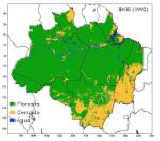
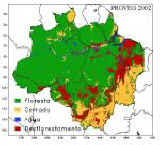
The future of the Amazon? A week in ManausRide for Climate � the Americas I spent a week in Manaus, staying in the apartment of two graduate students and visiting Instituto National de Pesquisas da Amazonia (INPA), a famous research center. Here, in addition to giving a presentation for INPA and also for students at a neighboring University, I talked with scientists modeling climate in the Amazon rainforest. From what I gather, the rainforest faces three major threats. Although the Amazon basin is enormous (similar in size to the contiguous U.S.), deforestation is a major threat. Everywhere roads are built, the forest is cut down, making way for fields of soy beans or beef cattle. From one of the researchers at INPA, I received the images below which show the forest in 1992, deforestation by 2002, and then projected deforestation in 2033 (deforestation shown in red).
I talked with two climate modelers at INPA, Francis and Theotonio about how this deforestation would affect the rainforest, as cutting down a forest changes evaporation and thus rain patterns. If the entire forest were cut down, they estimate that rainfall would decrease on average 30%, with many areas becoming too dry for forest. Indeed, one study suggests that there are two stable states of the Amazon � one state like the rainforest we find today, and another state where much of the forest is dry savannah. If too much forest is cut down, there is a possibility that it would push much of the Amazon into the drier state, unable to easily return to forest. These studies, however, do not consider the effects of global warming. To be sure, the effects of global warming are uncertain because large scale climate models are not good at modeling rainfall in the tropics. Nonetheless, a few models (not all) suggest that a warmer earth means a much drier Amazon, which would turn much of the basin into savannah. This may be wrong. It may also be correct. Decreasing rain and savannahization are real risks to the rainforest. Due to uncertainty in the science�we can�t be sure if deforestation or global warming will reduce rain�it is difficult to put percentages on these risks, and Theotonio and Francis, while claiming it a real possibility, balked at guessing its probability. Nonetheless, if it is true, the results are very bad. A loss of the Amazon would not only loose countless species, but also release incredible amounts of carbon dioxide to the atmosphere, accelerating global warming. Do we really want to find out if it is true or not?
|
Return to:Articles and Reports
Return to:Tropical Forests and Regions
Return to:Home Page
Your Comments and Inquiries are Welcome

Fair Use Notice: This document may contain copyrighted material whose use has not been specifically authorized by the copyright owners. We believe that this not-for-profit, educational use on the Web constitutes a fair use of the copyrighted material (as provided for in section 107 of the US Copyright Law). If you wish to use this copyrighted material for purposes of your own that go beyond fair use, you must obtain permission from the copyright owner.
|
Since
|


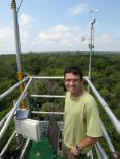
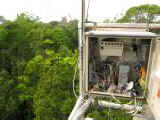
 My last full day in Manaus, I traveled with Alexender, one of my
hosts, to a large forest preserve near the city. In the preserve, Alex
maintains a large tower that measures CO2 concentrations, and is he
trying to understand how CO2 fluxes into and out of the forest. Alex let
me climb to the top of the tower, where I was able to look across the
treetops of a forest that stretches for thousands of miles beyond the
horizon. Listening to the birds, monkeys, and insects, it was hard not
to be both awed by the Amazon and to wonder what its future will be.
My last full day in Manaus, I traveled with Alexender, one of my
hosts, to a large forest preserve near the city. In the preserve, Alex
maintains a large tower that measures CO2 concentrations, and is he
trying to understand how CO2 fluxes into and out of the forest. Alex let
me climb to the top of the tower, where I was able to look across the
treetops of a forest that stretches for thousands of miles beyond the
horizon. Listening to the birds, monkeys, and insects, it was hard not
to be both awed by the Amazon and to wonder what its future will be.

 This site is hosted and maintained by