Recuperation of the Amazon Forest must be immediate
[15/11/2006 15:02]
Even though it is not yet possible to link specific events such as
tornadoes and floods to major changes observed in the planet's climate,
specialists like Antonio Nobre believe that we can no longer afford to
wait for unequivocal proof of the causes of certain phenomena. He thinks
that scientists have an obligation to warn society about environmental
problems. Nobre, a representative of the Inpa (National Research
Institute of the Amazon Region - Instituto Nacional de Pesquisas da
Amaz�nia) in the National Space Research Institute (Inpe) is author of
a study showing that the Amazon is a self- regulating system able to
capture moisture from the Atlantic Ocean in order to maintain the
stability of the climate as well as the regime of rains from South
America to the East of the Andes. A doctor in Biogeochemistry, he
explains in the following interview the need not only to suspend
deforestation of the Amazon Forest but also to recuperate it
immediately, otherwise the continent's population will be burdened with
what he considers an "unpayable price".
Since the late 1980s, there has been no doubt that pollution cast into
the atmosphere, chiefly by wealthy countries, is contributing to global
warming. An increase in the frequency of extreme climatic events in the
coming decades has also been ascertained. Another given is that
deforestation in poorer countries has also contributed significantly to
carbon emission, one of the key elements responsible for the greenhouse
effect. Based on evidence that the tropical forests also play a key role
in stabilising the climate, the Brazilian government presented a
proposal to reduce deforestation in return for resources from wealthy
countries, at the 12th Conference of the Parties of the Climate
Convention, held this November in Kenya. There is consensus among the
International community that there is sufficient evidence to affirm that
we are undergoing effects of climatic change.
Despite this, one of the arguments used by the United States government
so as not be involved in the Kyoto Protocol, an International treaty on
the theme, is that there is no scientific certainty concerning the
contribution of Earth's temperature increase to causing several
"natural" disasters which have taken place in recent years in
unexpected places, such as the successive heat waves across Europe, the
prolonged drought in the Amazon Region and the sequence of hurricanes
along the coast of the Caribbean among others. Their argument is partly
supported by the fact that mathematical models used by meteorologists
are devised based on a series of historic logs regarding average
atmospheric behaviour in the past and are unable to predict specific
climatic episodes. In fact, George W. Bush's administration has already
advocated in a number of debates that they cannot even be sure of the
contribution of pollution to climatic change.
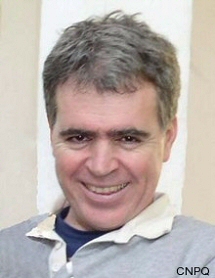 Nobre:
The climate is changing very fast. The deforestation had to be ceased at
least ten years ago. Nobre:
The climate is changing very fast. The deforestation had to be ceased at
least ten years ago.
Indeed, it is not yet possible to directly link specific events such as
floods and tornadoes with the great changes the climate is undergoing.
Nonetheless, several specialists have begun to take a more active stance
in the debate over the feature, heeding the possible catastrophic
consequences of global warming.
In Brazil, researcher Ant�nio Nobre is of the school that believes
that we can no longer afford to wait for unequivocal proof of the causes
of certain phenomenon, and that the duty of warning society of the
environmental problems lies with the scientists. Nobre, a representative
of the Inpa (National Research Institute of the Amazon Region -
Instituto Nacional de Pesquisas da Amaz�nia) in the National Institute
of Space Research (Inpe) is author of a study showing that the Amazon
Region is a self-regulating system able to capture moisture from the
Atlantic Ocean thereby maintaining the stability of the climate and
regime of rains from South America to the East of the Andes. A doctor in
Biogeochemistry, he believes that it is not only necessary to suspend
deforestation in the Amazon Forest but also to recuperate it immediately
otherwise the continent's population will be burdened with what he
considers an "unpayable price".
ISA - Is there a polemic concerning the ability of the Amazon
forest to capture carbon? What is the forest's role in this sense?
Ant�nio Nobre - More important than discussing whether the
Amazon forest is a carbon source or a carbon sink is that it does
regulate the quantity of carbonic gas in the atmosphere. The amount of
carbonic gas in the atmosphere regulates the climate, the planet's
temperature. The temperature regulates the whole water cycle,
evaporation from the ocean, rains, moisture shifts etc. There is very
strong evidence today that the biosphere - which includes
micro-organisms, plants, animals, all living things, including humanity
- over the geologic eras since Earth's formation, has been responsible
for the climate stability of the planet. More so than surface
geological, geophysical or geochemical factors.
So the Amazon forest plays an important role in regulating the planet's
climate?
In fact, if I had to put it simply, I'd say the following: imagine the
surface of a lake into which you toss a stone. The stone produces an
impact, which produces oscillations on the surface, which radiate out in
concentric waves which travel out to the edges of the lake. Then it hits
the bank, reflects and returns until part of it dissipates. The
atmosphere suffers because it is fluid, as gas is a type of fluid. It
responds in the same fashion. Waves propagate in the atmosphere yet we
do not know where they will end up reflecting. And these effects, or
wave propagations, of varying disturbances produce very complex
patterns, and this is why they are so difficult to predict�
In relation to climatic changes, is it not possible to predict events
and particular effects like hurricanes and droughts?
Specific episodes, I think not. I'm no meteorologist. Meteorologists are
the best people to ask and I'm pretty sure they'll say it's not
possible.
Even though it's not possible to specify these effects in
regulating climate in the Amazon's case, they surely exist?
There are several groups in the world [which study this], but the most
prominent is the group at the Hardley Centre in England which created
some climatic models at the end of the 1990s, different to the majority
produced up to that point, and that incorporate carbon life forms etc.
This model shows a vertiginous acceleration in the effects of global
warming and the demise of the Amazon by around 2050. But the physical
processes are not yet fully understood. These models are adjusted. They
create a series of model start-points under different configuration
conditions. The model produces a range of responses and they see what
the trend of the majority of the responses is. They create several runs
of the simulations using the model and say: "80% of the simulations
show that the Amazon will heat up and dry out; when it has dried up, the
forest will die; then fire takes hold and releases carbon dioxide (CO2)
which will then speed up warming, which in turn then accelerates the
effect and so on.."
Are you talking about a drought in the Amazon due to the effect of
global warming?
Yes. Because there would be heating of the Atlantic Ocean, the Pacific
Ocean and an intensity in sequences of El Ni�os. When these occur,
violently according to records, they bring about drought in a
significant proportion of the Amazon and then deformations occur in the
circulation over South America: instead of air rising in the Amazon,
producing rains, it descends causing drought.
Does this mechanism explain the region's last drought in 2005?
That drought was different. The known drought that caused fires in
Roraima in 1998 was produced by El Ni�o, stemming from the Pacific
Ocean. In 2005, it was a hot water pool in the Tropical North Atlantic.
Is it fair to say that deforestation in the Amazon can have effects on
the climate in the region itself as well as other parts of the world?
It would be very good if the meteorological community presented a full
picture of these effects. As there are a number of interesting studies,
such as the one stating that the Amazon will become
"savannah-like" once 40% of its area has been cleared. The
effects of deforestation on the reduction of evapotranspiration of the
forest are well known. According to INPE data, if you just take the 17%
of clearcutted area in the region, plus 22% of upper canopy destruction
due to selective timber extraction - in which up to 30% of this cover is
damaged, even if you remove a lesser number of trees - you are
compromising the forest's ability as a conditioner.
There are a number of studies showing that deforestation in the Amazon
is affecting the Mid-West of the United States, while others indicate an
effect in Norway, but now more recent studies have shown that hurricanes
in the Caribbean are associated to Amazon deforestation and the
intensity of El Ni�os, and vice-versa.
There is a new study by a group of Russian theorists, which is
suggesting something revolutionary, that not only will it become
savannah-like but that when you wipe out a convection system as powerful
as the Amazon, or like the forests of the Congo, in Africa or Siberia in
Russia, you invert the direction of atmospheric circulation: The air
which blows today from the ocean to the continent will blow from the
continent to the ocean. When this takes place, what is left is the
Sahara, desert. If what this new theory is suggesting can be proven -
and they have presented a very impressive and attractive theoretical
foundation, which has a solid grounding on mathematics and physics - we
will no longer be talking about becoming savannah-like but also
desert-like. Not the Amazon becoming desert, but South America and the
East Andes.
In my understanding, in view of what we know to date, it's a given and
the whole world agrees, that there are reasons why we should no longer
talk about reducing deforestation. This is my stance. In fact, we would
need to be replacing destroyed forest. Deforestation should have been
zero at least a decade earlier. It's no use saying: "but, it's only
18 thousand square kilometres [deforested]". These are obscene
numbers if you consider that South America's hydrologic engine is being
destroyed.
Do you think there are already strong indications of climatic
change brought about by deforestation?
I'm not sure if I have the right to think that. What I can say quite
frankly is that we can't bury our heads in the sand like ostriches. The
climate is undergoing accelerated change. How much of this is do to
global warming? Perhaps part of it. Who can say? Few people. Perhaps
nobody. Global warming is a relatively slow process of transgression.
These phenomena taking place in South America, associated to its
surrounding oceans are of rapid onset, things are happening now which
were predicted to occur from 2020, 2030.
What do I reckon accounts for the difference? Deforestation. You are
removing the hydrologic engine which allows atmospheric air to circulate
and moisture transport to occur. This has an effect and must comprise a
rougher force than global warming, with a picture of extremely rapid
change. As if this weren't enough� There is no effective justification
be it legal, ethical, moral, logical to carry on deforestation. We
should have left this phase behind.
In a speech given at ISA at the end of 2005, you quoted a study which
linked deforestation of the Amazon with the warming of the Atlantic�
The study I quoted has not yet been published but is being finalised.
They need to verify, run many scenarios on supercomputers, check the
variants of the test components. I took that early step because I saw a
correlation of information which coincided.
First, oceanographers specialising in the Atlantic, during a meeting
in Venice in 2005, could not explain Atlantic warming, the hot water
pool.
Global warming produces effects on a time scale incompatible with the
emergence of a hot water pool in the Atlantic in 2005. Sometimes, when a
quantity of water joins an underwater current, it takes more than a
thousand years for any signs to appear in another ocean. The ocean
responds slowly. Global warming is a relatively recent effect. So, for
an ocean to respond like this, it is possibly to do with a local effect,
a direct connection�
Following the deforestation of 40% of the Amazon, how long would the
process of becoming savannah-like take? Over a matter of centuries or
decades?
This could take place over a period of decades or less. It's taking
place at a blistering pace. Look at what is happening. Last year's
drought, but that has a different genesis�
But you said it is not yet possible to establish a direct link between
that drought, forest change and deforestation. It is not possible to
make predictions concerning a specific episode like this�
Regarding this episode, meteorologists themselves are saying that it's
linked to the warming of the Atlantic Ocean. Now, they are not making
this link, at least the group I cited who are concluding their study,
which says that Atlantic warming is related to deforestation. This
drought has been widely acknowledged as having resulted from Atlantic
warming. This is no longer a point of controversy. The relationship
between deforestation and Atlantic warming has not yet become public
knowledge, but I am already publicising this because I think it is very
serious situation.
How consistent is the hypothesis on the link between deforestation
and ocean warming?
We now have 15 years into [the International debate] which would not
have been possible if we had waited for scientific certainty over global
warming. The discourse circulating at the time was exactly the same as
what's happening over the Amazon problem now.
At the present time there are some uncertainties. There are people
from within the community showing that deforestation is, indeed
associated to Atlantic warming, which is in turn associated to
hurricanes and drought in the Amazon, back-firing.
There are those saying that deforestation is going to reduce the
transport of moisture from the Amazon to the Southeast, to the River
Plate Watershed, as I have been saying. Others are saying that it is
going to increase the intensity of the storms.
There is a whole lot of early knowledge ebullient in the scientific
community yet there is a significant proportion of this community who
are reluctant to go public and make relevant statements because they are
not sure yet. Exactly the way it was 15 years ago concerning discussion
over global warming.
But there are a lot of people, my self included, who have
decided to go public and say that a whole spectrum of risks do exist. I
am convinced by a number of these risks, which we already have knowledge
about.
And we need to do something. We cannot wait until they have
cleared the whole of the Amazon and then say: "Oh, now we know the
effects of deforestation for sure". Because the cost is too high
for society to pay.
It is said that Brazil is a "cradle of splendour", but we are
"eternally lying down" in it. We have not yet begun to
question. Let's take a world map and check out the other countries
around the globe. What other country or continent boasts such an
extensive green area, with the rains, the mildness (climatic) that South
America has? I have no doubt that what promotes the balance here are the
forests.
Responsibility for the balance is disappearing and is going through a
period of transition - without saying that one day it will turn into
desert, which remains a matter of controversy - but even if it becomes a
Savannah, there will be many more extreme events. Any meteorologist will
tell you so. It's not my opinion here. There will be more storms, more
tornadoes, more hurricanes.
Basically we'll be shifting from a situation in which the biosphere
maintains an extremely comfortable environment, to a situation of
continuous disasters. Mother Nature cannot be held responsible! Because
it is we who have destroyed the very system maintaining the atmospheric
cycle.
ISA, Oswaldo Braga de Souza.
|


 This site is hosted and maintained by