Woods Hole Amazon Ecological Program
The Amazon
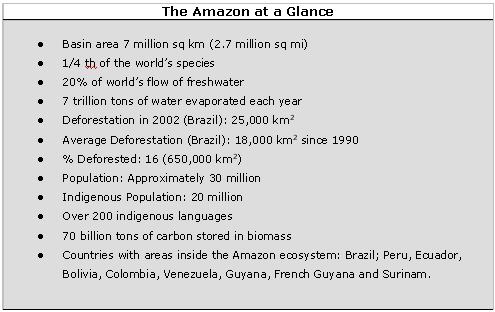
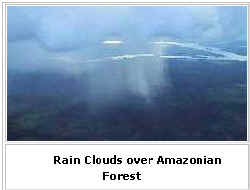 The Amazon rainforest is one of the world�s greatest conservation
challenges. This vast equatorial ecosystem is home to one fifth of the
planet�s plant and animal species, more than 200 indigenous cultures,
and 30 million people in search of sustenance and wealth. Carbon stocks
equivalent to more than a decade of global fossil fuel emissions are
stored in the wood of its trees. Even slight climate-induced changes in
the forest�s metabolism could undo the modest gains of the Kyoto
Protocol in slowing global warming. The forest also releases enough
water to the atmosphere via evapo-transpiration and to the ocean via
river outflow to influence world climate and ocean circulation systems;
and in doing so it also sustains the regional climate on which it
depends. The Amazon rainforest is one of the world�s greatest conservation
challenges. This vast equatorial ecosystem is home to one fifth of the
planet�s plant and animal species, more than 200 indigenous cultures,
and 30 million people in search of sustenance and wealth. Carbon stocks
equivalent to more than a decade of global fossil fuel emissions are
stored in the wood of its trees. Even slight climate-induced changes in
the forest�s metabolism could undo the modest gains of the Kyoto
Protocol in slowing global warming. The forest also releases enough
water to the atmosphere via evapo-transpiration and to the ocean via
river outflow to influence world climate and ocean circulation systems;
and in doing so it also sustains the regional climate on which it
depends.
Land use, Deforestation and Fire in the Amazon
 The Amazon basin ecosystem has historically been protected from
threats due to its isolation � access was difficult, there were
limited settlements, and resource extraction was confined to immediate
margins of navigable rivers. Throughout the 1960�s and 1970�s, new
roads and colonization projects settled millions of people into the
region. In three decades, 15% of the Amazon forest was clear-cut and 4
or 5% was degraded through timber harvest or fire. Each year, an average
of 18,000 km2 of forest are felled�an area larger than Massachusetts
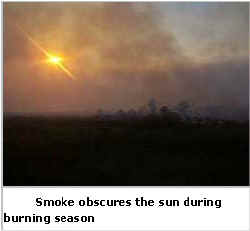
and half the size of Costa Rica. During the 1998 El Ni�o episode,
forest loss was accelerated through the downward spiral of land use,
drought and fire. Forty thousand square kilometers of dried out forest
burned during that year. In these areas half of the adult trees were
killed, wildlife was devastated, and the likelihood of recurrent fire
increased. The Amazon basin ecosystem has historically been protected from
threats due to its isolation � access was difficult, there were
limited settlements, and resource extraction was confined to immediate
margins of navigable rivers. Throughout the 1960�s and 1970�s, new
roads and colonization projects settled millions of people into the
region. In three decades, 15% of the Amazon forest was clear-cut and 4
or 5% was degraded through timber harvest or fire. Each year, an average
of 18,000 km2 of forest are felled�an area larger than Massachusetts
and half the size of Costa Rica. During the 1998 El Ni�o episode,
forest loss was accelerated through the downward spiral of land use,
drought and fire. Forty thousand square kilometers of dried out forest
burned during that year. In these areas half of the adult trees were
killed, wildlife was devastated, and the likelihood of recurrent fire
increased.
A Challenge to Conservation
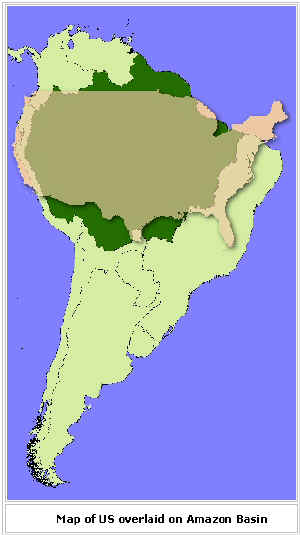 The Amazon emerges as a rare opportunity for comprehensive
conservation, because it remains mostly undisturbed. Eighty percent of
the forest is still standing, and forest-dependent economies have proven
themselves to be competitive with forest-replacing economies. It is not
too late to devise ways of managing the Amazon rainforest to protect its
biological diversity, its hydrologic functions, and its critical role in
climate regulation, while also addressing the needs and aspirations of
its people. The Amazon emerges as a rare opportunity for comprehensive
conservation, because it remains mostly undisturbed. Eighty percent of
the forest is still standing, and forest-dependent economies have proven
themselves to be competitive with forest-replacing economies. It is not
too late to devise ways of managing the Amazon rainforest to protect its
biological diversity, its hydrologic functions, and its critical role in
climate regulation, while also addressing the needs and aspirations of
its people.
The Amazon Program
The Woods Hole Center�s Amazon Program integrates scientific
research, policy analysis, natural resource management systems, and
education to help promote comprehensive conservation of the world�s
largest tropical rainforest. With more than 20 institutional partners in
South and North America and the devotion of eight staff members, this
program is helping to lay the groundwork for ecologically sustainable,
socially just, and economically viable development in the Amazon basin.
A commitment to rigorous scientific research lies at the core of the
program, along with informing policy analyses, forming strategic
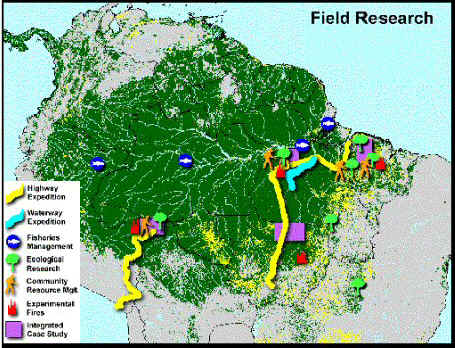
alliances with partners, and education. Program activities and field
research is carried out throughout the region, including along the
region�s new economic arteries�the highways that are being paved
into the core of the Amazon- and expanding agricultural frontiers. Our
goal is to use our scientific knowledge to explore new paths to
development in the Amazon that will lead to a sustainable future for the
region and its population.
|


 This site is hosted and maintained by