
|
|
Tropical Forests and Regions |
Articles and Reports: Tropical Forests and Regions
Can European Pressure Stop the Creep of Soy Fields into Brazil's Rainforests?Nature Conservancy magazine Today, in our fast food nation, in a culture of Super Size Me, in a place where obesity is ever more a national concern, everyone has a pretty good idea what they are eating when they go to McDonald�s. A Big Mac: 540 calories and 29 grams of fat. Chicken McNuggets: 420 calories and 24 grams of fat. Large fries: 570 calories and 30 grams of fat. The one question we don�t need to ask today is, Where�s the beef? But lately, another question has arisen. With deforestation, global warming and climate change the new buzz words on everyone�s lips, more and more people want to know: Where�s the beef from? Knowing what�s in burgers and fries is no longer enough. Environmentally aware consumers want to know how the beef, chicken or vegetables got to their dinner plates. Consumers now want health and justice. This is especially true in Western Europe, where environmentally aware shoppers have challenged fast-food outlets, supermarkets and department stores for selling beef, wood and other products that are hastening problems like climate change and deforestation. In particular, European concerns have turned to a new and growing environmental threat: soybeans. Fast-food outlets throughout Europe, including McDonald�s, rely heavily on Brazilian soybeans, which are increasingly harvested from fields that used to be Amazon rainforest. The European Union bought 10 million tons of soy from Brazil in 2006 � about 40 percent of Brazil�s soy export crop � soy that is used as animal feed to fatten the cows and chickens that become Big Macs and McNuggets. (Nearly 80 percent of the global soybean harvest is milled into animal feed, according to the Worldwatch Institute.) Europe�s culpability in the Amazonian soy harvest is a fact that sticks in the throat of consumers who are no longer prepared to buy from companies they suspect are complicit in illegal logging, deforestation, and growing or buying genetically modified (GM) crops. �Consumers don�t just look to see if it is a high-quality product but also [ask,] �Where does it come from,� says Karen Van Bergen, vice president of corporate relations for McDonald�s Europe. �Traceability is important. They won�t buy GM foods, and consumers tell us they don�t want to contribute to cutting down the rainforest. It�s �If I buy your product, what kind of company am I dealing with?�� A decade ago, when consumers caused a furor over deforestation, McDonald�s stopped buying beef from ranches carved out of the Amazon. So the company�s executives were dismayed last year when Greenpeace showed them the results of a two-year investigation documenting that deforested land in the Amazon was being used to grow soy imported to Europe.
�We have a firm policy against using beef � or any other products � that come from the rainforest,� said Bob Langert, McDonald�s vice president for corporate citizenship, in an interview with the Washington Post. �So when we learned that some of our soy was coming from there, we got involved.� 80 Percent Ignored Despite the heavy toll the Amazon has endured in the past few decades, Brazil has some of the most progressive environmental laws in the world. The country�s Forest Code requires farmers and ranchers in the Amazon to set aside 80 percent of their land as protected forest preserves. The rules also mandate that landowners leave forests standing within 10 to 50 meters of streams and rivers as �areas of permanent protection.� However, only a handful of farmers in the Amazon basin currently meet the Forest Code�s legal criteria, says David Cleary, The Nature Conservancy�s director of conservation strategies for South America. With almost no government enforcement and the draw of potential profits to be made from logging, cattle and agriculture, few people have paid much heed to the rule. In fact, 80 to 90 percent of the farmers have ignored the Forest Code, says Cleary. And, he says, many who are currently in compliance probably bought their land so recently they simply haven�t had time to clear forest yet. The original version of the Forest Code was instituted in 1965 and stipulated farmers in the Amazon keep at least 50 percent of their land as forest or natural vegetation. The Brazilian Congress tightened the ratio to 80 percent after record bouts of deforestation in the 1990s drew intense international scrutiny. But ratcheting up legal protections hasn�t helped much to slow the rates of destruction in the Amazon. When international prices for soy on commodity markets spiked in 2004, deforestation surged. The Amazon experienced its second-worst year of clearing as ranchers and farmers rushed to open new pasture and fields. So far, about 17 percent of Brazil�s Amazon has been lost, and scientists project that if current pressures keep pace, 40 percent of the forest will be cleared by 2050. In Brazil�s Wild West agricultural frontier, international markets � not legal edicts � control the future of the forest. �Brazil is one of the only countries in the world that has room for soy and agribusinesses to expand,� says Margaret Francis, the Conservancy�s information officer in Brazil. �And the push toward biofuels will only add to that.� That�s why in 2004 the Conservancy launched the Responsible Soy
Project, a certification program geared toward harnessing market
pressure on soy. The Conservancy had approached the biggest grain trader
in the world, Minnesota-based Cargill, with a plan. The idea was to set
up a seal of approval for �Amazon-friendly� soy � something
similar to certification for organic food � that would provide farmers
with a market incentive to stop clearing forested lands and give
Europeans and other concerned consumers a supply of guaranteed �forest-friendly�
soybeans. Paying the Price Out in the fields of Western Par� state, around Santar�m, it looks as though it will be the soy farmers who will pay the price for European demands for environmental compliance. And yet these farmers appear resigned to the rules and the foreigners who are imposing them. �We know that the market demands this,� says Fabio Luis Maraschin, a stoic farmer from near Santar�m who is one of about 180 farmers enrolled in the Responsible Soy Project. �We know it is for the good of the region. We know it is necessary.� Maraschin and other Santar�m soy farmers supplying Cargill cannot ignore the company�s ultimatum or they stand to lose their main source of income. After decades of little environmental oversight, the farmers are being told that the Forest Code is now to be enforced, and that it will cost them if they don�t get in line and work to reforest cleared lands. Their one consistent motivation is security. First, living within the law would mean they would no longer be at the mercy of corrupt local officials who demand bribes from farmers not in compliance with the Forest Code. Second is the possibility of getting a much-sought-after document from the state government certifying them and their land as legal and compliant. �The only way for us to have any security is to become legal,� says Claudio Goncalves, a strapping farmer who recently moved to Belterra, a small town about a two-hour drive south of Santar�m. He purchased 1,700 acres to farm soy, rice and corn. A handful of initial participants in the initiative dropped out because they failed to meet the guidelines or because they are working land bought or obtained illegally, says Cleary. (The Conservancy�s soy team so far has flagged around a dozen people whose documents � or lack of them � aroused suspicion.) The rest of the farmers know they have little choice but to get involved, even if reluctantly. �They hate environmentalists and were very suspicious, especially in the beginning,� says Cleary. �In fact, many of them who own more than one property only declared one during the first phase to see what was going to happen. Then a year later, when they could see we weren�t going to descend on them with SWAT teams, they declared their others.� Despite the potential benefits, the farmers around Santar�m all know that compliance will also cost them. �The problem is how to compensate,� says Maraschin. �How is it going to work? Do we have to buy land? This is very complex. There are a lot of doubts in my mind.� Few farmers and ranchers have the cash available to buy additional plots of forested land that could bring their ratio of native vegetation up to the mandated 80 percent. And many won�t be able to scrape by if they substantially reduce their soy harvest to meet reforestation goals. A report by the Brazil-based Amazon Institute for Environmental Research finds that profit margins for ranches in the Amazon drop to zero when owners fully comply with the Forest Code. One solution for bringing the farmers into compliance is to create a reserve bank of forested land for farmers to buy into, rather than having each farmer buy or restore small patches of a few hundred acres on their own. Such a huge investment could be funded by Cargill, which would set aside funding to buy the reserve. The bill would ultimately be passed on to the farmers, with Cargill deducting a percentage of its payments to the farmers to recover the costs. �We can find one piece of forest measuring 250,000 acres or we can find three or four smaller pieces,� says Ana Cristina Barros, the Conservancy�s representative in the capital city, Brasilia. �They could be used as a refuge or to create biodiversity corridors or as fire breaks. The compensatory forest could even be given over as reserves to traditional communities.� Many of the farmers working out on the small farms bordering the Santar�m-Cuiab� highway recognize that after years of forest destruction, something has to give. Some claim to love the forest and wish to see more of it, some say they are simply resigned to having to comply with the Forest Code, and a few say the lack of tree cover is a factor in causing the longer and hotter summers and the late rains that often hamper their plantings. Still, it remains to be seen as to whether the law can be enforced without driving Brazil�s soy farmers out of business. Making Soy Legal Seeking a credible arbiter to help make certain its farmers are going legal, Cargill asked the Conservancy to oversee the registry of participating farmers and determine who is in compliance. �They don�t have the capacity to monitor this,� says Margaret Francis. �That�s where they are turning to us.� To find out exactly what each participating farmer needed to do to become legal, Conservancy researchers fanned out around Santar�m to gather data about the extent of deforestation. They spent four months traveling to each of the participating farms and helped the owners use Global Positioning System (GPS) equipment to record the boundaries of their land. With the GPS data in hand, the researchers traced the perimeter of each farm on a collection of satellite images and verified the boundaries with deeds and legal documents. When they were done, the images revealed, quite clearly, how much of each farmer�s land was covered in natural vegetation and how much forest had been cut down. Since then, the researchers have been working with each of the farmers to draw up plans to regenerate forests on their lands. They have also been working with a local forestry school to hold workshops for farmers on planting trees. Meanwhile, the Conservancy has shared its findings with Cargill, which is using the satellite data as a reference when buying soy from the farmers. Afonso Champi, Cargill�s director of corporate affairs in Brazil, says that his company has been taking seriously its pledge to purchase only �forest-friendly� soy around Santar�m. Starting from the last harvest in late 2006, Cargill has purchased soy only from farmers the Conservancy verifies are complying with the Forest Code or who have agreed to take steps to get in line. Champi says Cargill bought 30 percent less soy from Santar�m farmers last year because they didn�t meet the standards. �That shows we are rigidly sticking to the criteria,� says Champi. �I�d say it is evidence that we want to buy if the community understands that it must produce correctly and that it has a long-term commitment to sustainability and Brazilian law.� Still, the problem with insisting on compliance is that getting everyone legal is a mammoth task. And the Responsible Soy Project is just a first step; the pilot project helped reform only a small percentage of the soy Cargill ships away from Brazil�s fields and former forests. In addition, the project covers a relatively small area: Just 5 percent of the soy that leaves Cargill�s port in Santar�m bound for Europe and Asia comes from farmers near Santar�m. (The other 95 percent is barged down the Amazon and its tributaries from industrial-sized soy fields farther south.) The Conservancy�s longer-term goal is to change the way soy is grown throughout Brazil, not just in a handful of Cargill�s fields. In fact, the greatest threat from soy is now thousands of miles south of Santar�m � in the southern and eastern reaches of the Amazon, along what is called the Arc of Deforestation. This was the hot spot of deforestation in 2003 and 2004, when clearing and fires peaked at the highest levels in a decade. In the state of Mato Grosso alone, an area larger than Massachusetts � more than 8,500 square miles � was cleared or cut down over the course of those two years, according to figures from the government�s National Institute of Space Research. Soy production has doubled in the past decade in the state of Mato Grosso. And the Conservancy is expanding its project into this region, which has become a global epicenter of agricultural expansion. �The whole point of Santar�m is that we can leverage it into Mato Grosso,� says the Conservancy�s Cleary, �because Mato Grosso is where we really need to be.� The Golden Chainsaw Greenpeace�s protests in 2006 did more than influence Cargill. A number of Brazilian industry groups took notice after protesters dumped tons of soy at the gates of Cargill�s European headquarters outside London, and when Greenpeace�s signature dinghies blocked a ship carrying Amazonian soy from entering a Dutch port. In July 2006, the Brazilian Association of Vegetable Oil Industries (ABIOVE) and the National Association of Grain Exporters � which together represent 92 percent of Brazil�s soybean buyers and exporters � agreed to a moratorium on purchasing soy from areas deforested after July 2006. �The world is changing and the game is changing and new rules apply and we need to play to them,� says ABIOVE president Carlo Lovatelli. �Brazil plays a central role in agribusiness exports, and our friends in Europe are doing more and more to keep our enthusiasm under control.� But the moratorium is far from being a silver bullet. The deal lasts only two years and applies only to the �Amazonian Biome,� an area in which just 3 percent of Brazil�s soy is grown. In addition, it makes no mention of legal compliance and commits no resources to enforcement or monitoring. And yet many involved agree that the moratorium is a step forward. If managed properly, it could serve as a model for future bans in other areas threatened by soy and its expansion. �I think that everybody will eventually accept that products need to be responsibly sourced,� says the Conservancy�s Cleary. Cleary hopes that the growing pressure on soy producers, together
with the model created by the Responsible Soy Project around Santar�m,
can change the way companies operate in Brazil. Cargill is not the only
international heavy hitter with a stake in Brazil�s massive soy
market. Other big players include U.S.-based Bunge Limited and Archer
Daniels Midland, and the biggest soy exporter in the world: Brazil�s
own Grupo A.Maggi. The Ag Frontier One proposal is to pay Brazilian farmers to get in line with the Forest Code through carbon-trading schemes. Essentially, consumers who want to compensate for carbon emissions released by heating their homes or taking a flight would pay the farmers to protect or restore forests. Climate-changing carbon emissions would be reduced, while the farmers would get paid to get in compliance. But this kind of arrangement isn�t likely to happen soon. Meanwhile, pressure for land is growing as Brazil rushes to clear pasture for its booming cattle industry, to sow more sugar cane to meet the growing ethanol demand and to plant soy for its growing export markets. The expansion is moving so quickly that Brazil, already the world�s largest beef exporter, in 2006 surpassed the United States as the largest soy exporter. In the face of this growth, reforming the practices of the big players like Maggi, Bunge or Cargill is perhaps the best hope for making a significant change. The Conservancy�s project in Santar�m is a model that is helping create leverage for change throughout the Amazon, says David Cleary: �If Cargill accepts this in Santar�m, we can ask the question, Why only Santar�m?� Out in Belterra, the small farming town south of Santar�m, distant horizons and spectacular sunsets provide a beautifully contradictory testament to the deforestation, the disappearing landscape. The Conservancy�s man on the ground backs Cleary�s vision as the most realistic, even if it is, at times, unpalatable to conservationists. �Do we work with them to change things or do we say we are not working with you?� asks Benito Guerrero, the Responsible Soy Project field coordinator. �That�s the dilemma. Call me naive, call me stupid, but I know that working with Cargill to implement environmental criteria can change the way of buying and will be a lot more successful than saying we won�t work with you because we don�t agree with you or because you broke the law. They�re here; we�re not going to make them go away. We need to work with them.� People eating Big Macs in Paris and London might one day be grateful. |
Return to:Articles and Reports
Return to:Tropical Forests and Regions
Return to:Home Page
Your Comments and Inquiries are Welcome

Fair Use Notice: This document may contain copyrighted material whose use has not been specifically authorized by the copyright owners. We believe that this not-for-profit, educational use on the Web constitutes a fair use of the copyrighted material (as provided for in section 107 of the US Copyright Law). If you wish to use this copyrighted material for purposes of your own that go beyond fair use, you must obtain permission from the copyright owner.
|
Since
|
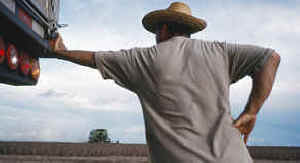 McDonald�s Europe, recognizing it could not guarantee consumers
that the soy used to fatten its chickens was not grown in Amazonian
clear-cuts, called its suppliers with this stark warning: Take
verifiable steps to ensure you are not selling us soy from deforested
land in the Amazon or we will look elsewhere.
McDonald�s Europe, recognizing it could not guarantee consumers
that the soy used to fatten its chickens was not grown in Amazonian
clear-cuts, called its suppliers with this stark warning: Take
verifiable steps to ensure you are not selling us soy from deforested
land in the Amazon or we will look elsewhere.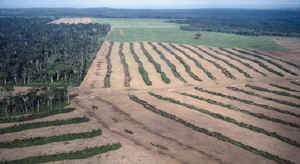


 This site is hosted and maintained by