
|
|
Tropical Forests and Regions |
Articles and Reports: Tropical Forests and Regions
Amazon Fire Wars Exacerbate Global Warmingby Christopher Joyce
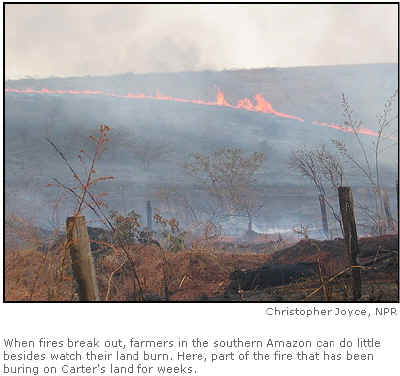
Carter thinks the fire burning on his land and that of his neighbors was deliberately set. The fire has scorched 90 percent of his 22,000 acre ranch. All Things Considered, November 5, 2007 � In Brazil, it's the end of the burning season, when people use fire to clear land for farms and ranches. But people also use fire as a weapon in range wars to push others off their land. Scientists say this fire cycle is not just destroying parts of the Amazon's southern forests, but altering the climate as well.
John Carter is in the middle of one of these range wars. He's an American who has adopted Brazil as his home. He's equally comfortable on a horse or in the cockpit of his Cessna three-seat airplane. At the moment, he's flying above the southern edge the Amazon forest over his cattle ranch, Esperanza. "On a normal year, you fly (during) the burning season, you can't see a kilometer on either side of you," Carter says. "You can't see ground underneath, the smoke goes up to 10,000 or 15,000 feet. It's a blanket of smoke that covers the Amazon, it's unbelievable." Burning Duels It's common in the frontier here for squatters or land grabbers to set fire to land to force owners off, especially when land title is in dispute. If they can show the owners aren't developing that land in the first place, it's theirs.
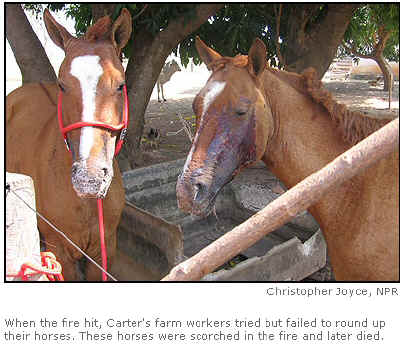
Sometimes these fires rage out of control. Carter says squatters set fire to his neighbor's ranch and it spread to his. Now, his pastures and forests are a blackened wasteland. Carter learned cattle ranching in his native Texas. He was a paratrooper in the first Iraq war, then married a Brazilian and came here. His ranch covers 22,000 acres. He says more than 90 percent of it has just burned. And fires are still consuming what's left. Carter's ranch hands managed to save his farmhouse. Among them was Sebastian Fonseca dos Santos, who fought the fire for days. Dos Santos says the fire was huge and brutal. It came over a hill and crossed a swamp, heading for the main house. Dos Santos used bulldozers to clear around the house so it wouldn't burn down. Lasting Effects Carter isn't the only victim of these burning duels. These fires put millions of tons of carbon into the atmosphere, which makes global warming worse. They're also drying up the Amazon. Carter wants to protect Amazon forests and started a local environmental group to do so. But for the moment, climate change isn't high on his worry list. He's angry. He loads a pistol and sticks it in a backpack and drives out to see the damage.
Dark plumes of smoke punctuate the horizon like exclamation points. We park and walk down a dirt track. We're with Dan Nepstad, a colleague of Carter's who is a fire ecologist with the Woods Hole Research Center in Massachusetts. Nepstad cautiously approaches a column of flame that's climbing a bank of trees. He calls it a "chimney." Chimneys happen when the fire moves along the forest floor and reaches a standing dead tree with some vines. The fire climbs up the tree and into the forest canopy. There's a lot of carbon going up into the atmosphere from fires like this one. And the climate damage doesn't stop when the flames die out. "Once the fire moves through this forest, those trees die and begin to decompose," Nepstad says, releasing even more carbon into the atmosphere. Around the world, deforestation contributes about one-fifth of all the greenhouse gases that are warming the planet. Most of Carter's cattle have scattered in the fire. He spots a calf that's been separated from its mother and he drives after it. He leaps from the moving truck and runs after the calf through the smoldering forest. Carter gets catches the calf, ropes its legs with a few turns and loads it into the back of his jeep. Carter says his property has been burned three times over the last several years. For him, this is a personal battle � to hold onto his ranch. But he says he can't do it alone. He's trying to make alliances with his fellow ranchers. "The only way we've seen to really fight this is work with other landowners and have a good neighbor policy, where you talk to people," he says. "One ranch sends over his firefighting equipment, that's the best way to do it." Otherwise, he says, much of the Amazon will burn. And with billions of tons of carbon in that giant forest, the climate will know the difference. |
Return to:Articles and Reports
Return to:Tropical Forests and Regions
Return to:Home Page
Your Comments and Inquiries are Welcome

Fair Use Notice: This document may contain copyrighted material whose use has not been specifically authorized by the copyright owners. We believe that this not-for-profit, educational use on the Web constitutes a fair use of the copyrighted material (as provided for in section 107 of the US Copyright Law). If you wish to use this copyrighted material for purposes of your own that go beyond fair use, you must obtain permission from the copyright owner.
|
Since
|



 This site is hosted and maintained by