
|
|
Tropical Forests and Regions |
Articles and Reports: Tropical Forests and Regions
Tropical Forests Must Be Protected, Indonesian Minister SaysBy eNews 2.0 Staff
Indonesia expected an international agreement which would create incentives for sustainable forest management via market mechanisms, Malam Sambat Kaban said in Nusa Dua. Indonesia and other countries with tropical forests have been pressing for financial rewards to protect the woodlands. The clearing of tropical forests contributes 20 per cent of annual greenhouse gas emissions. A reduction of emissions had to be more lucrative than the commercial use of forests by cattle breeders, plantation owners or paper combines, it was argued. The Bali conference discusses whether countries which protect their tropical forests could in exchange get emission certificates, which could then be bought by producers of greenhouse gases who have to reduce their emissions. A reduction of emissions caused by deforestation and damage to forests had to be part of the climate agreement that would come into force after the Kyoto protocol, the minister said. As a first answer to the minister's call, the Global Environment Facility (GEF) - the world's largest environmental funding body - said Saturday it plans to launch tropical forest account initiative to stop deforestaion to help safeguard forest ecosystem for protected areas and for sustainable forest management. "The window to save the last remaining functioning expanses of tropical forests, which are responsible for the delivery of crucial global environmental services, is closing fast," said GEF chairwoman Monique Barbut. "GEF is teaming up with its partner agencies, governments, business and civil society to address this challenge head on. GEF's investments are also expected to encourage more robust financing from private investors looking to build environmentally-friendly forest markets." Tropical deforestation is on the rise, and is now responsible for over 20 percent of global CO2 emissions. The fate of tropical forests is also intimately tied to the future of biodiversity, as these forests harbour over one half of all global biodiversity. The so-called Tropical Forest Account Initiative would fund projects to stop deforestation in 17 countries of the Amazon, Congo Basin, New Guinea and Borneo, arguing that action is need as threats mount for the tropical forests in these areas. Habitat loss in tropical forests threatens 74 per cent of endangered mammals, 44 per cent of endangered birds, 57 per cent of endangered amphibians, and 67 per cent of endangered reptiles, the group said. Each of the GEF-targeted areas has over 8 million hectares of wet broadleaf forests, and they collectively harbour an astonishing 54 per cent of tropical forest cover and 68 per cent of tropical forest carbon. More than 70 per cent of the forest remains intact, but man- made threats are mounting quickly. By focusing on large, intact tropical forest, the GEF can invest in relatively low cost, proactive ways to prevent deforestation in countries where forest cover is high. Intervening in these areas now is much more cost effective than trying to reverse damage in already deforested areas. "GEF's investment will fund the strengthening and sustainable financing of protected area networks, the introduction of effective policy and regulatory frameworks for mainstreaming forest conservation in development sectors, and also the fostering of markets for forest goods and services," Barbut said. The GEF values the role that tropical forests play in providing global and local environmental benefits. In addition to conserving global biodiversity, and providing spiritual and cultural havens for local and remote populations, these forests are vital for sustainable development in each and all of these countries. The GEF is a 178 member-strong international financing body devoted to global environmental issues that support sustainable development. GEF grants flow to projects in developing countries related to biodiversity, climate change, international waters, land degradation, the ozone layer and persistent organic pollutants. Since 1991, GEF has achieved a strong track record with developing countries and countries with economies in transition, providing 7.4 billion dollars in grants and leveraging 28 billion dollars in co- financing for over 1,800 projects in over 150 countries. Through its Small Grants Programme (SGP), GEF has also made more than
7,000 small grants, up to 50,000 dollars each, directly to
nongovernmental organizations and community organizations. |
Return to:Articles and Reports
Return to:Tropical Forests and Regions
Return to:Home Page
Your Comments and Inquiries are Welcome

Fair Use Notice: This document may contain copyrighted material whose use has not been specifically authorized by the copyright owners. We believe that this not-for-profit, educational use on the Web constitutes a fair use of the copyrighted material (as provided for in section 107 of the US Copyright Law). If you wish to use this copyrighted material for purposes of your own that go beyond fair use, you must obtain permission from the copyright owner.
|
Since
|
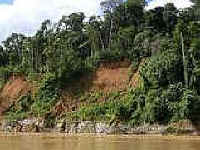 The Indonesian forest minister called for an international
recognition for the protection of tropical forests, on the Forest Day of
the UN Climate Change Conference in Bali on Saturday.
The Indonesian forest minister called for an international
recognition for the protection of tropical forests, on the Forest Day of
the UN Climate Change Conference in Bali on Saturday.
 This site is hosted and maintained by