
|
|
Tropical Forests and Regions |
Articles and Reports: Tropical Forests and Regions
Biofuels are worsening global warmingRhett Butler, mongabay.com Converting native ecosystems for production of biofuel feed stocks is worsening the greenhouse gas emissions they are intended to mitigate, reports a pair of studies published in the journal Science. The studies follow a series of reports that have linked ethanol and biodiesel production to increased carbon dioxide emissions, destruction of biodiverse forest and savanna habitats, and air and water pollution. Analyzing the lifecycle emissions from biofuels, the first study found that carbon released by converting rainforests, peatlands, savannas, or grasslands often far outweighs the carbon savings from biofuels. Conversion of peatland rainforests for oil palm plantations for example, incurs a "carbon debt" of 423 years in Indonesia and Malaysia, while the carbon emission from clearing Amazon rainforest for soybeans takes 319 years of renewable soy biodiesel before the land can begin to lower greenhouse gas levels and mitigate global warming.
"This research examines the conversion of land for biofuels and asks the question 'Is it worth it"'," said lead author Joe Fargione, a scientist for The Nature Conservancy. "The answer is no." "These natural areas store a lot of carbon, so converting them to croplands results in tons of carbon emitted into the atmosphere." Fargione continued, "We analyzed all the benefits of using biofuels as alternatives to oil, but we found that the benefits fall far short of the carbon losses. It's what we call 'the carbon debt.' If you're trying to mitigate global warming, it simply does not make sense to convert land for biofuels production. All the biofuels we use now cause habitat destruction, either directly or indirectly. Global agriculture is already producing food for six billion people. Producing food-based biofuel, too, will require that still more land be converted to agriculture." U.S. ethanol worsens global warming While a number of studies have shown that conversion of tropical ecosystems, including peat swamps in Southeast Asia and rainforests and grasslands in South America, for energy crops result in net emissions, the second study shows that when assessed at a global level, U.S. corn ethanol is also a major CO2 source � not a CO2 sink as usually claimed by the farm industry. "Using a worldwide agricultural model to estimate emissions from land use change, we found that corn-based ethanol, instead of producing a 20% savings, nearly doubles greenhouse emissions over 30 years and increases greenhouse gasses for 167 years," write the authors. Their assessment is based on the additional land that needs to be converted abroad as a result of increased corn acreage planted for ethanol production in the United States.
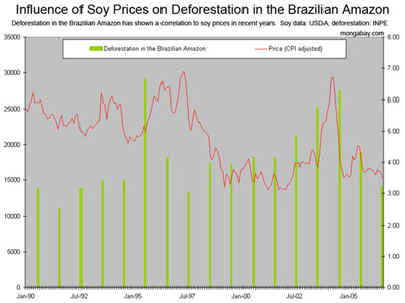
"To produce biofuels, farmers can directly plow up more forest or grassland, which releases to the atmosphere much of the carbon previously stored in plants and soils through decomposition or fire," write the authors. "The loss of maturing forests and grasslands also forgoes ongoing carbon sequestration as plants grow each year, and this foregone sequestration is the equivalent of additional emissions. Alternatively, farmers can divert existing crops or croplands into biofuels, which causes similar emissions indirectly. The diversion triggers higher crop prices, and farmers around the world respond by clearing more forest and grassland to replace crops for feed and food. Studies have confirmed that higher soybean prices accelerate clearing of Brazilian rainforest." In particular, the authors � including researchers from Princeton University, Agricultural Conservation Economics, the Woods Hole Research Center, and Iowa State University � say that U.S. corn ethanol production is having a global effect. As U.S. corn exports declined sharply, production picks up in other countries where yields are lower, requiring conversion of more land for production, and driving global grain prices even higher. Misplaced incentives The researchers say the current system has misplaced incentives: farmers are rewarded for the amount of biofuel produced while the resulting carbon emissions are ignored. "We don't have proper incentives in place because landowners are rewarded for producing palm oil and other products but not rewarded for carbon management," said University of Minnesota Applied Economics professor Stephen Polasky, a co-author of the study. "This creates incentives for excessive land clearing and can result in large increases in carbon emissions. Creating some sort of incentive for carbon sequestration, or penalty for carbon emissions, from land use is vital if we are serious about addressing this problem."
Still the authors say that some biofuels do not contribute carbon emissions to the atmosphere because they do not require clearing of native vegetation. These include fuels produced from agricultural waste, weedy grasses, and woody biomass grown on lands unsuitable for conventional crops. "Biofuels made on perennial crops grown on degraded land that is no longer useful for growing food crops may actually help us fight global warming," said University of Minnesota researcher Jason Hill, a co-author. "One example is ethanol made from diverse mixtures of native prairie plants. Minnesota is well poised in this respect." The researches recommend that the full environmental impact of biofuel production be evaluated when making decisions on energy sources. "In finding solutions to climate change, we must ensure that the cure is not worse than the disease," noted Jimmie Powell, who leads the energy team at The Nature Conservancy. "We cannot afford to ignore the consequences of converting land for biofuels. Doing so means we might unintentionally promote fuel alternatives that are worse than fossil fuels they are designed to replace. These findings should be incorporated into carbon emissions policy going forward." "We will need to implement many approaches simultaneously to solve climate change. There is no silver bullet, but there are many silver BBs," said Fargione. "Some biofuels may be one silver BB, but only if produced without requiring additional land to be converted from native habitats to agriculture." References Emissions From Land Use Change. Science, Feb 8, 2008. |
Return to:Articles and Reports
Return to:Tropical Forests and Regions
Return to:Home Page
Your Comments and Inquiries are Welcome

Fair Use Notice: This document may contain copyrighted material whose use has not been specifically authorized by the copyright owners. We believe that this not-for-profit, educational use on the Web constitutes a fair use of the copyrighted material (as provided for in section 107 of the US Copyright Law). If you wish to use this copyrighted material for purposes of your own that go beyond fair use, you must obtain permission from the copyright owner.
|
Since
|


 This site is hosted and maintained by