Animals in Labs Article used with permission from All-Creatures.org
Ed Boks interviews Delcianna Winders, one of the nation’s foremost authorities on animal law and policy.
Codifying Compassion: Delcianna Winders and the Legal Fight for Animal Justice
From Ed Boks, Animal Politics with Ed Boks, AnimalPolitics.substack.com
May 2025
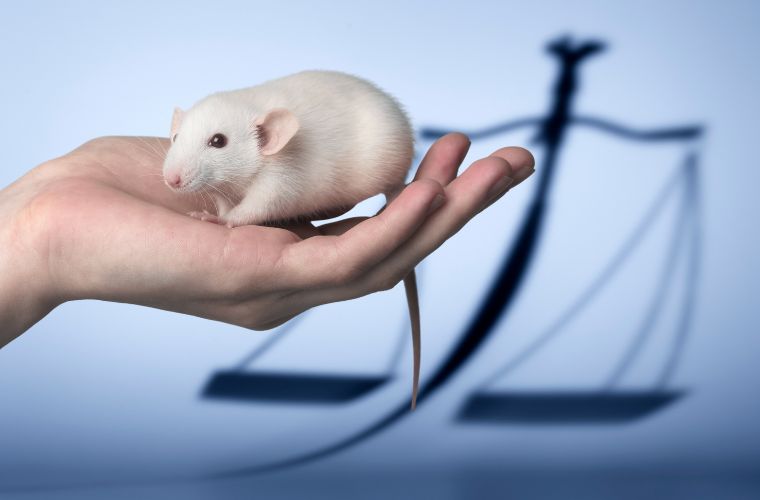
Images from Canva
Introduction
Animal experimentation is once again in the national spotlight following the recent Harvard research animal euthanasia scandal, as detailed in the Animal Politics article, Harvard’s Preventable Crisis: A Research Giant Caught Unprepared. In the wake of this crisis, and amid new federal moves to phase out animal testing, many are asking urgent questions about the hidden realities and systemic failures of animal research in the United States.
To help illuminate these issues, Animal Politics is honored to interview Delcianna “Delci” Winders, one of the nation’s foremost authorities on animal law and policy. Delci is celebrated for her pioneering work in litigation, scholarship, and advocacy on behalf of animals in research, agriculture, the pet trade, and entertainment. She currently serves as Associate Professor of Law and Director of the Animal Law and Policy Institute at Vermont Law and Graduate School, where she leads the fastest-growing animal law program in the world.
Previously, Delci was the founding director of the nation’s first law school clinic dedicated to farmed animal advocacy at Lewis & Clark Law School. She also served as Vice President and Deputy General Counsel at the PETA Foundation and was the inaugural Academic Fellow at Harvard’s Animal Law & Policy Program.
Her legal scholarship has appeared in top journals including the NYU Law Review, Ohio State Law Journal, and Animal Law Review, and her commentary is frequently featured in major media outlets such as National Geographic, Newsweek, and USA Today. Named one of “Six Women Who Dare” by O, The Oprah Magazine, Delci is a sought-after commentator and the recent recipient of the American Bar Association’s Excellence in the Advancement of Animal Law Award.
Delci’s career is defined by a relentless commitment to advancing animals’ legal status and training the next generation of advocates. Her voice is essential in the evolving conversation around animal experimentation and the broader fight for animal protection.
In this interview, Delci draws on her deep expertise to address the ethical, legal, and practical dimensions of animal experimentation, offering critical insights into why these issues matter now more than ever, and what meaningful reform could look like.
Interview with Delcianna (Delci) Winders
Animal Politics: What initially inspired your commitment to animal law and advocacy?
Delci: Like many kids, I loved animals—but at some point, we're taught to disassociate that love from how animals are used for food, clothing, and more. When I was about fourteen, I was gifted two baby pigs. I bottle-fed them, kept them in my bedroom and then in our suburban backyard. They were my companions. One day, without warning, they were gone—slaughtered. That moment changed me. I went to the library and read everything I could on animal welfare, animal rights, and factory farming. From then on, I was an animal advocate.
Animal Politics: After reading the “Harvard’s Preventable Crisis” article, what perspective do you feel is missing from the public conversation about animal experimentation?
Delci: It’s important to remember that animals used in experimentation—at Harvard and across the country—are almost always destined for euthanasia. Of course they deserve to go to reputable sanctuaries. But the reality is, no number of sanctuaries could absorb the staggering volume of animals used in research. Harvard alone experiments on thousands of animals every year.
These animals suffer unspeakable torment. There is no legal limit to what can be done to animals in the name of research. At Harvard, for instance, baby monkeys have been torn from their mothers, had their eyes sewn shut, and later had their brains dissected. Frankly, I would rather be euthanized than endure that.
This isn’t just a funding issue—it’s a moral one. With the federal government’s recent commitment to phasing out animal testing in favor of human-relevant research, we have a real opportunity to ensure that the generation of animals currently in labs is the last.
Animal Politics: How would you describe the current state of animal experimentation in the United States, both scientifically and ethically?
Delci: Much of it is scientifically dubious and ethically indefensible. Over 100 million vertebrate animals—and countless invertebrates—are subjected to experiments in the U.S. each year. Most aren’t even covered by the Animal Welfare Act (AWA), which excludes rats and mice bred for research, and so-called "cold-blooded" animals. There are no legal limits on what can be done to them—no harm-benefit analysis, no required ethical review, and no prohibition against repeating already completed studies.
Worse still, these experiments rarely deliver. Over 92% of drugs that pass animal testing fail in human trials. Because of profound biological differences between species, results often don’t translate. What works in nonhuman animals frequently doesn’t work in humans—or worse, causes harm.
Animal Politics: What are the most significant legal protections for animals used in research, and where do you see the greatest gaps?
Delci: Invertebrate animals have no legal protections, despite growing evidence of their sentience and intelligence. Octopuses, for example, are capable of learning, problem-solving, and even using tools—yet they’re unprotected under U.S. law.
Rats, mice, and birds bred for research, along with all "cold-blooded" animals—fish, amphibians, reptiles, etc.—are excluded from the Animal Welfare Act. In privately funded research, they receive no protection at all. In federally funded experiments—despite the U.S. being the world’s largest funder—the Health Research Extension Act only calls for compliance with weak guidelines that don’t govern research methods and relies on self-policing. Institutions are supposed to self-report violations. Even when problems are acknowledged, consequences are minimal. A recent study found that agencies are largely deferential, often imposing no more than token measures like remedial training, allowing repeat violations to go unchecked.
As for the AWA itself, it applies only to warm-blooded animals other than rats, mice, and birds bred for research. Its standards are minimal and rarely enforced. Inspections are infrequent. Even egregious violations often result only in warnings. Just last month, Oregon Health & Science University—home to one of seven national primate centers—received its fourth warning after repeated primate deaths. On the rare occasions when fines are levied, they’re so heavily discounted that even the agency admits that labs treat them as a “cost of doing business.”
While the AWA explicitly allows stronger state and local laws, most governments have deferred to federal oversight. Only once has a researcher been convicted under a state cruelty law—and that was overturned. But things are starting to change. Some states and cities are now requiring post-experiment sanctuary placement, increasing oversight, or banning the sale of cosmetics tested on animals. There’s enormous potential for state and local leadership to fill the federal vacuum.
Animal Politics: The Animal Welfare Act excludes purpose-bred mice and rats from its protections. What are the implications of this omission?
Delci: The implications are staggering—and largely invisible by design. Rats and mice are intelligent, playful, and emotionally sensitive; rats even enjoy being tickled. Yet because they’re excluded from the Animal Welfare Act, there’s no legal obligation to track their use or consider their welfare. As a result, we don’t even know how many are experimented on annually. The best estimate is 111.5 million. That’s an unimaginable scale of unregulated, unreported suffering—all happening entirely out of public view.
Animal Politics: In your view, why does animal experimentation persist despite the availability of alternative methods?
Delci: One major reason is federal funding. The U.S. government remains the largest funder of animal experimentation worldwide. But that’s beginning to shift. Federal funding for animal research has been steadily declining, and the National Institutes of Health recently launched a groundbreaking initiative to reduce animal use and invest in innovative, human-based science.
The new Office of Research Innovation, Validation, and Application will drive this transition by scaling non-animal methods, expanding training and funding, addressing bias toward animal studies in grant reviews, and tracking progress publicly. Similar efforts are underway at the Food and Drug Administration (FDA) and the Environmental Protection Agency (EPA). The momentum is finally shifting toward science that better reflects human biology—and ethics.
Animal Politics: How transparent are research institutions about what happens to animals during and after experiments?
Delci: There is virtually no transparency. For the small subset of animals covered by the Animal Welfare Act—warm-blooded animals excluding purpose-bred rats, mice, and birds—facilities must file annual reports listing numbers used, by species, and how many endured unmitigated pain or distress. But beyond those figures, the public gets no meaningful information about experiments. The details of what these animals endure, and what happens to them once they’re no longer “useful,” are kept behind closed doors. Most of the animals are simply killed.
Animal Politics: What happens to lab animals when research projects are abruptly ended or funding is cut?
Delci: There are no laws that explicitly govern this. The Animal Welfare Act requires facilities to have contingency plans for emergencies or disasters, but those focus on foreseeable events. Abrupt project cancellations or funding cuts aren’t meaningfully addressed and historically haven’t been a significant issue. In light of recent developments, however, going forward, any facility using animals in research should be required to plan for these eventualities.
Animal Politics: What role do Institutional Animal Care and Use Committees (IACUCs) play, and are they effective in protecting animals?
Delci: IACUCs are self-regulating bodies—and self-regulation consistently fails as a substitute for real oversight. They’re supposed to oversee animal care, inspect facilities, investigate concerns, and review proposed experiments. But they’re largely made up of animal experimenters employed by the very institutions they’re supposed oversee—some even have financial incentives. With only one unaffiliated member required by law, these committees often function as rubber stamps.
Animal Politics: How can animal law be leveraged to increase accountability and transparency in research institutions?
Delci: There’s enormous potential. A recent poll found that 85% of Americans support phasing out animal experimentation in favor of modern methods. Even among those who still support it, most want strict oversight. But there’s a wide gap between public opinion and the law. Our laws—federal, state, and local—need to catch up with both science and ethics. The biggest opportunities lie in defunding animal research and banning it in specific contexts, like for cosmetics, or on dogs (nearly 50,000 used annually) and primates (over 100,000 each year).
Animal Politics: What is your assessment of the FDA’s and EPA’s recent moves to phase out certain animal tests?
Delci: The FDA’s new plan to reduce animal testing in favor of human-relevant methods is a win all around. It’s better for animals, and it means drugs will be developed more quickly and will be cheaper and more reliable.
Congress also amended the Toxic Substances Control Act to push the EPA toward non-animal methods. Under Trump, the EPA pledged to cut mammal testing 30% by 2025 and eliminate it entirely by 2035. But the Biden administration quietly scrapped those targets, and, despite rumors, the EPA hasn’t yet recommitted. But EPA Administrator Lee Zeldin previously fought to end cat and dog testing at U.S. Department of Veterans Affairs (VA), so there’s reason for cautious optimism—which is good news for the estimated 20,000 to 100,000 vertebrates used in U.S. toxicology testing each year.
Animal Politics: How do you envision the future of animal law and policy in the context of scientific research?
Delci: I’m confident we’re headed toward a future where billions in taxpayer dollars are no longer spent experimenting on millions of animals each year—and the private sector will follow. The only question is how soon. That’s where the law comes in.
Federal oversight of animal experimentation has always been weak—and may get worse—but funding agencies are shifting their priorities, and Congress can speed that up, especially through appropriations.
States also have a crucial role to play, and many are stepping up. Twelve have banned the sale of animal-tested cosmetics. Virginia now requires public research institutions to consider sanctuary placement for primates and mandates transparency from publicly funded labs. More states should follow suit—and go further.
Animal Politics: What advice do you have for students and young professionals who want to make a difference in animal law?
Delci: First, know that this is a viable career path. When I entered law school with the goal of practicing animal law, I was told—even by well-meaning mentors—that it wasn’t a real field. Nearly 20 years later, it’s the only area of law I’ve practiced.
At the Animal Law and Policy Institute at Vermont Law and Graduate School, we’re working to make it easier for the next generation of animal advocates. We offer a range of online, in-person, and hybrid degree programs—including a J.D. with an animal law concentration and a master of public policy focused on animal protection.
Our courses are also open for auditing, including a rich slate of summer offerings like Animal Undercover Investigations and Animal Welfare Science and Ethics. We’ll soon launch a micro-credential program as well. We welcome anyone seeking guidance on their path in animal law and policy to reach out.
Animal Politics: What role do public opinion and advocacy play in shaping research policy and practice?
Delci: Public opinion is powerful—it drives the conversation and puts pressure on institutions. But it’s advocacy that transforms that sentiment into law. Without advocacy, public support remains just that: support. With it, we can achieve lasting, enforceable change.
Animal Politics: Is there a particular case or campaign from your career that you believe exemplifies the challenges and possibilities in this field?
Delci: One that stays with me is the story of Nosey the elephant. Taken from Zimbabwe as a baby after witnessing her family's slaughter in a government cull, she spent decades alone in a traveling circus with a long record of abuse and neglect. Despite her serious untreated medical issues, federal and state agencies repeatedly failed her. I dedicated years to advocating for her, even hiring a former student to help full time. But because she was in a new town nearly every day, enforcement was elusive.
Then, on my anniversary, I got a call: Nosey was chained on the roadside in Alabama and local officials were ready to act. I skipped dinner, flew out overnight, and with expert witnesses by my side, attended a hearing where a judge ordered Nosey's transfer to sanctuary. I had the privilege of accompanying her to The Elephant Sanctuary in Tennessee, where she now thrives with other elephants and finally receives proper care.
And as fate would have it, during that journey, I met a stray dog outside a gas station who had been living there for weeks. She’s now my dog Lovey—snoring behind me as I type this.
Nosey’s story is about perseverance, but it’s also a reminder: the chance to help an animal can appear anywhere, anytime—and you have to be ready to seize it.
Animal Politics: Looking ahead, what gives you the most hope for the future of animals in our legal and policy systems?
Delci: My students give me tremendous hope. They arrive with a mission to help animals, and after graduating, they go out and do exactly that. It’s incredibly rewarding to see a growing community of advocates I’ve helped train now working across the country—and even more gratifying to watch some of them begin training the next generation themselves. I often liken it to a football coaching tree.
I also take heart in the progress I’ve witnessed over the course of my career. When I started, dozens of elephants were still being hauled across the country to perform in circuses, bears were confined to barren concrete pits, and chimpanzees lived in solitary confinement. Today, those practices are nearly extinct. While a few animals still endure such conditions and we must continue to fight for them, I believe these inhumane and outdated practices will soon be consigned to history.
Tiger cub petting is another example. Less than a decade ago, it was widespread—fueling a constant cycle of breeding and abandonment. Today, it's illegal, and many of the facilities that profited from it have shuttered. Nearly one-third of U.S. states have banned at least one form of cruel intensive confinement in industrial agriculture. Over 500 localities—and eight states—have banned the retail sale of dogs, and often other animals, sourced from mills.
And then there’s the growing momentum on animal experimentation reform, which I discussed earlier. We’ve made significant gains—and we’re only getting started.
Closing Comment from Animal Politics:
Animal Politics: Through this conversation with Delcianna Winders, we’ve gained a deeper understanding of how legal strategy, policy reform, and public advocacy converge to protect animals—especially those historically overlooked in laboratories, circuses, and other institutions. Her work underscores the power of persistence, the critical importance of codifying compassion into law, and the real-world impact one person can have when the law is wielded with purpose.
From landmark legislative victories to the unforgettable rescue of Nosey the elephant, Delci reminds us that meaningful change is not only possible—it is already underway.
- You can contact Delci at: [email protected]. You can also connect with her on Bluesky, Instagram, LinkedIn, and X.
- You can learn more about Delci and her programs at: vermontlaw.edu/animallaw. You can also connect with the Vermont Law and Graduate School Animal Law and Policy Institute on Instagram and LinkedIn.
Posted on All-Creatures.org: May 22, 2025
Return to Animals in Labs
Follow us on:


- Home Page
- What's New
- Contact Us
- Action Alerts
- Animal Exploitation
- Animal Issues
- Animal Rights Activism
- Archives
- Art & Photography
- Articles Directory
- Bible
- Bible Commentary Blog
- Books
- Campaigns
- Church & Religion
- Discussions
- Events / Podcasts / Media
- Health
- Hosted Web Sites
- Humor
- Kids' Korner
- Letters
- Links
- Nature Studies
- Newsletter
- Poetry & Stories
- Prayers
- Quotations
- Recipes with Photos
- Recipes Without Photos
- Sermons
- Stop Cruelty in Churches
- Video Library
- The Mary T. and Frank L. Hoffman Family Foundation
- Email: [email protected]
A web site sponsored by The Mary T. and Frank L. Hoffman Family Foundation and all-creatures.org
Copyright © 1998-2026 The Mary T. and Frank L. Hoffman Family Foundation. All rights reserved. May be copied only for personal use or by not-for-profit organizations to promote compassionate and responsible living. All copied and reprinted material must contain proper credits and web site link www.all-creatures.org.
Fair Use Notice: This document, and others on our web site, may contain copyrighted material whose use has not been specifically authorized by the copyright owners. We believe that this not-for-profit, educational use on the Web constitutes a fair use of the copyrighted material (as provided for in section 107 of the US Copyright Law). If you wish to use this copyrighted material for purposes of your own that go beyond fair use, you must obtain permission from the copyright owner.
Thank you for visiting all-creatures.org.
