Animals in Labs Article used with permission from All-Creatures.org
Last Chance for Animals provides details from their undercover investigation of a research laboratory at York University where experiments are conducted on primates. Their findings paint a chilling picture of the extreme suffering endured by the macaques imprisoned there.
Legacy of Cruelty: LCA Releases Investigation Into Primate Research at York U
From LCA Last Chance for Animals, LCAnimal.org/StopYorkPrimateResearch.com
May 2026
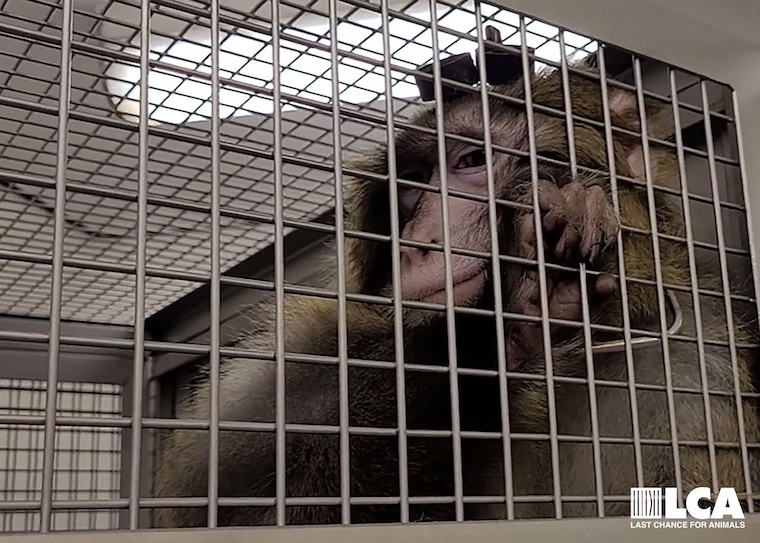
Kenny Gripping Cage Bars, LCA Investigation Photo
Released April 30, 2026
LCA Exposes the Cruelty of Primate Research at Canada's York University
Toronto, Ontario, Canada – A newly released undercover investigation by LCA exposes the suffering of nine rhesus macaques used in neuroscience research studies at York University in Toronto. For nine months, from 8/2024 to 5/2025, LCA’s investigator worked as a Laboratory Animal Attendant at York and provided care to the macaques. LCA’s investigation marks the first-ever undercover investigation released by an animal rights group into animal research at a Canadian university.
The footage from the investigation shows macaques suffering from cranial implants, restraint collars, social isolation, and water deprivation.
The Investigative Journalism Bureau (IJB) released an exclusive article on 4/30/2026 on this investigation.
CLICK HERE TO READ THE ARTICLE
Watch the Investigation Now ↓
Year After Year of Experiments
The Nine Macaques Hidden at York University
LCA’s investigator worked with nine macaques held in York University’s Behavioral Sciences building. All of the macaques were involved in neuroscience (brain/vision) research under Professor Doug Crawford and Assistant Professor Kohitij Kar. There were four males, Bento, Kenning (aka Kenny), Magneto, and Monkey Do (aka Do), and five females, Hannah, Liesl, Mini-Sass, Olivia, and Virginia.
According to records examined by LCA, Hannah, Liesl, Mini-Sass, Olivia, Virginia, and Do arrived in 2009 from World Wide Primates, a Florida-based supplier of primates laboratories, and the remaining three arrived as follows: Kenny in 2015 from Western University in Ontario, Bento in 2023 originated from the California National Primate Research Center (CNPRC) at UC Davis, and Magneto in 2023 originated from Harvard’s New England Primate Research Center (NEPRC).
[Click here for more information about each macaque.]
Undercover footage showed the macaques had headposts and chamber implants. According to a National Institute of Health paper, chamber implants have removable plugs that allow researchers to directly access the brain. The headposts are typically attached to the macaques’ skulls by peeling back their skin, drilling into the skull, and using bone screws to secure the posts. The headpost is used to keep the macaques still during the research studies.
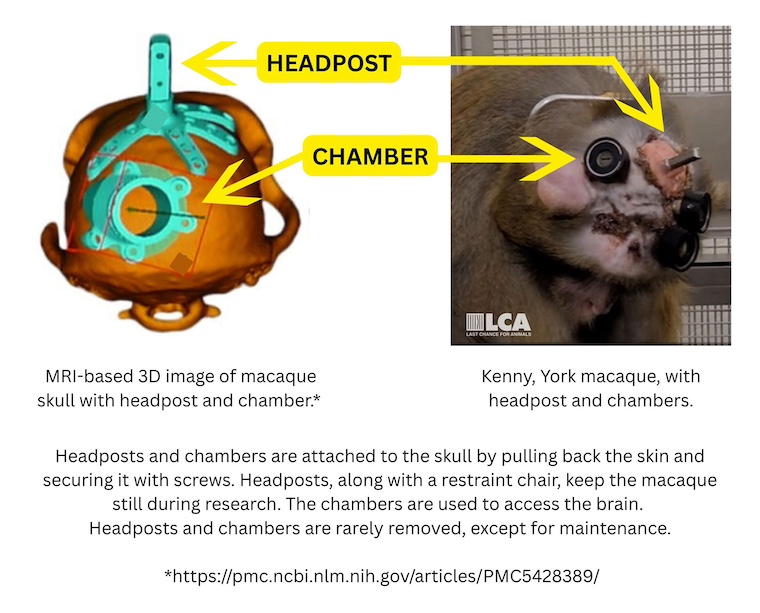
Image from Last Chance for Animals
All of the macaques wore permanent restraint collars. Typically, a restraint collar and a pole are used to move macaques from their cages into the restraint chair for research. Restraint collars have been used by the scientific community since the 1980s to handle primates.
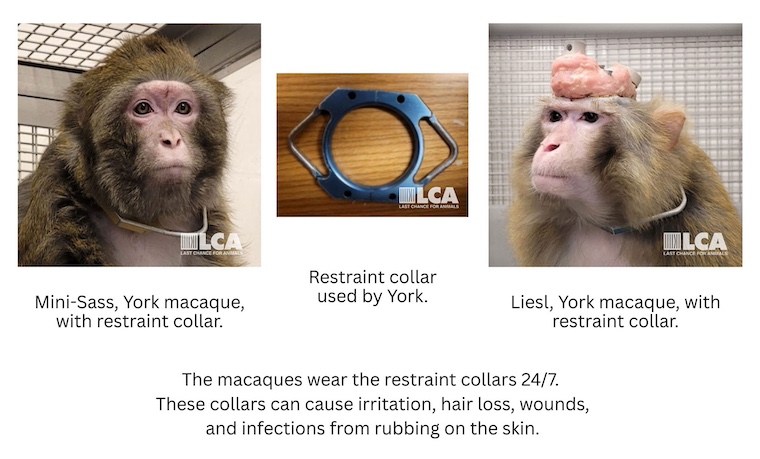
Image from Last Chance for Animals
What We Found
LCA's Investigation Documented:
- Macaques living in small, barren cages are unable to exhibit natural behaviors.
- Macaques with visible brain implants, some of which were encrusted with blood. Kenny was seen picking at his implant and eventually pulled it out.
- Macaques exhibiting stereotypic behaviors: pacing in their cages, swaying back and forth, overgrooming, and pulling out their hair.
- Seven of the nine macaques were housed alone.
- All macaques were observed wearing restraint collars around their necks.
- Macaques struggling to swallow their food and gripping their restraint collars.
- Macaques suffering from hair loss and/or alopecia.
- Health records for female macaques that underwent multiple eye coil surgeries.
- Liesl suffering from significant vision loss.
- Water restriction as part of the research control parameters. The head primate technician admitted they didn’t think the macaques were getting enough water to prevent dehydration.
- Macaques drinking their own urine, likely due to water deprivation.
- Liesl escaping her cage after an employee failed to properly lock her door. Employees admitted that macaques had previously escaped from their cages, and staff did not know how to handle such situations.
- Olivia, a diabetic macaque, was on water control, even though she was not part of any research.
LCA filed a formal complaint against York University with the Canadian Council on Animal Care (CCAC) on 2/13/2026. Based on the investigation’s findings, LCA believes that York University violated several guidelines for the care of non-human primates. The CCAC responded they are investigating LCA’s complaint.
The CCAC is a non-profit organization that provides national oversight for laboratory animals across Canada and publishes care guidelines for non-human primates. There is no federal Canadian agency that regulates labs, and CCAC certification is voluntary. York is certified with the CCAC.
Warning: Graphic Images
LCA Investigation Photos
[Click here for photographs from the investigation.]
Inadequate Water
Water Control was Routinely Used as a Motivational Tool for the Macaques
Water control is widely used in neuroscience research to motivate macaques in behavioral tasks. LCA confirmed, after examining the macaques’ water records from January 2024 to April 2025, that York used water control. Staff admitted that the amount of water the York macaques received, both in and out of research, depended on how well they cooperated in the studies.
LCA’s investigation documented Bento drinking his own urine, and staff admitted that Do also drank his urine. Per health documents, Kenny appeared to get sick when he was placed on water control. York’s Head Primate Technician admitted Do is thirsty, and says, “Is it enough (water) to keep them from dehydrating? I don’t think so.”
York’s protocols allowed fruit as a water substitute, so the total amount of water given to the macaques included the water amount provided by fruit. For example, water records showed on 1/27/2025, Virginia was allowed 70 ml (⅓ cup) of water, consisting of 60 ml from an apple and 10 ml of water. On 2/6/2025, water records showed Do was allowed 220 ml (1 cup) of water, consisting of 20 ml from a cantaloupe and 200 ml of water.
An expert opinion of LCA’s investigation materials by Dr. Erin Zamzow, DMV, attending Veterinarian, from 2008-2013, for the Chimpanzee Human Communication Institute at Central Washington University, stated, “even if the water content of fruit is taken into account, it does not serve as an adequate substitute for the same portion of water since the process of digesting fruits, especially high fiber fruits, requires water as well.”
Years of Suffering
Health Records Show a Life of Surgeries, Social Isolation and Suffering
Macaques at York had cranial/brain implants. Various types of these implants are visible in photos of the macaques. In some cases, like Liesl’s, the implants were encrusted with blood and other fluids. The implants appeared to cause the macaques discomfort; Kenny was seen repeatedly picking at his implant and eventually pulled it out, leaving a gaping hole in his head. Health records showed infections due to the implants.
According to health records, the macaques, combined, underwent over 80 surgeries. Medical records examined by LCA showed multiple surgeries that included headpost and chamber implants; dura scrape and bone removal; craniotomies and eye coils.
York staff said the eye coils were placed around their eye orbits or in the pockets around their eye to track eye movements. According to health records, the female macaques had eye coil implants; the males did not. York’s head primate technician said a York assistant professor made the eye coils, which were described by York staff as a “sperm with a super long tail.” York staff said the male eye movements were tracked using a different technology from that used for the females. According to health records, both Liesl and Virginia had multiple surgeries to implant eye coils or to repair them. Liesl experienced significant vision loss.
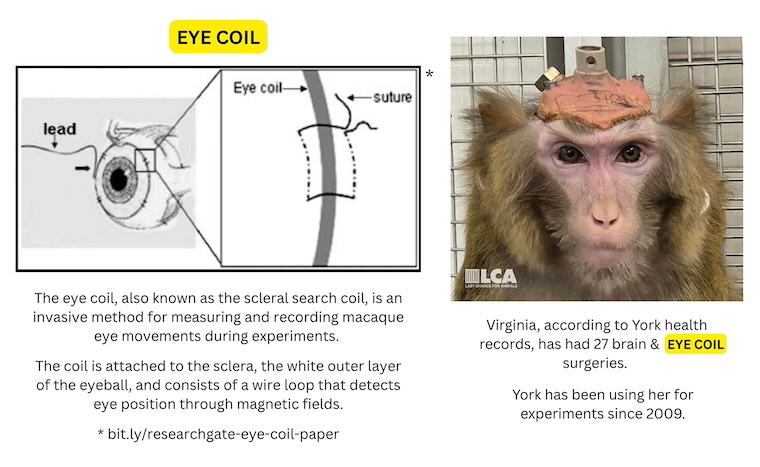
Image from Last Chance for Animals
Like humans, social isolation harms macaques’ physical and mental health. In the wild, macaques live in established social groups. At York, LCA observed most of the macaques housed alone. York compatibility reports, examined by LCA, for Do, Hannah, and Liesl showed they had lived alone for several years. Almost all macaques exhibited stereotypic behaviors of captive animals, including pacing, swaying, overgrooming, and pulling out hair.
“Unreliable and Flawed Results”
Expert Opinions
“The monkeys featured in this investigation present clear evidence of physical and mental distress and suffering. Stress, frustration, trauma, pain, and nutrient deprivation all impact hormones, neurotransmitters, and behavior. From a scientific and data collection standpoint, the husbandry practices that these monkeys are enduring create unreliable and flawed results.”
– Dr. Erin Zamzow, DMV – Attending Veterinarian, from 2008-2013, for the Chimpanzee Human Communication Institute at Central Washington University.
“From the moment we deprive a primate of its social life within a group, we strip it of its very essence. It becomes an animal without social integrity, unable to achieve full psychological development. But, of course, if we add to that isolation the methods of animal experimentation, which disorient the primate even further from its own integrity as an individual, and many of which surely cause pain, then we are not only harming and making primates suffer, but we are also harming our own species. This is what is happening to us, because of the lack of respect for animals, for the other species that share our planet, it is part of the very process of self-destruction that humanity is carrying out.”
– Dr. Luis Flores-Giron, Head Veterinarian – Lwiro Primates Rehabilitation Center, DRC
Big Business, Big Money
York University Researchers aka "Principal Investigators"
According to York’s internal documents and staff, two researchers use the macaques for their neuroscience studies:
John Douglas Crawford is a Principal Investigator or PI
- Responsible for the five female macaques
- Crawford joined York University in 1995
- Crawford’s York University webpage
Kohitij Kar is a Principal Investigator or PI
- Responsible for the four male macaques
- Kar joined York University in 2022
- Kar’s York University webpage *NOTE: Within a week after the investigation release, Kar’s York webpage was deleted for unknown reasons.
An Outdated System
Macaques in Canadian Animal Research
According to the CCAC, 7,826 non-human primates were reportedly used in Canadian research labs in 2024. However, because reporting to the CCAC is voluntary and there is no government-centralized public database, it is impossible to determine the true number of macaques used in Canadian laboratories. Transparency surrounding animal research in Canada remains severely limited. The number of non-human primates in Canadian research has been increasing since 2020. Macaques can live an average of 20-30 years in captivity for research.
Rhesus macaques’ brains are favored for neuroscience studies because of their similarities to human brains. But that similarity also means they are capable of experiencing significant psychological and physical suffering in these environments, just as humans would. LCA believes the suffering of animals for the sake of scientific progress is wrong.
One of the biggest questions in science is how unnatural living conditions imposed on animals held captive in research can alter results. Living in a steel cage with little enrichment, stereotypic behavior, water deprivation, and social isolation is unnatural for macaques. It can thus result in physical and psychological damage, including living with chronic stress. It seems illogical that animals experiencing constant fear, isolation, and deprivation could produce consistent or reliable scientific data.
Animal experimentation is highly profitable, generating hundreds of millions of dollars through research grants, institutional funding, and industry partnerships for research centers and universities such as York. The Centre for Vision Research, of which both Doug Crawford and Kohitij Kar are affiliated, raised over $100 million in its first seven years of operation from 2016 to 2023.
Advances in research technology, shifting ethical standards, and growing public concern over animal research are slowly reshaping how animal research is conducted. But the changes are not coming fast enough for the millions of animals that suffer in research.
If research universities, like York, were to take a strong stance against animal testing, the industry at large would be forced to adopt non-animal testing methods. In the meantime, animals like York’s macaques will continue to pay the price.
Take Action
How You Can Help End Primate Research at York University
LCA is calling for the end of primate research at York University, the surrender of the nine macaques to a sanctuary, and the prioritization of non-animal research methods and funding.
[Click here to take action for the macaques at York University.]
Posted on All-Creatures.org: May 18, 2026
Return to Animals in Labs
Follow us on:


- Home Page
- What's New
- Contact Us
- Action Alerts
- Animal Exploitation
- Animal Issues
- Animal Rights Activism
- Archives
- Art & Photography
- Articles Directory
- Bible
- Bible Commentary Blog
- Books
- Campaigns
- Church & Religion
- Discussions
- Events / Podcasts / Media
- Health
- Hosted Web Sites
- Humor
- Kids' Korner
- Letters
- Links
- Nature Studies
- Newsletter
- Poetry & Stories
- Prayers
- Quotations
- Recipes with Photos
- Recipes Without Photos
- Sermons
- Stop Cruelty in Churches
- Video Library
- The Mary T. and Frank L. Hoffman Family Foundation
- Email: [email protected]
A web site sponsored by The Mary T. and Frank L. Hoffman Family Foundation and all-creatures.org
Copyright © 1998-2026 The Mary T. and Frank L. Hoffman Family Foundation. All rights reserved. May be copied only for personal use or by not-for-profit organizations to promote compassionate and responsible living. All copied and reprinted material must contain proper credits and web site link www.all-creatures.org.
Fair Use Notice: This document, and others on our web site, may contain copyrighted material whose use has not been specifically authorized by the copyright owners. We believe that this not-for-profit, educational use on the Web constitutes a fair use of the copyrighted material (as provided for in section 107 of the US Copyright Law). If you wish to use this copyrighted material for purposes of your own that go beyond fair use, you must obtain permission from the copyright owner.
Thank you for visiting all-creatures.org.
