A Sentience Article from All-Creatures.org
Horses have complex emotions, but interpreting them has proven difficult
From Eric Ralls, Earth.com Staff Writer, as published on
Tuesday's Horse
January 2024
Researchers in England have made a breakthrough in understanding the emotional lives of horses. In a recent study, they have pinpointed distinct facial expressions that differentiate between frustration and disappointment in horses.
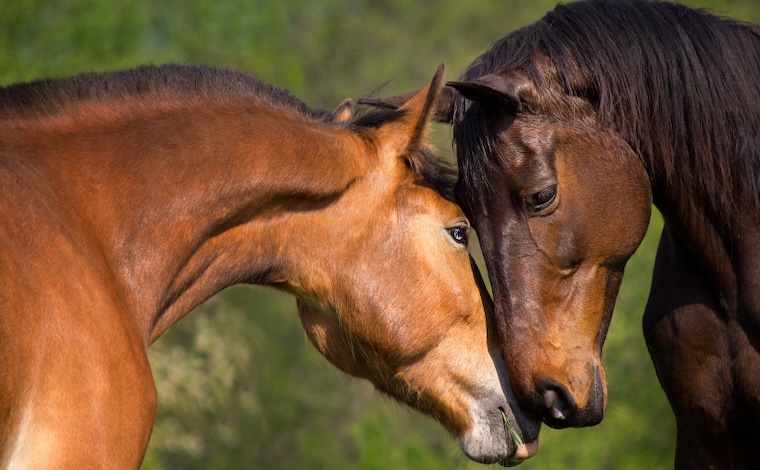
Researchers in England have made a breakthrough in understanding the
emotional lives of horses. In a recent study, they have pinpointed
distinct facial expressions that differentiate between frustration
and disappointment in horses.
The research team is composed of Claire Ricci-Bonot and Daniel Simon
Mills from the University of Lincoln. The study involved a series of
tests that centered on the availability of food as a reward, which
they conducted on a diverse group of 31 horses, aged 2 to 23.
“There is good reason to suppose that horses live in an emotionally
complex world,” the researchers wrote in the journal Applied Animal
Behaviour Science.
Horses have an intricate communication system
According to the researchers, horses are not just social animals.
They also possess an intricate system of communication that involves
subtle visual signals like eye direction, ear position, and,
importantly, facial expressions.
However, the experts noted a prevalent issue: the common
misunderstanding of horses’ negative emotions. Most of the time, the
emotions horses express are misread or overlooked altogether. This
problem is partly because much of our understanding of horse
expressions comes from anecdotes, lacking in scientific evidence.
How the study was conducted
Ricci-Bonot and Mills set out to bring science into this arena. They
trained the horses to anticipate a food reward in a controlled
environment. The food, in the form of pellets, was placed inside a
clear acrylic screen. After a wait of 10 seconds, the screen was
moved back, making the food accessible.
Once the horses had familiarized themselves with this process and
the 10-second wait, the researchers conducted tests under three
different conditions.
The first scenario created anticipation of the reward, considered a
positive emotional state. The second was a frustration phase, where
the horses had to wait for a minute before they could reach the
food. The third stage was a disappointment phase, where the horses
found no food after the wait. The second and third situations were
considered negative emotional states.
To accurately gauge the horses’ reactions, all interactions were
videotaped for later examination. These videos were analyzed using
the Horse Facial Action Coding System (EquiFACS), which objectively
records facial movements based on muscle contractions.
What the researchers learned
While the researchers couldn’t pin down facial markers for
anticipation, they found a set of nine distinct actions that
occurred under the scenarios of frustration and disappointment. When
frustrated, horses often revealed more of the whites of their eyes,
rotated their ears more, and tended to turn their heads to the left
more frequently than when disappointed.
On the other hand, disappointment was characterized by increased
blinking, nostril-lifting, showing the tongue more often, and more
frequent chewing behaviors. These horses also exhibited a tendency
to lick the feeder. Frustration, rather than disappointment,
prompted horses to bite the feeder.
“There is good reason to suppose that horses live in an emotionally
complex world,” the researchers wrote in the journal Applied Animal
Behaviour Science.
Horses have an intricate communication system
According to the researchers, horses are not just social animals.
They also possess an intricate system of communication that involves
subtle visual signals like eye direction, ear position, and,
importantly, facial expressions.
However, the experts noted a prevalent issue: the common
misunderstanding of horses’ negative emotions. Most of the time, the
emotions horses express are misread or overlooked altogether. This
problem is partly because much of our understanding of horse
expressions comes from anecdotes, lacking in scientific evidence.
Gender also plays a role in how horses emote their feelings
In addition, the researchers found a gender difference in the
disappointment phase, with female horses blinking more than their
male counterparts.
According to Ricci-Bonot and Mills, these findings show that
specific facial expressions can potentially help discern a horse’s
emotional state. “The results highlight how there may be different
qualities of a given emotional valence (frustration and
disappointment) which can be distinguished from the facial
expressions shown at the time,” they wrote.
However, the researchers added a note of caution, stating that these
results might only be applicable in feeding situations, underlining
the need for further research. Another question raised by their
study is whether the anticipation of food is truly a positive event
for horses, as they were unable to identify facial markers for this
state.
The study marks a significant stride in understanding horse
emotions, and their research could open the door to improving our
interactions and overall relationship with these remarkable animals.
Return to Sentience Articles
Read more at Articles Reflecting a Vegan Lifestyle
Read more at Animal Rights/Vegan Activist Strategies
Follow us on:


- Home Page
- What's New
- Contact Us
- Action Alerts
- Animal Exploitation
- Animal Issues
- Animal Rights Activism
- Archives
- Art & Photography
- Articles Directory
- Bible
- Bible Commentary Blog
- Books
- Campaigns
- Church & Religion
- Discussions
- Events / Podcasts / Media
- Health
- Hosted Web Sites
- Humor
- Kids' Korner
- Letters
- Links
- Nature Studies
- Newsletter
- Poetry & Stories
- Prayers
- Quotations
- Recipes with Photos
- Recipes Without Photos
- Sermons
- Stop Cruelty in Churches
- Video Library
- The Mary T. and Frank L. Hoffman Family Foundation
- Email: [email protected]
A web site sponsored by The Mary T. and Frank L. Hoffman Family Foundation and all-creatures.org
Copyright © 1998-2026 The Mary T. and Frank L. Hoffman Family Foundation. All rights reserved. May be copied only for personal use or by not-for-profit organizations to promote compassionate and responsible living. All copied and reprinted material must contain proper credits and web site link www.all-creatures.org.
Fair Use Notice: This document, and others on our web site, may contain copyrighted material whose use has not been specifically authorized by the copyright owners. We believe that this not-for-profit, educational use on the Web constitutes a fair use of the copyrighted material (as provided for in section 107 of the US Copyright Law). If you wish to use this copyrighted material for purposes of your own that go beyond fair use, you must obtain permission from the copyright owner.
Thank you for visiting all-creatures.org.
