An Animal Rights/Vegan Activists' Strategies Article used with permission from All-Creatures.org
Tams Nicholson reports on the tragic killing of companion donkey HeeHaw by police, which is only the latest incident of needless violence against companion animals by law enforcement. In light of these tragedies, Tams discusses the need for mandatory animal-encounter training for officers and transparency and accountability in the aftermath of HeeHaw’s death.
Justice for HeeHaw—and Training Before Another Beloved Animal is Killed
From Tams Nicholson, Executive Director, All-Creatures.org
September 2026
Images from Canva
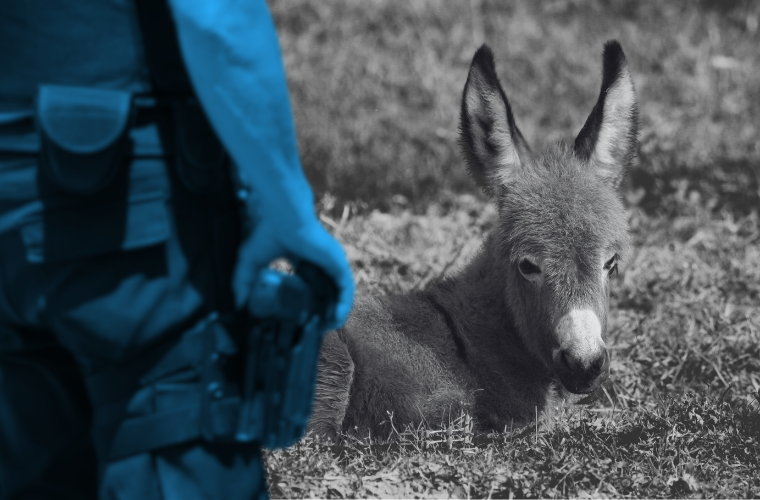
HeeHaw was not simply “an animal in a field.” He was a gentle, bottle-raised young donkey who had grown up around people. He interacted with children while at a petting zoo. Yet during an overnight search for a missing child, law-enforcement officers entered the pasture where HeeHaw lived, and Cedartown Police Officer Trenton Garner shot and killed him.
Officer Garner wrote in his incident report that HeeHaw “began to charge” toward the officers and a team of bloodhounds. He stated that another officer attempted to deter HeeHaw by arcing a taser and that, when this did not stop him, Garner fired one round.
HeeHaw’s person tells a profoundly different story of who this little donkey was: bottle-raised, gentle, accustomed to strangers, and trusted around children. He was in his own pasture, approaching unfamiliar people and doing what donkeys naturally do—investigating and alerting when strangers enter their home. (Newsweek; FOX 5 Atlanta; The Guardian) Whatever conclusions the independent investigation ultimately reaches, one truth is already painfully clear: law-enforcement officers need proper, extensive, mandatory training for the many encounters they have with sentient beings in our communities, homes, and on our properties.
Law enforcement officers routinely enter homes, yards, farms, pastures, roadsides, parks, and other places where they encounter dogs, cats, horses, donkeys, farmed animals, free-living animals, frightened animals, injured animals, protective animals, and animals who are simply curious. An officer who cannot recognize ordinary animal behavior may interpret barking, braying, running, approaching, or standing one’s ground as aggression. When that officer is armed, a tragic misunderstanding can become a death sentence within seconds.
This has been happening to families and their beloved companions for years.
In Ocala, Florida, two officers fired 30 rounds during an encounter with three dogs. An internal review found that portions of the officers’ actions were reckless, unnecessary, and contrary to department policy. Both officers had been placed on administrative duty during the investigation; one subsequently received a 100-hour suspension and was removed from the field-training program, while the other received a 20-hour suspension. The police chief acknowledged the tragic event that they “simply got wrong” and changed department policy to require nonlethal options whenever possible. (WCJB)
In Sturgeon, Missouri, an officer shot and killed Teddy, a 13-pound Shih Tzu mix who was blind and deaf. Body-camera footage showed Teddy moving away from the officer rather than attacking him. The officer was later suspended and left the department, and the city and officer ultimately agreed to a $500,000 settlement with Teddy’s person. (The Washington Post; Animal Legal Defense Fund)
In New Orleans, Officer Derrick Burmaster killed Apollo, a 16-week-old, 22-pound puppy. Multiple internal investigations and the department’s Use of Force Review Board concluded that Apollo posed no threat and that the shooting was unjustified and violated policy. A federal jury later found that the officer violated Apollo’s family’s constitutional rights, although qualified immunity shielded the officer from personal liability. (Associated Press)
These are not isolated lessons. They demonstrate why animal-encounter training must be treated as an essential part of public safety rather than an optional seminar.
A substantial training curriculum already exists. With support from the U.S. Department of Justice’s Office of Community Oriented Policing Services, the National Sheriffs’ Association developed an eight-hour Law Enforcement Dog Encounters Training program. It teaches officers to recognize animal body language, use calming positioning, assess actual danger, employ nonlethal alternatives, and make better decisions about the use of deadly force. Its developers expressly acknowledge that many lethal encounters are preventable. (National Sheriffs’ Association; U.S. Department of Justice publication overview)
That foundation must be expanded beyond dogs. Police academies and departments need support to have and require comprehensive training developed with veterinarians, qualified animal-behavior specialists, humane officers, wildlife professionals, and animal-protection organizations. Officers should learn species-specific behavior, safe retreat and containment practices, de-escalation, and when to call animal control or another properly trained professional. They should also carry appropriate nonlethal equipment and be required to exhaust reasonable alternatives before using a firearm against an animal who poses no immediate and unavoidable danger.
Training, practice, and mastery of such foundational skills better protects all of us – the creatures, officers, families, neighbors, bystanders, and the integrity of law enforcement itself. If officers have a personal fear or dislike of animals, those things need to be addressed and resolved before they ever receive their weapon. Firing a weapon in a yard, neighborhood, home, or pasture can endanger everyone nearby. Killing someone’s beloved companion traumatizes families and neighborhoods and destroy years of trust between a law enforcement and its community. With nearly 400 million pets in the United States, it’s time for a solution.
HeeHaw’s killing also requires transparency and accountability.
The Cedartown police chief placed Officer Garner on administrative leave and referred the matter to the Georgia Department of Agriculture’s Law Enforcement Division for independent investigation. That investigation must be thorough, impartial, and public in its conclusions. But the officer’s written account cannot be the only version the public is permitted to examine.
The body-camera footage—and any other official video or audio recording of the encounter—needs to be preserved and released as promptly as the law allows. The community deserves to see what happened before HeeHaw was killed: how the officers entered the pasture, how HeeHaw approached them, how much time passed, what warnings were given, whether retreat was possible, and whether reasonable nonlethal alternatives existed. They were searching for a missing child—not at a crime scene. What if the child had been with HeeHaw?
Releasing the footage is not an act of hostility toward law enforcement. It is an act of public accountability. Body cameras cannot build trust if the recordings are withheld precisely when their evidence matters most.
If the evidence shows that Officer Garner acted unnecessarily, recklessly, outside department policy, or without exhausting reasonable alternatives, then administrative leave alone is not accountability. He must be held responsible through appropriate disciplinary, civil, or legal processes. Accountability should be based on the complete evidence—but it must be real, not symbolic.
I recognize that police officers do confront numerous genuinely dangerous situations and must make rapid decisions. Proper training acknowledges that reality. But fear arising from an inability to understand animal behavior cannot be allowed to justify murder.
We need mandatory, recurring, species-appropriate animal-encounter training for law-enforcement officers throughout this country. We need clear policies requiring de-escalation and nonlethal intervention whenever reasonably possible. We need transparent reporting whenever an officer injures or kills another animal. And we need meaningful accountability when an officer’s actions violate the law, policy, or the public trust.
The creatures who share our homes and communities are not disposable obstacles. They are living, feeling beings whose lives matter deeply to them and to the people who love them.
Justice for HeeHaw must include the truth about what happened to him—and a commitment to ensuring that no more nonhuman beings are needlessly killed because the people entrusted with protecting the community were never properly trained to understand them.
Kindness ~
Tams Nicholson
Executive Director, All-Creatures.org
Posted on All-Creatures.org: September 4, 2026
Return to Animal Rights/Vegan Activist Strategies
Follow us on:


- Home Page
- What's New
- Contact Us
- Action Alerts
- Animal Exploitation
- Animal Issues
- Animal Rights Activism
- Archives
- Art & Photography
- Articles Directory
- Bible
- Bible Commentary Blog
- Books
- Campaigns
- Church & Religion
- Discussions
- Events / Podcasts / Media
- Health
- Hosted Web Sites
- Humor
- Kids' Korner
- Letters
- Links
- Nature Studies
- Newsletter
- Poetry & Stories
- Prayers
- Quotations
- Recipes with Photos
- Recipes Without Photos
- Sermons
- Stop Cruelty in Churches
- Video Library
- The Mary T. and Frank L. Hoffman Family Foundation
- Email: [email protected]
A web site sponsored by The Mary T. and Frank L. Hoffman Family Foundation and all-creatures.org
Copyright © 1998-2026 The Mary T. and Frank L. Hoffman Family Foundation. All rights reserved. May be copied only for personal use or by not-for-profit organizations to promote compassionate and responsible living. All copied and reprinted material must contain proper credits and web site link www.all-creatures.org.
Fair Use Notice: This document, and others on our web site, may contain copyrighted material whose use has not been specifically authorized by the copyright owners. We believe that this not-for-profit, educational use on the Web constitutes a fair use of the copyrighted material (as provided for in section 107 of the US Copyright Law). If you wish to use this copyrighted material for purposes of your own that go beyond fair use, you must obtain permission from the copyright owner.
Thank you for visiting all-creatures.org.
