An Animal Rights/Vegan Activists' Strategies Article used with permission from All-Creatures.org
The National Link Coalition reports on a new law in Paraguay that will require animal welfare to be taught as part of the country’s primary and secondary school curriculum.
Paraguay Mandates Animal Welfare Education Based on The Link
From April 2026 LINK-Letter, The National Link Coalition
April 2026
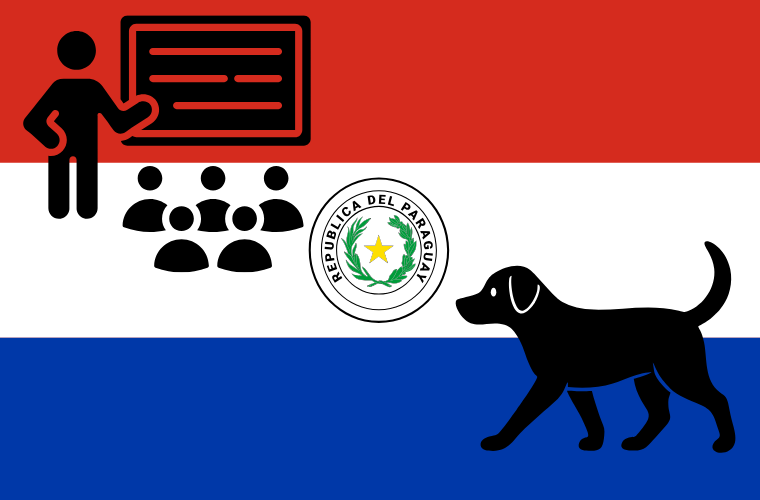
Images from Canva
The government of Paraguay has taken the bold step of mandating that Animal Welfare be integrated into the curriculum of both basic and secondary education nationwide with a new law whose underlying premise is the recognition that cruelty toward animals often serves as an early indicator of violent behavior within society.
On Feb. 26, the Ministry of Education and Sciences changed Animal Welfare from a tangential topic to a mandatory one beginning with the 2026 school year. The Ministry called the new law No. 7513/25 a milestone that promises to transform the foundations of social coexistence and ethical formation within the country.
Integrating animal welfare into the classroom acts as a tool for primary social prevention, said the Ministry. The public policy aim is to ensure that the 21st-century Paraguayan student not only masters technical-scientific competencies but also cultivates the emotional and ethical intelligence necessary to coexist harmoniously within a biodiverse environment through a “pedagogy of care” instilled into the very core of learning. The new law transitions from a purely biological approach to teaching toward a form of civic education grounded in respect for sentient beings.
The Ministry, in collaboration with the National Directorate for Animal Defense, Health, and Welfare, has structured this new curricular component not as an optional workshop, but as a distinct subject with its own allocated instructional time and clear learning objectives.
The directive recognized the challenges on school time and resources when introducing a mandated subject. But it called on school principals to use adaptive leadership as an opportunity to utilize the subject matter as a unifying theme for innovative institutional projects. Successful implementation will not stem from merely “filling the hour”, but rather from the leadership team’s capacity to foster transdisciplinary Project-Based Learning that enables students to investigate real-world problems within their communities — such as stray animal overpopulation, wildlife protection, or responsible pet ownership — and to propose concrete solutions.
The mandate sees the curriculum as infusing a sense of empathy in students that will result in a substantial improvement in school climate. By teaching children and young people to recognize the suffering and needs of a being unable to express itself through human language, their skills in listening and compassion toward their own peers will be strengthened. Institutions that have implemented pilot programs in other countries have reported a decrease in bullying rates and an increase in the sense of community responsibility. “Paraguay now has the opportunity to validate these theories on a national scale, transforming its schools into laboratories for social peace,” the Ministry added.
The Ministry sees the new mandate as positioning Paraguay as a model for all of South America, particularly for educational policymakers in Argentina, Chile and Colombia.
“The question is no longer whether this content belongs in schools, but rather how it can be integrated in a way that generates a tangible impact on students’ academic profiles upon graduation. Paraguay’s educational leadership now faces the challenge of demonstrating that this innovation is not merely a cosmetic change on a report card, but a profound transformation of institutional culture,” they concluded.
“The lesson from Paraguay is clear: the most powerful curricular innovation is not always the one that incorporates the most technology, but rather the one that reclaims ethics as the central pillar of knowledge. Educational administrators now face the mission of transforming this legislation into a vibrant learning experience — one that turns every school into a sanctuary of respect and a driving force for change toward a more just and compassionate society.”
Posted on All-Creatures.org: April 16, 2026
Return to Animal Rights/Vegan Activist Strategies
Read more at Legislation/Policy Articles
Follow us on:


- Home Page
- What's New
- Contact Us
- Action Alerts
- Animal Exploitation
- Animal Issues
- Animal Rights Activism
- Archives
- Art & Photography
- Articles Directory
- Bible
- Bible Commentary Blog
- Books
- Campaigns
- Church & Religion
- Discussions
- Events / Podcasts / Media
- Health
- Hosted Web Sites
- Humor
- Kids' Korner
- Letters
- Links
- Nature Studies
- Newsletter
- Poetry & Stories
- Prayers
- Quotations
- Recipes with Photos
- Recipes Without Photos
- Sermons
- Stop Cruelty in Churches
- Video Library
- The Mary T. and Frank L. Hoffman Family Foundation
- Email: [email protected]
A web site sponsored by The Mary T. and Frank L. Hoffman Family Foundation and all-creatures.org
Copyright © 1998-2026 The Mary T. and Frank L. Hoffman Family Foundation. All rights reserved. May be copied only for personal use or by not-for-profit organizations to promote compassionate and responsible living. All copied and reprinted material must contain proper credits and web site link www.all-creatures.org.
Fair Use Notice: This document, and others on our web site, may contain copyrighted material whose use has not been specifically authorized by the copyright owners. We believe that this not-for-profit, educational use on the Web constitutes a fair use of the copyrighted material (as provided for in section 107 of the US Copyright Law). If you wish to use this copyrighted material for purposes of your own that go beyond fair use, you must obtain permission from the copyright owner.
Thank you for visiting all-creatures.org.
