A Wildlife Article used with permission from All-Creatures.org
How did harp seals get their name? How long can they live? When do they lose their fluffy white fur? Learn all this and more in this article of fascinating facts from HarpSeals.org!
About Seals
From HarpSeals.org
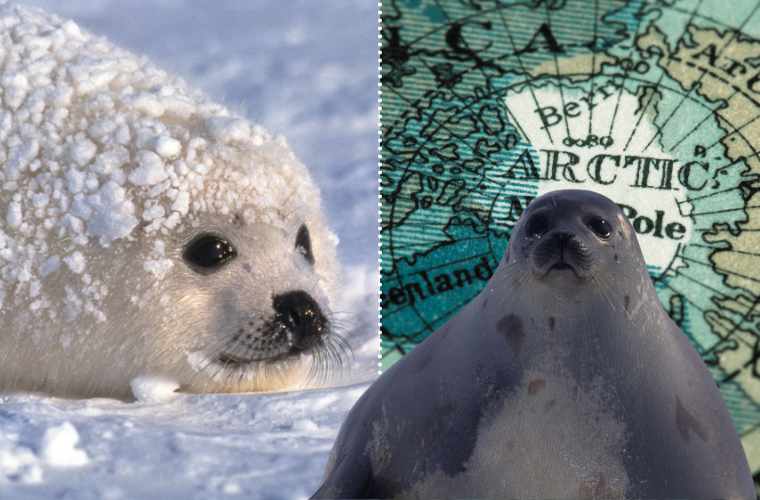
Images from Canva
Harp seals are just one species of pinnipeds in Canadian waters
The other pinnipeds who live around Canada are bearded seals, grey seals, harbor seals, hooded seals, ringed seals, northern elephant seals, spotted seals, Guadalupe fur seals, northern fur seals, California sea lions, Steller sea lions, and walruses. Among these, the first 7 and harp seals are true seals.
Harp seals are the main seals who are slaughtered in Canada. Grey seals are killed commercially in much smaller numbers. Inuit kill mostly ringed seals and some harp seals primarily for food.
Harp seal facts
How did harp seals get their name?
Harp seals are named for a dark marking on their fur which is seen after molting. It looks like a Celtic harp.
Taxonomy
Family: Phocidae (true, earless seals)
Genus: Pagophilus
Species: Pagophilus groenlandicus
Diet
The harp seal diet changes during their lives, with young pups preying upon small crustaceans, and older harp seals feeding on a variety of prey but with a focus on polar cod, capelin, crustaceans, including small amphipods, and Atlantic herring, when they are available. Many of these species have been overfished, which has caused harp seals to seek nutrition from other prey, including sand eels, sculpins, Atlantic cod, redfish, squid, and Greenland halibut. North Atlantic cod is normally not primary prey of harp seals.
Anatomy
Harp seals, as true seals, have no external ear flaps. They move on ice by pulling themselves with their front flippers, which have strong claws. Their hind flippers do not rotate and have smaller claws. Pups are born without blubber; they develop blubber as they nurse.
Adult Weight:
220 - 320 lbs.
Adult Length:
4.6 - 6.6 ft.
Reproduction
Harp seal mothers can only give birth to one pup each year, and they do this on pack ice late in February or in the first half of March. Like other seals, harp seals can delay the implantation of embryos in their uterus until environmental conditions and physiological conditions are suitable for developing the embryo. This can be helpful when they return to their traditional whelping area, only to find that there is no sea ice. However, it takes energy to search far and wide for sea ice.
Mothers nurse their pups for about 12 days and then leave them. The pups begin to molt their fluffy white coat (called lanugo) a few days later.
Harp seals can live to be 35 years old.
Population Groups
Harp seals are medium sized true seals with 3 populations, the largest being the Northwest Atlantic population. The Greenland Sea and White Sea populations have fewer than 2 million seals combined; however, there is evidence of mixing of these populations.
Migration Patterns
Thousands of harp seals in the Northwest Atlantic subpopulation group migrate in groups each year from waters around Baffin Island (located in the territory of Nunavut) to their birthing grounds in the Gulf of St. Lawrence and the waters around Newfoundland and Labrador in Canada. They leave the Arctic waters in the fall and reach their birthing grounds from December to February, where they disperse and feed intensively. After whelping, as the ice recedes in June, the harp seals migrate back to the Arctic.
Harp seal lifecycle
Yellowjacket
Newborn pup's white fur is tinted yellow from placental fluid. His/her birth weight is about 24 lbs. and length is almost 3 feet long.
Whitecoat
Pup's yellowish tint disappears in a few days, leaving the iconic fluffy white fur. Pups nurse on mother's high-fat milk (~45% fat), tripling their weight to > 70 lbs. in ~12 days. Mother finds her pup in the herd by smell.
Ragged Jacket
Pup is weaned at ~12 days old and starts to molt in patches, leaving a dense silver-grey fur with black spots. Pups do not eat after being weaned until they can swim and find food on their own. This can take 6 weeks.
Beater
After about 18 days, pup's white coat is completely molted. Pup will learn how to swim by beating the water with his/her front flippers, which led to the name "beaters."
Bedlamer
Immature seals were given this name in the 15th or 16th century by the Basque and Breton settlers in the Strait of Belle Isle. The term comes from the French "Betes de la mer" (Animals of the Sea).
Adult
Males reach maturity at about 7-8 years of age. Females reach maturity at about 4-6 years of age.
Posted on All-Creatures.org: October 1, 2025
Return to Wildlife Articles
Read more at Fishes and Other Sea Animals Articles
Follow us on:


- Home Page
- What's New
- Contact Us
- Action Alerts
- Animal Exploitation
- Animal Issues
- Animal Rights Activism
- Archives
- Art & Photography
- Articles Directory
- Bible
- Bible Commentary Blog
- Books
- Campaigns
- Church & Religion
- Discussions
- Events / Podcasts / Media
- Health
- Hosted Web Sites
- Humor
- Kids' Korner
- Letters
- Links
- Nature Studies
- Newsletter
- Poetry & Stories
- Prayers
- Quotations
- Recipes with Photos
- Recipes Without Photos
- Sermons
- Stop Cruelty in Churches
- Video Library
- The Mary T. and Frank L. Hoffman Family Foundation
- Email: [email protected]
A web site sponsored by The Mary T. and Frank L. Hoffman Family Foundation and all-creatures.org
Copyright © 1998-2026 The Mary T. and Frank L. Hoffman Family Foundation. All rights reserved. May be copied only for personal use or by not-for-profit organizations to promote compassionate and responsible living. All copied and reprinted material must contain proper credits and web site link www.all-creatures.org.
Fair Use Notice: This document, and others on our web site, may contain copyrighted material whose use has not been specifically authorized by the copyright owners. We believe that this not-for-profit, educational use on the Web constitutes a fair use of the copyrighted material (as provided for in section 107 of the US Copyright Law). If you wish to use this copyrighted material for purposes of your own that go beyond fair use, you must obtain permission from the copyright owner.
Thank you for visiting all-creatures.org.
