A Wildlife Article used with permission from All-Creatures.org
In response to recent public concern in the U.S. over the use of oral vaccination to prevent rabies in wildlife populations, Ed Boks provides valuable context for the vaccination program, explaining what the vaccine is, how it is used, and how it is responsible for saving the lives of many wild creatures.
When Rabies Control Goes Viral: Fact, Fear, and the Politics of Wildlife Vaccination
From Ed Boks, Animal Politics with Ed Boks, AnimalPolitics.substack.com
March 2026
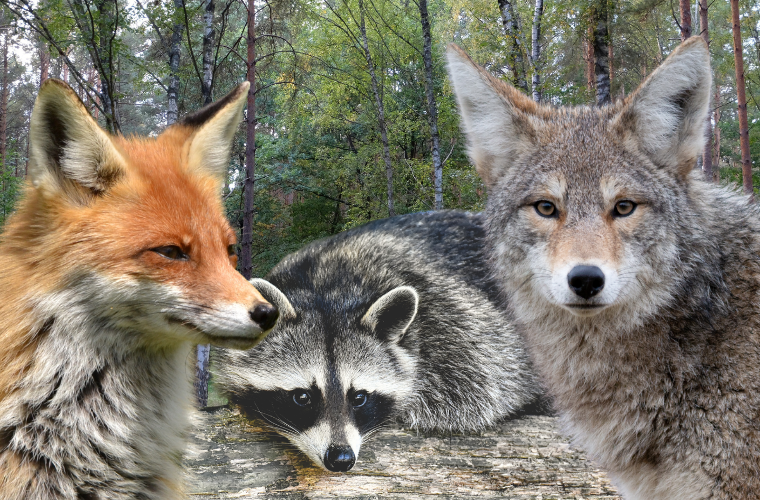
Images from Canva
Background & History
Rabies has long occupied a unique place in public health and animal policy, feared, fatal, and politically sensitive. Before modern vaccination programs, rabies outbreaks periodically moved through wildlife populations and spilled into domestic animals and humans, triggering large-scale animal control responses that often relied on widespread killing of wildlife.
By the late 20th century, public health authorities confronted a stubborn reality: traditional containment methods were failing. Rabies persisted not because pets were unvaccinated, but because wildlife reservoirs, particularly raccoons, foxes, and coyotes, maintained transmission cycles across large geographic regions.
In the 1990s, federal and state agencies adopted a different strategy: oral rabies vaccination (ORV). Instead of reacting to outbreaks, agencies attempted to create immune barriers in wildlife populations by distributing edible vaccine baits across rural landscapes.
The program, administered by the USDA Wildlife Services under the National Rabies Management Program, uses an oral vaccine known as RABORAL V-RG, delivered by aircraft, vehicles, and hand placement.
Over three decades, ORV campaigns have helped eliminate or contain several regional rabies variants and significantly reduced transmission risk along expanding wildlife corridors.
Yet the very scale that makes the program effective, millions of baits distributed over large areas, periodically fuels public concern, especially when images of aerial drops circulate online without context.
This Week’s Question
A viral social media thread claims that planes and helicopters are “blanketing rural America” with genetically engineered rabies vaccines without public warning, describing the effort as an uncontrolled experiment exposing humans and animals to a live recombinant virus.
“Is the federal oral rabies vaccine program a legitimate public-health intervention or an undisclosed biological risk imposed on rural communities?” - A.L.
Animal Politics’ Response
The underlying event is real. The viral interpretation is not.
Yes, federal wildlife officials distribute oral rabies vaccine baits across multiple states each year. This has been standard practice for decades, not a newly introduced policy. Public announcements are routinely issued through state health departments, local governments, and USDA communications before distribution begins.
The vaccine itself is recombinant, a scientific term that often triggers alarm but simply describes a technology widely used in modern medicine. The vaccine cannot cause rabies. Its purpose is to stimulate immunity in wildlife populations that otherwise sustain the disease.
Risk discussions cited online rely on selective readings of scientific literature. Studies examining limited vaccine virus replication are part of routine safety monitoring, not evidence of uncontrolled spread. Documented human exposures are extremely rare and almost exclusively involve direct handling of damaged bait packets under unusual conditions.
What the viral narrative misses is the policy context.
Rabies control presents governments with only three practical choices:
- Allow wildlife rabies to expand geographically.
- Attempt large-scale wildlife eradication.
- Immunize wildlife populations.
Modern animal welfare ethics, and decades of field experience, have pushed policy toward the third option. Oral vaccination replaced far more lethal control methods once considered acceptable.
In other words, the ORV program reflects a shift away from mass killing and toward population-level disease prevention.
The controversy reveals something larger than vaccine fear. It exposes a recurring tension in animal policy: large-scale interventions designed to prevent suffering often become politically vulnerable precisely because they operate quietly in the background. When visibility arrives without context, public health measures can appear secretive rather than preventive.
The lesson is not that skepticism is misplaced. Public trust depends on transparency and communication, especially when programs operate at continental scale.
But the available evidence shows this is neither an experiment nor a hidden threat. It is a long-running wildlife vaccination campaign; imperfect, continually studied, and largely successful, aimed at preventing one of the oldest zoonotic diseases known to humanity.
Posted on All-Creatures.org: March 30, 2026
Return to Wildlife Articles
Follow us on:


- Home Page
- What's New
- Contact Us
- Action Alerts
- Animal Exploitation
- Animal Issues
- Animal Rights Activism
- Archives
- Art & Photography
- Articles Directory
- Bible
- Bible Commentary Blog
- Books
- Campaigns
- Church & Religion
- Discussions
- Events / Podcasts / Media
- Health
- Hosted Web Sites
- Humor
- Kids' Korner
- Letters
- Links
- Nature Studies
- Newsletter
- Poetry & Stories
- Prayers
- Quotations
- Recipes with Photos
- Recipes Without Photos
- Sermons
- Stop Cruelty in Churches
- Video Library
- The Mary T. and Frank L. Hoffman Family Foundation
- Email: [email protected]
A web site sponsored by The Mary T. and Frank L. Hoffman Family Foundation and all-creatures.org
Copyright © 1998-2026 The Mary T. and Frank L. Hoffman Family Foundation. All rights reserved. May be copied only for personal use or by not-for-profit organizations to promote compassionate and responsible living. All copied and reprinted material must contain proper credits and web site link www.all-creatures.org.
Fair Use Notice: This document, and others on our web site, may contain copyrighted material whose use has not been specifically authorized by the copyright owners. We believe that this not-for-profit, educational use on the Web constitutes a fair use of the copyrighted material (as provided for in section 107 of the US Copyright Law). If you wish to use this copyrighted material for purposes of your own that go beyond fair use, you must obtain permission from the copyright owner.
Thank you for visiting all-creatures.org.
