A Wildlife Article used with permission from All-Creatures.org
Fleur Dawes shares how In Defense of Animals plans to help fund a critical wildlife ambulance to be used in Virunga National Park, whose already vulnerable creatures face additional threats from armed conflict and an Ebola outbreak.
International Effort Launched to Save DRC’s Endangered Animals Amid Ebola and Armed Conflict Threats
From Fleur Dawes, IDA In Defense of Animals, idausa.org
July 2026
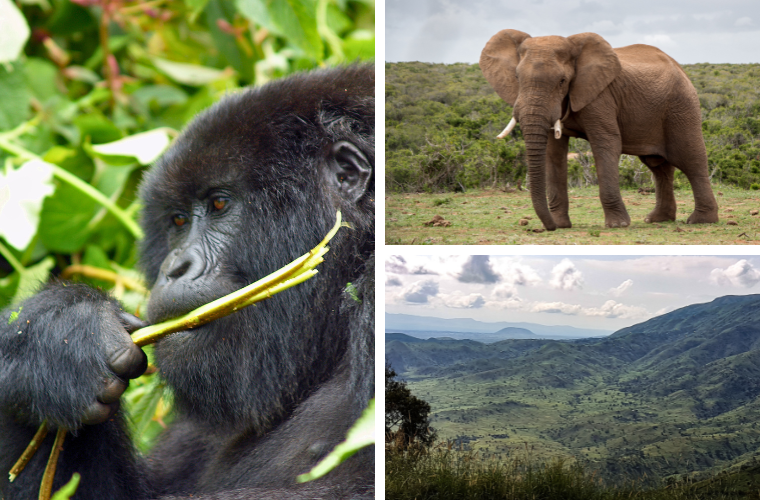
Images from Canva
BENI, North Kivu, Democratic Republic of Congo (July 20, 2026) — In Defense of Animals (IDA), a leading U.S.-based animal protection organization, has announced a new partnership with Innovation pour le Développement et la Protection de l’Environnement (IDPE), a civil society organization operating within the Virunga landscape in the Democratic Republic of Congo, to fund a dedicated animal rescue ambulance. The announcement comes as an outbreak of Bundibugyo ebolavirus — a strain for which no approved vaccine exists — is spreading through North Kivu Province, threatening both human communities and the critically endangered wildlife IDPE works to protect.
The convergence of armed conflict and epidemic disease has created an unprecedented emergency in and around Virunga National Park, home to nearly half of the world’s remaining mountain gorilla population. Fewer than 1,100 mountain gorillas survive on Earth. On May 4, 2026, members of the armed militia group M23 opened fire on a herd of elephants on the shores of Lake Edward inside the park, killing at least one animal. Hippos are being shot and hacked apart for meat and ivory teeth; crocodiles are slaughtered for their skins. More than 200 Virunga rangers have been killed in the line of duty — more than any other protected area on the planet.
The Ebola outbreak compounds an already critical situation. Bundibugyo ebolavirus was first identified in 2007 in Bundibugyo District, Uganda — directly across the border from Virunga — and has no approved vaccine. Eight million displaced people in the region have little access to healthcare. Two-thirds of Virunga National Park, along with most of its staff, are inside the affected zone. Mountain gorillas, like all great apes, have no natural immunity to Ebola, and mortality rates in gorilla populations have reached as high as 95% during previous filovirus outbreaks. A single introduction of the virus into a gorilla family group could be catastrophic for a species already on the edge of extinction.
For the IDPE team, the convergence of threats transforms every rescue mission. Each sick or dead animal approached in an active Bundibugyo zone carries a potential exposure risk. Without a properly equipped vehicle to carry personal protective equipment and enable rapid deployment, conducting safe animal rescue in an Ebola-affected area is nearly impossible. Reaching animals before they die matters now more than ever: an infected carcass left in the field is a danger to both the rescue team and surrounding communities. The World Health Organization (WHO) has confirmed at least 1,963 cases and at least 719 have died.
On June 17, 2026, IDPE Director General Bantu Lukambo wrote directly to the Military Governor of North Kivu, raising the alarm about dangerous practices undermining epidemic control: bushmeat continues to be sold openly in officially infected areas, entry point controls remain insufficient, and traditional healers are falsely claiming the ability to cure Ebola. The formal letter was copied to the President of the DRC, the WHO Director General, UNESCO, MONUSCO, and international ambassadors — reflecting the gravity IDPE believes the situation demands.
“Our field investigations reveal that the situation remains deeply concerning. The sale of bushmeat continues in infected areas, controls at entry points are insufficient, and communities are being misled about the disease. Animals and people are suffering in the same landscape. Coordinated, urgent action is the only way to protect both.”
— Bantu Lukambo, Director General, Innovation pour le Développement et la Protection de l’Environnement (IDPE)
The animal ambulance IDA is fundraising to provide for IDPE will allow the team to reach injured animals faster, transport emergency veterinary supplies and personal protective equipment into conflict and outbreak zones, and conduct rescues under conditions that the current absence of a dedicated vehicle makes unsafe. It is the foundational infrastructure needed to operate under the dual pressures of armed conflict and epidemic disease — and to protect a species for which there is no margin left.
“Virunga holds some of the rarest animals on this planet, and right now they are caught between armed militia and an Ebola outbreak with no approved vaccine. The team at IDPE is already in the field — detained, robbed, and still going back. What they need is not more courage. They need a vehicle. Our donors can make that possible right now, and it will make the difference between animals that can be reached and animals that cannot.”
Posted on All-Creatures.org: July 21, 2026
Return to Wildlife Articles
Follow us on:


- Home Page
- What's New
- Contact Us
- Action Alerts
- Animal Exploitation
- Animal Issues
- Animal Rights Activism
- Archives
- Art & Photography
- Articles Directory
- Bible
- Bible Commentary Blog
- Books
- Campaigns
- Church & Religion
- Discussions
- Events / Podcasts / Media
- Health
- Hosted Web Sites
- Humor
- Kids' Korner
- Letters
- Links
- Nature Studies
- Newsletter
- Poetry & Stories
- Prayers
- Quotations
- Recipes with Photos
- Recipes Without Photos
- Sermons
- Stop Cruelty in Churches
- Video Library
- The Mary T. and Frank L. Hoffman Family Foundation
- Email: [email protected]
A web site sponsored by The Mary T. and Frank L. Hoffman Family Foundation and all-creatures.org
Copyright © 1998-2026 The Mary T. and Frank L. Hoffman Family Foundation. All rights reserved. May be copied only for personal use or by not-for-profit organizations to promote compassionate and responsible living. All copied and reprinted material must contain proper credits and web site link www.all-creatures.org.
Fair Use Notice: This document, and others on our web site, may contain copyrighted material whose use has not been specifically authorized by the copyright owners. We believe that this not-for-profit, educational use on the Web constitutes a fair use of the copyrighted material (as provided for in section 107 of the US Copyright Law). If you wish to use this copyrighted material for purposes of your own that go beyond fair use, you must obtain permission from the copyright owner.
Thank you for visiting all-creatures.org.
