A Wildlife Article used with permission from All-Creatures.org
Joan Harrison deftly refutes claims made about Mute Swans that served as justification for a plan to kill these creatures en masse in New York State. Originally written in 2017 in response to the Department of Environmental Conservation's call for public comments on its third Mute Swan Management Plan, then updated in 2018 following the Oneida Lake swan massacre, and again in 2026 in light of recent developments, this paper remains as relevant today as Mute Swans continue to be slaughtered across the United States.
Why Swan Management?
From Joan Harrison
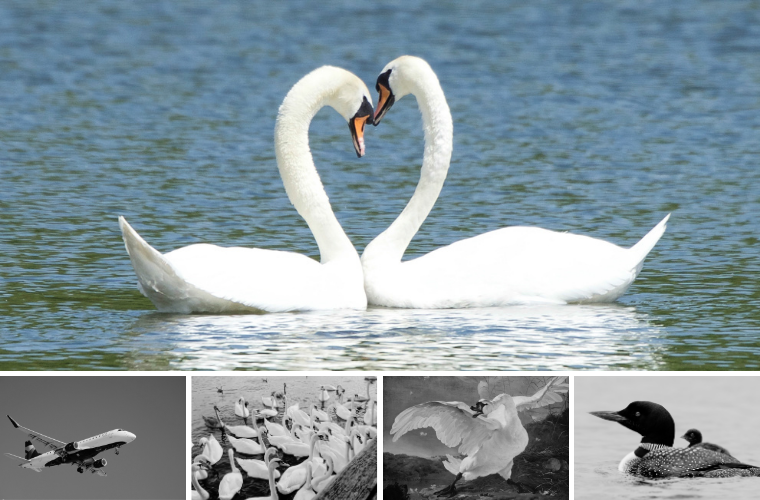
Images from Canva
He [Robert Alison] kindly worked with me and provided material he had used in the past in an effort to save the Mute Swans from forced extinction on this continent. We are hoping this, and a great deal of prayer, will help these wonderful birds, whose only sin, in the eyes of man, is that they protect their families the way humans used to. (Kathryn Stillwell Burton [October 7, 1939-November 25, 2014], founder of Save Our Swans USA and Save The Mute Swans)
The New York State Department of Environmental Conservation’s 2017 third Mute Swan management paper is a plan for animal genocide couched in euphemisms and humane jargon. The fourteen page text with four pages of footnotes amounts to a propaganda tract deceptively written and brimming over with unfounded assertions. The third plan merely repeats the same charges against the swans made by the earlier plans, all of which are questionable, and none of which, even if true, individually or collectively, would justify the killing of a single swan:
(a) they're a non-native/invasive species;
(b) they're overabundant;
(c) they displace other water birds;
(d) they're a threat to air safety;
(e) they eat too much sub-aquatic vegetation (SAV);
(f) their waste contains high levels of fecal coliform bacteria;
(g) they're aggressive and a danger to humans.
a)
The first deceit is in the DEC’s title: “Mute Swans in New York: A Management Plan to Prevent Population Growth and Minimize Impacts of a Non-Native Invasive Species.” How many ornithologists and other scientists are needed to point out the fossil evidence strongly suggesting that Mute Swans are native to North America? Dr. Robert Alison, the American Ornithologists Union, the Cooper Ornithological Society, and the Society of Canadian Ornithologists, as examples, all regard the Mute Swan as native to North America. Dr. George T. Jefferson, a paleontologist at Berkeley, insists that the native status of Mute Swans cannot be ruled out. Dr. Alison and Kathryn Burton argue beyond this that the swans were almost certainly “prehistoric inhabitants” of North America. Though the evidence presented may be disputed, at the very least the case is not closed.
The DEC report states that Mute Swans “are not native to North America; they were imported as captive birds from Europe during the late 1800’s . . . ” The article by Robert Alison and Kathryn Burton about their discoveries, tells a very different story (Alison, R. and K. S. Burton, 2008. “New evidence of early presence of Cygnus olor.” Picoides 21:36-45). The article is replete with so much documentation from such a vast array of sources who witnessed Mute Swans in North America hundreds of years ago or discovered fossils showing the presence of Mute Swans long before, that the question needs to be asked why the non-native charge arises at all, let alone dominates official discourse even today.
A painting of a North American swan by John White from 1585, for example, was routinely identified as showing a Trumpeter Swan because of his or her dark bill. Kathryn Burton, however, noticed the basal knob above that bill which is THE defining characteristic of a Mute Swan. The basal knob exists on no other type of swan. The bill of the Mute Swan, on the other hand, is orange. A curator at the British Museum where the painting is housed, also certain that the bird was a Mute Swan, believed that the bill was originally painted orange because the type of paint John White used typically darkens with time and apparently did darken over the next four hundred years.
There was an attempted refutation to the Alison-Burton material concerning the John White painting. The refuter claimed that there’s no proof the swan’s bill was originally orange and the painter may have been painting a combination of different swans. Both of those statements are obviously true. The painter, an Englishman, may also have seen Mute Swans in Europe, memorized the basal knob, and superimposed it upon a North American model. And yet there’s no proof that that happened either. John White, moreover, is said to have been commissioned by Sir Walter Raleigh to “draw to life” the inhabitants of America and their surroundings [https://en.wikipedia.org/wiki/John_White_(colonist_and_artist)]! The basal knob, as stated, IS present in the painting,1 and the fact that it's smaller than one might expect could easily be explained by the fact that Mute Swan cygnets have smaller basal knobs AND dark grey to black bills. If the figure in the painting is a Mute Swan cygnet, the refuter is refuted. And even if the painter combined different swans in one image—though that is scarcely a “drawing to life”!—the presence of the basal knob on that image shows that a Mute Swan was one of those combined.
The reader may object that the swan in the painting is white, whereas Mute Swan cygnets are grey-brown. According to the Regal Swan Foundation, the cygnets begin turning white at 6 months of age. Their bills don’t become completely orange until a year old. Therefore, the swan in the painting, if a Mute Swan—white feathers with a dark bill and basal knob—would be older than six months though younger than a year. And it’s an exact match with the white Mute Swan cygnets who appear here: https://www.youtube.com/watch?v=JEk--UCBgZM. The burden of proof thus lies not with Alison-Burton, rather, with the objectors!
That I who know little of swans and as little of science am able nevertheless to arrive at the most obvious solution to the mystery here (and remember that the John White painting is only one small piece of the data presented by Alison and Burton—many other more obvious early representations of Mute Swans in North America also exist along with much earlier fossil remains) would seem to suggest that those who, in the face of the evidence, continue emphatically to deny even the possibility of the native status of Mute Swans are guided less by a spirit of free inquiry than by prejudice. Yet what is the source of that prejudice? According to the Burton-Alison data, the mislabeling of the John White watercolor as a Trumpeter Swan began in the 1960’s, the flowering of the anti-war movement here, and about it the authors modestly wrote: "The mislabeling of the drawing, at University of North Carolina, is very curious, and deserves additional research.”2
Though the hysteria over non-native species is unwarranted, the non-native charge, even when patently unfounded, is nevertheless commonly used as a basis for mass extermination. Not only the DEC, rather, the United States Department of Agriculture/APHIS/Wildlife Services, among others, uses it for exactly that. In its reports justifying the annual massacring of Canada Geese, for example, one of the USDA’s main arguments given for the necessity of killing is that the geese are non-native and invasive—something very much in dispute. And though its agents trap, gas, shoot, and slaughter millions of wild animals each year, including Mute Swans, under the non-native banner, about half of those they kill are native, while a number of those designated non-native they allow to live!
The Hudsonia report, a detailed scientific analysis that finds the claims against Mute Swans by the DEC and other such groups largely unsubstantiated, tacitly undermines the use of non-native/invasive status as a justification for killing by pointing out:
“Invasive species can have negative or positive effects on SAV [=subaquatic vegetation].” (My italics.)
And there are documents showing that the part of subaquatic vegetation that Mute Swans most favor is a non-native/invasive plant! So even those who believe that Mute Swans are non-native and that native/good :: non-native/evil would have to acknowledge that Mute Swans provide an important service!
The Hudsonia report, however, does not go nearly far enough. It rejects many conclusions of the DEC, though not its premises. The Hudsonia never asks, for example, whether it’s morally acceptable for human beings to so-called manage—i.e. violate and murder—other animal species in the first place. The Hudsonia does not question the supposed non-native designation bestowed upon Mute Swans by humans—and certainly not the validity of the native/non-native dichotomy itself, which many in the scientific community seriously question. Yet even granting the validity of that dichotomy, to invoke it for justifying widespread killing cannot be a matter of majority rule. So even if most ornithologists accept the non-native label in the case of the swans—and why they do so is a question that needs to be asked—that alone does not prove the designation correct, nor does it validate swan management. More importantly, environmentalists’ excessive concern with native/non-native designations, particularly in these times, would have to be politically suspect—all the more so when the DEC, among other environmental and wildlife agencies, refer to Mute Swans as immigrants!3
(b)
The DEC claims that Mute Swans are overabundant, though on what basis? There are water birds of other species who exist in greater numbers and yet are not being targeted. Another DEC document states, moreover, that one-third of the Mute Swans in New York die each winter of starvation. How do those remarks hang together? If the swans are dying in droves, and it appears that they are, and not only in the United States—it is known, for example, that in Essex, England one year about 90% of the Mute Swans died out, from starvation mostly and secondarily from parasitic disease—how could that support the DEC claim of overabundance?
A Michigan Department of Natural Resources (DNR) report similarly refers to the Mute Swan as a “long-lived” creature even while pointing out that “Although they may live twenty-five years in the wild, seven years is a more typical life span (AFC 2003).” Yet in what sense are the swans long-lived if they generally die after living only one-third of their expected life?
The documents of environmental and wildlife organizations produced to justify the killing of swans, geese, and other wild creatures, are typically filled with contradictions and sophistries. That, along with the other irregularities, raises the question as to what the true reason for the mass killings is. The DEC and its counterparts in other states are supposed to be about conservation not mass extermination. And enough is known about the DEC’s approach to swans over and above their cynically argued management plans to nullify their authority over Mute Swans in the minds of swan lovers everywhere. Though the DEC indicates, for example, that no hunting season for Mute Swans exists in North America and hunting of them is prohibited in New York, not long ago the DEC hired USDA/Wildlife Services agents to go into a New York park at Oneida Lake where they shot dead in broad daylight in front of children relaxing with their own parents a pair of parent swans, and then took the cygnets out of the public eye to break their necks. The supposed justification was a complaint by one woman, a complaint that was never investigated. The agents who carried out the killings were neither arrested nor interrogated, nor were those who hired them. There was a state law in effect that prohibited the killing of Mute Swans at the time, which is why the DEC hired the USDA.4 How law-abiding! And the DEC is and was permitted year after year to impose upon New Yorkers one unfounded, gruesome plan after another for swan extermination.
The DEC’s second plan is particularly revealing. Supposedly concerned with the huge public outcry over the first plan—which was to kill all 2,200 Mute Swans in New York State by 2025—it now promoted as a more humane and accommodating plan one which was in point of fact even worse. The second plan entailed, among other things, including mass extermination, the surgical mutilation of the wings of a significant number of New York’s Mute Swans so that they could no longer fly and would be in constant pain.
The third plan, discussed here, retains the goal of mass extermination, though disguised within still newer packaging, under the pretense of using mainly “non-lethal” methods such as egg oiling—unless, that is, killing were to prove “necessary,” “practical,” “feasible,” or “timely,” and the latter terms remain conveniently undefined. It is known, of course, that egg oiling is not generally an effective way of reducing populations, nor is it non-lethal: the embryo or about-to-be-hatched cygnet slowly suffocates to death.
The third plan states also that the DEC intends to develop “outreach materials to summarize . . . methods for ensuring the birds remain flightless.” [p. 11] Surgical mutilation, then, is apparently still on the agenda. And the proposed killing of “fewer than 100” adult swans per year would leave zero mute swans after about twenty-two years. That would suggest that the true charge of the DEC is not that Mute Swans are overabundant, rather, it would suggest that the true charge is that they exist at all. That this sentence from Gayet et al (2013) appears at the center of the DEC management plan would thus seem unsurprising: “ . . . there is genuine risk of biological invasion in North America and it can be considered a safety measure to eradicate the species from North America.” [“Effects of mute swans on wetlands: a synthesis,” Hydrobiologia 723: 195-204.]
The DEC should not be permitted to have anything to do with wild creatures. It is prejudiced against them, depersonalizes them, and intends them harm. Its reports speak of Mute Swans as if they were consumer goods that provide “viewing opportunities” and imply that Tundra and Trumpeter swans are more or less interchangeable with Mute Swans so there’s no real loss if the latter are killed. And now, as if to silence critics of their scapegoating, they’re making tacit threats against Trumpeter Swans! Their third plan, in fact, is replete with tacit threats. So much for the DEC’s openness to public concerns. And it is, again, in violation of the Mute Swan Bill passed into law by Governor Cuomo at the end of 2016 and still [as of 2018] in effect.5 The DEC is a lawless agency that uses so-called wildlife management as a form of human social control. It should be shut down.
(c)
The DEC report claims that Mute Swans “often behave aggressively towards other birds.” (p. 5) A page later (p. 6) it states, “Non-breeding swans generally do not behave aggressively toward one another or other species . . . “ What is the reader to make of such inconsistency? Video after video, moreover, shows Mute Swans living in harmony with Canada Geese and other wild creatures and with humans.
The following is a link to a video showing a Mute Swan feeding fish: https://www.youtube.com/watch?v=4g275ZsS3QY.
Here’s another: https://www.youtube.com/watch?v=HIviEsVyz8M.
This link shows a swan couple reunited after separation: https://www.youtube.com/watch?v=WvVnADu2ma4. These are the creatures whom the DEC wishes to destroy!
The DEC report states that Mute Swans “can displace other sensitive bird species by their sheer abundance on loafing sites.” Yet one swan researcher relates that the 2013 summarizing by Gayet et al of Mute Swan studies “found that where there was a territorial pair of mute swans, there were MORE waterfowl species [not fewer].” And even if that were not the case, is displacing other species a reason to call for mass extermination?
(d)
The DEC report asserts that Mute Swans are "a serious threat to aviation." That belies not only common sense, it belies a recent wildlife strike report by the Federal Aviation Administration in which Mute Swans scarcely receive a mention: https://www.faa.gov/airports/airport_safety/wildlife/media/Wildlife-Strike-Report-1990-2015.pdf.6 The authorities in Michigan also claim that Mute Swans are a grave threat to air safety—even though they also confess that not a single air collision involving Mute Swans ever took place there!
(e)
According to the DEC, Mute Swans eat too much sub-aquatic vegetation (SAV) and thus deprive other water birds and fish of food. Yet it’s been pointed out by experts from The Trumpeter Swan Society and The Regal Swan Foundation that Trumpeter Swan cygnets eat a great deal more sub-aquatic vegetation daily than adult Mute Swans. Trumpeter Swan adults, then, would obviously eat a great deal more than that. And yet, mercifully, there’s been no DEC campaign against Trumpeter Swans. That means that the charge against the Mute Swans centering on SAV is specious, or there would have been a campaign against Trumpeter Swans all along. The current DEC plan, however, as I mentioned, on grounds of possible overabundance, whatever that means, now hints for the first time at just such a campaign! Are we to regard such a threat as a sign of impartiality?
(f)
The DEC report expresses concern about high levels of bacteria in Mute Swan feces that also contribute to water pollution—another reason it claims to be targeting Mute Swans. At the DEC hearing in Hauppauge, Long Island, this past November, however, New York State Assemblyman Steven Englebright, who is a scientist with knowledge in this area, testified that that charge had no merit to it whatsoever.
The fecal matter of farmed animals, on the other hand, encrusted onto their fur unto slaughter should be of great concern to the DEC and yet apparently is not. And the run-off from factory farms is known to be the primary culprit behind polluted waterways, including reservoirs, certainly in New York State. The data are overwhelming that show a profound link between animal agriculture and climate change, world hunger, the global water shortage, environmental degradation even beyond water pollution, and the extreme weather events we see everywhere fueling population destabilization and mass migrations. How seriously is an environmental agency to be taken whose members still think nothing of eating the flesh and drinking the fluids of animals?
(g)
The DEC accuses Mute Swans of being aggressive and a danger to humans. They provide three examples of the most "extreme" cases that "resulted" in "accidental death." The most recent (2012) of such cases was reported several times in the news. The other cases were reported by official Rhode Island swan management groups—the DEC's analogues in that state—one from 1972, the other from more than three decades later in 2006.
The most recent case from 2012 bears noting. A man named Anthony Hensley was a caretaker of Mute Swans who were owned by a condominium that used them to scare away Canada Geese and other wild creatures. Hensley drowned after his kayak, which he’d brought into the swan area, capsized in the presence of one of the nesting swans.
The first question that arises in my mind is: What sort of training did the condominium give the swans to make them scare away other creatures? A number of owners of pit bulls who wish to make their dogs scare off intruders beat and starve them. Nothing is said of such tactics being used on the swans in the Hensley story. The question is important, however, because from the outset those swans are not the Mute Swans one normally sees floating gracefully on a lake. Though they are the same beings of loveliness and fragility, nevertheless those particular swans are captives exploited throughout their lives—objects of human use rather than free individuals with their own interests and integrity.
The second question that arises is: Why was Mr. Hensley not wearing a life preserver, which was a requirement for the job? He'd apparently brought the preserver with him to the swan area though left it on the floor of the kayak. Is it conceivable that after ten years of tending to the swans Mr. Hensley felt so comfortable even around those who were nesting—vigilantly protective of their young, as he must have known they are—that he decided against putting on his life preserver? Wouldn't that seem strongly to suggest that Mr. Hensley encountered nesting swans on prior occasions who were not at all aggressive?
The third question that arises is: What was the primary food source for the swans? Was the condominium manipulating them by the doling out and withholding of food? A starving creature comports himself or herself toward others differently from the way he or she would when fed.
The fourth question that arises is: Given the amount of anti-swan propaganda floating around, who were the witnesses who reported the swan's aggression toward Mr. Hensley?
The fifth question that arises—one asked by a news reporter—is: How close did Mr. Hensley get to the nesting area?
If the errant swans had anything to do with the deaths of the humans in the examples given, it would seem likely that human ignorance of swans—and of animals more generally—or in the case of Mr. Hensley, perhaps, mistaken judgment—had at least as much to do with those deaths.
Animals are being studied now more than ever—increasingly in their natural abodes rather than in laboratories—as science rediscovers much that was known to many ancients of the intelligence and wisdom of our nonhuman animal brethren. A worldwide Copernican Revolution for animals is revolutionizing the way humans think about and perceive them. The DEC's approach to swans and other creatures is clearly as outmoded as Ptolemaic astronomy.
The evils of anthropocentric prejudice are being laid bare every day. They determine much that is wrong with the human world. Animals almost certainly hold the key to our survival on this planet and, in particular, the key to an end of wars. For if wars do not end—including the government’s war on animals both wild and domesticated—human existence will. Yet wars will not end until meat eating and other forms of institutionalized animal abuse end. And as long as anti-animal agencies like the DEC exist there will never be earthly peace.
Endnotes
1
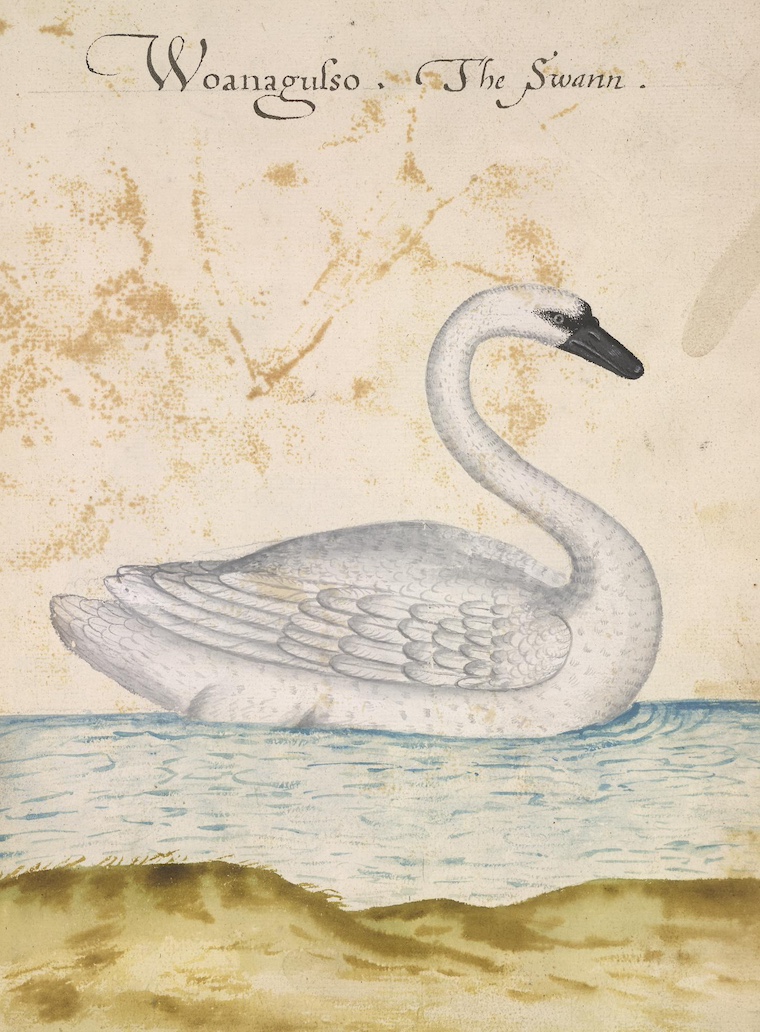
© The Trustees of the British Museum. Shared under a Creative Commons Attribution-NonCommercial-ShareAlike 4.0 International (CC BY-NC-SA 4.0) licence. Image has been cropped.
This is a link for a letter I wrote to the British Museum regarding the title of this painting.
2 The DEC’s August, 2014 response to public comments regarding their first Mute Swan plan included a strikingly dismissive statement by the DEC about the Alison-Burton analysis of the John White painting, the link to which statement is now defunct (http://www.dec.ny.gov/docs/wildlife_pdf/pubcomsmuteswan2015.pdf). The only link I could find today, in 2026, containing the DEC’s response to public comments, in fact, was for its 2017 third Mute Swan plan, the topic of this 2018 report, a response revised apparently in 2023, that does not mention Alison or Burton at all: https://dec.ny.gov/sites/default/files/2023-12/musw3rddrafapc.pdf.
3 The Alison-Burton report states:
“ . . . in 2001 a DC Federal Circuit Court of Appeals ruled (Hill v Norton) that all swans are protected by the MBTA [=Migratory Bird Treaty Act], including the Mute Swan. This prompted the US federal agencies to regroup and promote legislative steps to remove US federal Mute Swan protection. This was lobbied and formalized as the Migratory Bird Treaty Reform Act of 2005, based on the contention that the bird is not native to North America. While more than 100 other species of birds were put on the unprotected list, the Federal Register entry made by their attorney, Helen Paul, made it clear that the Mute Swan was the target of interest, but the reasoning is flawed and evidence goes against it.”
4 https://www.animals24-7.org/2016/12/04/speaking-up-wins-a-reprieve-for-mute-swans-in-new-york-state/
5 It would not seem out of place to mention that not long after Governor Cuomo signed Assembly Member Cymbrowitz’s Mute Swan Bill into law, following a long, arduous letter-writing campaign by activists, a young woman, a mom, a swan advocate working for Mr. Cymbrowitz, and a volunteer for GooseWatch NYC, died unexpectedly under mysterious circumstances, something that traumatized many of us.
6 Though the link is no longer working in 2026, current data from the FAA wildlife strike reports are readily available online and are similarly illuminating.
Posted on All-Creatures.org: August 31, 2026
Return to Wildlife Articles
Follow us on:


- Home Page
- What's New
- Contact Us
- Action Alerts
- Animal Exploitation
- Animal Issues
- Animal Rights Activism
- Archives
- Art & Photography
- Articles Directory
- Bible
- Bible Commentary Blog
- Books
- Campaigns
- Church & Religion
- Discussions
- Events / Podcasts / Media
- Health
- Hosted Web Sites
- Humor
- Kids' Korner
- Letters
- Links
- Nature Studies
- Newsletter
- Poetry & Stories
- Prayers
- Quotations
- Recipes with Photos
- Recipes Without Photos
- Sermons
- Stop Cruelty in Churches
- Video Library
- The Mary T. and Frank L. Hoffman Family Foundation
- Email: [email protected]
A web site sponsored by The Mary T. and Frank L. Hoffman Family Foundation and all-creatures.org
Copyright © 1998-2026 The Mary T. and Frank L. Hoffman Family Foundation. All rights reserved. May be copied only for personal use or by not-for-profit organizations to promote compassionate and responsible living. All copied and reprinted material must contain proper credits and web site link www.all-creatures.org.
Fair Use Notice: This document, and others on our web site, may contain copyrighted material whose use has not been specifically authorized by the copyright owners. We believe that this not-for-profit, educational use on the Web constitutes a fair use of the copyrighted material (as provided for in section 107 of the US Copyright Law). If you wish to use this copyrighted material for purposes of your own that go beyond fair use, you must obtain permission from the copyright owner.
Thank you for visiting all-creatures.org.
