Animals, Slavery, and the Holocaust
An Animal Rights Article from All-Creatures.org
FROM
Charles
Patterson, Author of
Eternal Treblinka
November 2012 Animals, Slavery, and the Holocaust
Another American contribution to Nazi Germany's Final Solution--eugenics--was rooted in animal exploitation. The breeding of domesticated animals--breeding the most desirable and castrating and killing the rest--became the model for American and German eugenic efforts to upgrade their populations. America led the way with regard to forced sterilizations, but Nazi Germany quickly caught up and went on to euthanasia killings and genocide.
Where does all the war, racism, terrorism, violence, and cruelty that's so endemic to human civilization come from? Why do humans exploit and massacre each other so regularly? Why is our species so violence-prone? To answer these questions we would do well to think about our exploitation and slaughter of animals and its effect on human civilization. Could it be that we oppress and kill each other so readily because our abuse and slaughter of animals has desensitized us to the suffering and death of others?
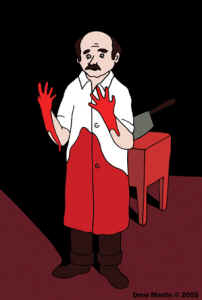
The "domestication" of animals--the exploitation of goats, sheep, cattle, and other animals for their meat, milk, hides, and labor that began in the Near East about 11,000 years ago--changed human history. In earlier hunter-gatherer societies there had been some sense of kinship between humans and animals, reflected in totemism and myths which portrayed animals, or part-animal part-human creatures, as creators and progenitors of the human race. However, mankind crossed the Rubicon when Near Eastern herdsmen and farmers started castrating, hobbling, and branding captive animals to control their mobility, diet, growth, and reproductive lives. To distance themselves emotionally from the cruelty they inflicted, they adopted mechanisms of detachment, rationalization, denial, and euphemism, and in the process became a harder, more ruthless lot.
In 1917 Sigmund Freud put the issue in perspective when he wrote: "In the course of his development towards culture man acquired a dominating position over his fellow-creatures in the animal kingdom. Not content with this supremacy, however, he began to place a gulf between his nature and theirs. He denied the possession of reason to them, and to himself he attributed an immortal soul, and made claims to a divine descent which permitted him to annihilate the bond of community between him and the animal kingdom."
The domination, control, and manipulation that characterizes the way humans treat animals who come under their control has set the tone and served as a model for the way humans treat each other. The enslavement/domestication of animals paved the way for human slavery. As Karl Jacoby writes, slavery was "little more than the extension of domestication to humans."
In the first civilizations that emerged in the river valleys of ancient Egypt, Mesopotamia, India, and China, the exploitation of animals for food, milk, hides, and labor was so firmly established that these civilizations sanctified the notion that animals existed solely for their benefit. That allowed humans to use, abuse, and kill them with total impunity. It also led humans to place other humans--captives, enemies, strangers, and those who were different or disliked--on the other side of the great divide where they were vilified as "beasts," "pigs," "dogs," "monkeys," "rats," and "vermin." Designating other people as animals has always been an ominous development because it sets them up for humiliation, exploitation, and murder. As Leo Kuper writes in Genocide: Its Political Use in the Twentieth Century, "the animal world has been a particularly fertile source of metaphors of dehumanization."
From Slaughterhouse to Death Camp
The relationship of animal exploitation to the Holocaust is less apparent than it is in the case of slavery, but there is a connection nonetheless. Take the case of Henry Ford, whose impact on the twentieth century began, metaphorically speaking, at an American slaughterhouse and ended at Auschwitz.
In his autobiography, My Life and Work (1922), Ford revealed that his inspiration for assembly-line production came from a visit he made as a young man to a Chicago slaughterhouse. "I believe that this was the first moving line ever installed. The idea [of the assembly line] came in a general way from the overhead trolley that the Chicago packers use in dressing beef." A Swift and Company publication from that time described the division-of-labor principle that so impressed Ford: "The slaughtered animals, suspended head downward from a moving chain, or conveyor, pass from workman to workman, each of whom performs some particular step in the process." It was but one step from the industrialized slaughter of animals to the assembly-line mass murder of people. In J. M. Coetzee's novel, The Lives of Animals, the protagonist Elizabeth Costello tells her audience: "Chicago showed us the way; it was from the Chicago stockyards that the Nazis learned how to process bodies."
Most people are not aware of the central role of the slaughterhouse in the history of American industry. "Historians have deprived the packers of their rightful title of mass-production pioneers," writes James Barrett in his study of Chicago's packinghouse workers in the early 1900s, "for it was not Henry Ford but Gustavus Swift and Philip Armour who developed the assembly-line technique that continues to symbolize the rationalized organization of work."
Henry Ford, who was so impressed by the efficient way meat packers slaughtered and dismantled animals in Chicago, made his own unique contribution to the slaughter of people in Europe. Not only did he develop the assembly-line method that Germans used to kill Jews, but he launched a vicious anti-Semitic campaign that helped make the Holocaust happen.
In the early 1920s Ford's weekly newspaper, the Dearborn Independent, published a series of articles based on the text of the Protocols of the Elders of Zion, an anti-Semitic tract that had been circulating in Europe. Ford published a book-length compilation of the articles entitled The International Jew, which was translated into most of the European languages and was widely disseminated by anti-Semites, chief among them the German publisher Theodor Fritsch, an early supporter of Hitler. Thanks to a well-financed publicity campaign and the prestige of the Ford name, The International Jew was hugely successful both domestically and internationally.
The International Jew found its most receptive audience in Germany where it was known as The Eternal Jew. Ford was enormously popular in Germany. When his autobiography went on sale there, it immediately became the country's number one bestseller. In the early 1920s The Eternal Jew quickly became the bible of the German anti-Semitism, with Fritsch's publishing house printing six editions between 1920 and 1922.
After Ford's book came to the attention of Hitler in Munich, he used a shortened version of it in the Nazi propaganda war against the Jews of Germany. In 1923 a Chicago Tribune correspondent in Germany reported that Hitler's organization in Munich was "sending out Mr. Ford's books by the carload." Baldur von Schirach, the leader of the Hitler Youth movement and the son of an aristocratic German father and American mother, said at the postwar Nuremberg war crimes trial that he became a convinced anti-Semite at age seventeen after reading The Eternal Jew. "You have no idea what a great influence this book had on the thinking of German youth. The younger generation looked with envy to symbols of success and prosperity like Henry Ford, and if he said the Jews were to blame, why naturally we believed him."
Hitler regarded Ford as a comrade-in-arms and kept a life-sized portrait of him on the wall next to his desk in his office in Munich. In 1923 when Hitler heard that Ford might run for President of the United States, he told an American reporter, "I wish that I could send some of my shock troops to Chicago and other big American cities to help in the elections. We look to Heinrich Ford as the leader of the growing Fascist movement in America. We have just had his anti-Jewish articles translated and published. The book is being circulated in millions throughout Germany." Hitler praised Ford in Mein Kampf, the only American to be singled out. In 1931, when a Detriot News reporter asked Hitler what Ford's portrait on the wall meant to him, Hitler said, "I regard Henry Ford as my inspiration."
Although Ford stopped publishing the Dearborn Independent in late 1927 and agreed to withdraw The International Jew from the book market, copies of The International Jew continued to circulate in large numbers throughout Europe and Latin America. In Nazi Germany the influence of The Eternal Jew continued to be strong and lasting, with German anti-Semites advertising and distributing it throughout the 1930s, often putting the names of Henry Ford and Adolf Hitler together on the cover. By late 1933, Fritsch had published twenty-nine editions, each with a preface praising Ford for his "great service" to America and the world for his attacks on the Jews.
In 1938, on the occasion of his seventy-fifth birthday, Henry Ford, the great admirer of the efficient way they slaughtered and cut up animals in America, accepted the Grand Cross of the Supreme Order of the German Eagle, the highest honor Nazi Germany could bestow on a foreigner (Mussolini was one of the three other foreigners to be so honored).
On January 7, 1942--exactly one month after the Japanese attack on Pearl Harbor that brought the United States into the war--Ford wrote a letter to Sigmund Livingston, national chairman of the Anti-Defamation League, in which he expressed his disapproval of hatred "against the Jew or any other racial or religious group." By that time, Einsatzgruppen (German mobile killing squads) in the East had already murdered hundreds of thousands of Jewish men, women, and children, and the first German extermination camp at Kulmhof (Chelmno) was already operational.
From Animal Breeding to Genocide
Another American contribution to Nazi Germany's Final Solution--eugenics--was rooted in animal exploitation. The breeding of domesticated animals--breeding the most desirable and castrating and killing the rest--became the model for American and German eugenic efforts to upgrade their populations. America led the way with regard to forced sterilizations, but Nazi Germany quickly caught up and went on to euthanasia killings and genocide.
The desire to improve the hereditary qualities of the human population had had its beginnings in the 1860s when Francis Galton, an English scientist and cousin of Charles Darwin, turned from meteorology to the study of heredity (he coined the term "eugenics" in 1881). By the end of the nineteenth century, genetic theories, founded on the assumption that heredity was based on rigid genetic patterns little influenced by social environment, dominated scientific thought.
The eugenics movement in America began with the creation of the American Breeders' Association (ABA) in 1903. At the second meeting of the ABA in 1905, a series of reports about the great success achieved in the selective breeding of animals and plants prompted delegates to ask why such techniques could not be applied to human beings. The creation of a committee on Human Heredity, or Eugenics, at the third ABA meeting in 1906 launched the American eugenics movement in America.
Its leader was poultry researcher Charles B. Davenport, who served as the director of the Eugenics Record Office (ERO) at Cold Spring Harbor on Long Island in New York. Davenport, who described eugenics as "the science of the improvement of the human race by better breeding," looked forward to the time when a woman would no more accept a man "without knowing his biologico-genealogical history" than a stockbreeder would take "a sire for his colts or calves who was without pedigree." He believed that "the most progressive revolution in history" could be achieved if "human matings could be placed upon the same high plane as that of horse breeding." Sterilization began in America in 1887, when the superintendent of the Cincinnati Sanitarium published the first public recommendation for the sterilization of criminals, both as a punishment and a way to prevent further crime. Authorities used the same method to sterilize male criminals that farmers used on their male animals not selected for breeding--castration. Castration was the preferred method used to sterilize male criminal offenders until 1899, when vasectomy was adopted because it was more practical.
Indiana passed the first state sterilization law in 1907. By 1930 more than half the American states passed laws that authorized the sterilization of criminals and mentally ill people, with California leading the way with more than sixty percent of the country's forced sterilizations. By the 1930s compulsory sterilization had widespread support in the United States, with college presidents, clergymen, mental health workers, and school principals among its strongest supporters. The United States quickly became the model for other countries that wanted to sterilize their "defectives." Denmark was the first European country to pass such a law in 1929, followed in rapid succession by other European nations.
In Germany, which passed its sterilization law six months after the Nazis came to power, eugenics established deep roots in medical and scientific circles after World War I. In 1920 two respected academics--Karl Binding, a widely published legal scholar, and Alfred Hoche, a professor of psychiatry with a specialty in neuropathology--published Die Freigabe der Vernichtung lebensunwerten Lebens (Authorization for the Destruction of Life Unworthy of Life). In it they argued that German law should permit the mercy killing of institutionalized patients who were lebensunwert ("unworthy of life") and whose lives were "without purpose" and a burden to their relatives and society. Beginning in the 1920s, the Rockefeller Foundation and other American foundations provided extensive financial support for eugenics research in Germany. By the time the Nazis came to power, more than twenty institutes for "racial hygiene" had already been established at German universities.
The Law on Preventing Hereditarily Ill Progeny, which the Nazi government issued on July 14, 1933, required the sterilization of patients suffering from mental and physical disorders in state hospitals and nursing homes. By then, the United States had already sterilized more than 15,000 people, most of them while they were incarcerated in prisons or homes for the mentally ill. America's sterilization laws made such a favorable impression on Hitler and his followers that Nazi Germany looked to the United States for racial leadership. Hitler took a special interest in the progress of eugenics in the United States. "I have studied with great interest the laws of several American states concerning prevention of reproduction by people whose progeny would, in all probability, be of no value or be injurious to the racial stock." However, Nazi Germany's sterilization efforts quickly surpassed those of the United States. Estimates of the total number of Germans sterilized under the Nazis range from 300,000 to 400,000.
The Germans were also impressed by America's immigration laws, which barred people with hereditary diseases and limited people from non-Nordic countries. In 1934 the German race anthropologist Hans F. K. Gunther told an audience at the University of Munich that American immigration laws should serve as a guideline and inspiration for Nazi Germany. German race scientists also admired America's segregation and miscegenation laws. In fact, Nazi theorists complained that German race policies lagged behind America's, pointing out that in certain southern states a person with 1/32 black ancestry was legally black, while in Germany, if somebody was 1/8 Jewish or in many instances 1/4 Jewish, that person was considered legally Aryan.
Americans were the strongest foreign supporters of Nazi race policies. In 1934 Eugenic News proclaimed that in "no country of the world is eugenics more active as an applied science than in Germany" and praised the Nazi sterilization law as an historic advance. Scores of American anthropologists, psychologists, psychiatrists, and geneticists visited Nazi Germany where they had high-level meetings with Nazi leaders and scientists and visited racial hygiene institutes, public health departments, and hereditary health courts. When the Americans returned and reported on their visits in professional journals and newsletters, they lauded the German sterilization program.
Like the American Charles Davenport, Heinrich Himmler, head of the Nazi SS and a main architect of the Final Solution, began his eugenics education with animal breeding. His agricultural studies and experience breeding chickens convinced him that since all behavioral characteristics are hereditary, the most effective way to shape the future of a population--human or otherwise--was to institute breeding projects that favored the desirable and eliminated the undesirable. Himmler was soon in a position to apply eugenic principles and methods to human beings in a way no American eugenicist was ever able to do.
Rudolf Hoss, the commandant of Auschwitz and another strong supporter of eugenics with a farming background, wrote in his autobiography after the war that the original plan for Auschwitz had been to make it into a major agricultural research station. "All kinds of stockbreeding was to be pursued there." However, in the summer of 1941 Himmler summoned him to Berlin to inform him of the fateful order for the mass extermination of the Jews of Europe, an order that soon turned Auschwitz into "the largest human slaughterhouse that history had ever known." By the summer of 1942 Auschwitz was a vast, full-service eugenics center for the improvement of animal and human populations, complete with stockbreeding centers and the Birkenau extermination camp for the culling of Jews, Gypsies, and other "sub-humans." Germany's eugenics campaign entered a new, deadly phase in 1939 when Hitler issued a secret order for the systematic murder of mentally retarded, emotionally disturbed, and physically infirm Germans who were an embarrassment to the myth of Aryan supremacy.
Once "defective" children were identified and institutionalized, doctors and nurses either starved them to death, or gave them lethal doses of luminal (a sedative), veronal (sleeping pills), morphine, or scopolamine. The "euthanasia" program--named Operation T4, or simply T4--transported adults to special killing centers outfitted with gas chambers. T4 killed between 70,000 and 90,000 Germans before it was officially stopped in August 1941. In 1942, not long after German psychiatrists had sent the last of their patients to the gas chambers, the Journal of the American Psychiatric Association published an article that called for the killing of retarded children ("nature's mistakes").
The breeding and culling of animals that was at the center of American and German eugenics produced a number of key T4 personnel, including those sent to Poland to operate the death camps. Victor Brack, T4's chief manager, received a diploma in agriculture from the Technical University in Munich, while Hans Hefelmann, who headed the office that coordinated the killing of handicapped children, had a doctorate in agricultural economics. Before spending more than two years at the Hartheim euthanasia center in Austria, Bruno Bruckner had worked as a porter in a Linz slaughterhouse. Willi Mentz, an especially sadistic guard at Treblinka, had been in charge of cows and pigs at two T4 killing centers, Grafeneck and Hadamar. Treblinka's last commandant, Kurt Franz, trained with a master butcher before joining the SS. Karl Frenzel, who worked as a stoker at Hadamar before being posted to the Sobibor death camp, had also been a butcher. For German personnel sent to Poland to exterminate Jews, experience in the exploitation and slaughter of animals proved to be excellent training.
The exploitation and slaughter of animals provides the precedent for the mass murder of people and makes it more likely because it conditions us to withhold empathy, compassion, and respect from others who are different. Isaac Bashevis Singer wrote, "There is only one little step from killing animals to creating gas chambers a la Hitler." Indeed there is. About the same time the German Jewish philosopher Theodor Adorno made a similar point: "Auschwitz begins whenever someone looks at a slaughterhouse and thinks: they're only animals."
Indeed it does.
Charles Patterson is a social historian, Holocaust educator, editor, therapist, and author. His first book, Anti-Semitism: The Road to the Holocaust and Beyond, was called "important" by Publisher’s Weekly. The National Council for the Social Studies in Washington, D.C. presented Patterson with its Carter G. Woodson Book Award for his biography of Marian Anderson at a special luncheon at its annual convention in St. Louis, Missouri in 1989. His best known book is Eternal Treblinka: Our Treatment of Animals and the Holocaust (now in 16 languages).
Return to Animal Rights Articles
Follow us on:


- Home Page
- What's New
- Contact Us
- Action Alerts
- Animal Exploitation
- Animal Issues
- Animal Rights Activism
- Archives
- Art & Photography
- Articles Directory
- Bible
- Bible Commentary Blog
- Books
- Campaigns
- Church & Religion
- Discussions
- Events / Podcasts / Media
- Health
- Hosted Web Sites
- Humor
- Kids' Korner
- Letters
- Links
- Nature Studies
- Newsletter
- Poetry & Stories
- Prayers
- Quotations
- Recipes with Photos
- Recipes Without Photos
- Sermons
- Stop Cruelty in Churches
- Video Library
- The Mary T. and Frank L. Hoffman Family Foundation
- Email: [email protected]
A web site sponsored by The Mary T. and Frank L. Hoffman Family Foundation and all-creatures.org
Copyright © 1998-2026 The Mary T. and Frank L. Hoffman Family Foundation. All rights reserved. May be copied only for personal use or by not-for-profit organizations to promote compassionate and responsible living. All copied and reprinted material must contain proper credits and web site link www.all-creatures.org.
Fair Use Notice: This document, and others on our web site, may contain copyrighted material whose use has not been specifically authorized by the copyright owners. We believe that this not-for-profit, educational use on the Web constitutes a fair use of the copyrighted material (as provided for in section 107 of the US Copyright Law). If you wish to use this copyrighted material for purposes of your own that go beyond fair use, you must obtain permission from the copyright owner.
Thank you for visiting all-creatures.org.
