From all-creatures.org
Animal Rights Articles
Moo-ving people toward compassionate living
Visit the all-creatures.org Home Page.
Write us with your comments: [email protected]
New Orangutan Population Found in Indonesia
By Robin McDowell, AP
Conservationists have discovered a new population of orangutans in a remote, mountainous corner of Indonesia � perhaps as many as 2,000 � giving a rare boost to one of the world's most endangered great apes.
A team surveying forests nestled between jagged, limestone cliffs on the eastern edge of Borneo island counted 219 orangutan nests, indicating a "substantial" number of the animals, said Erik Meijaard, a senior ecologist at the U.S.-based The Nature Conservancy.
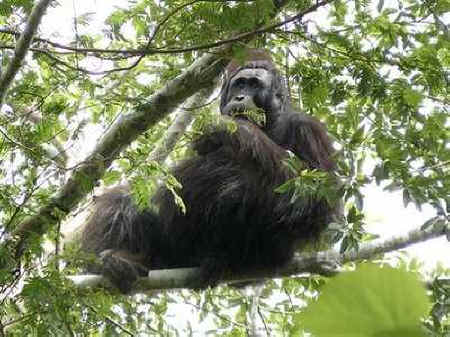
In this undated photo released by The Nature Conservancy, an orangutan of a newly found population is seen in Sangkulirang forest on Borneo island, Indonesia. (AP Photo/The Nature Conservancy, HO)"We can't say for sure how many," he said, but even the most cautious estimate would indicate "several hundred at least, maybe 1,000 or 2,000 even."
The team also encountered an adult male, which angrily threw branches as they tried to take photos, and a mother and child.
There are an estimated 50,000 to 60,000 orangutans left in the wild, 90 percent of them in Indonesia and the rest in neighboring Malaysia.The countries are the world's top producers of palm oil, used in food, cosmetics and to meet growing demands for "clean-burning" fuels in the U.S. and Europe. Rain forests, where the solitary animals spend almost all of their time, have been clear-cut and burned at alarming rates to make way for lucrative palm oil plantations.
The steep topography, poor soil and general inaccessibility of the rugged limestone mountains appear to have shielded the area from development, at least for now, said Meijaard. Its trees include those highly sought after for commercial timber.
Birute Mary Galdikas, a Canadian scientist who has spent nearly four decades studying orangutans in the wild, said most of the remaining populations are small and scattered, which make them especially vulnerable to extinction.
"So yes, finding a population that science did not know about is significant, especially one of this size," she said, noting that those found on the eastern part of the island represent a rare subspecies, the black Borneon orangutan, or Pongo pygmaeus morio.
The 700-square mile (2,500-square kilometer) jungle escaped the massive fires that devastated almost all of the surrounding forests in the late 1990s. The blazes were set by plantation owners and small-scale farmers and exacerbated by the El Nino droughts.
Nardiyono, who headed The Nature Conservancy's weeklong survey in December, said "it could be the density is very high because after the fires, the orangutans all flocked to one small area."It was unusual to come face-to-face with even one of the elusive creatures in the wild and to encounter three was extraordinary, he said, adding that before this expedition, he had seen just five in as many years.
Conservationists say the most immediate next step will be working with local authorities to protect the area and others that fall outside of national parks. A previously undiscovered population of several hundred also was found recently on Sumatra island, home to around 7,000.
"That we are still finding new populations indicates that we still have a chance to save this animal," said Paul Hartman, who heads the U.S.-funded Orangutan Conservation Service Program, adding it's not all "gloom and doom."
Noviar Andayani, head of the Indonesian Primate Association and Orangutan Forum, said the new discoveries point to how much work still needs to be done to come up with accurate population assessments, considered vital to determining a species' vulnerability to extinction.
"There are many areas that still have not been surveyed," she said, adding that 18 private conservation groups have just started work on an in-depth census based on interviews with people who spend time in the forests.
They include villagers and those working on plantations or within logging concessions.
"We hope this will help fill in a few more gaps," said Andayani, adding that preliminary tests in areas where populations are known indicate that the new interview-based technique could provide a clearer picture than nest tallies.
"Right now the information and data we have about orangutans is still pretty rudimentary," she said.
Some experts say at the current rate of habitat destruction, the animals could be wiped out within the next two decades.
Return to Animal Rights Articles
Please Help Our Efforts
We welcome your comments:
Fair Use Notice: This document may contain copyrighted material whose use has not been specifically authorized by the copyright owners. We believe that this not-for-profit, educational use on the Web constitutes a fair use of the copyrighted material (as provided for in section 107 of the US Copyright Law). If you wish to use this copyrighted material for purposes of your own that go beyond fair use, you must obtain permission from the copyright owner.
All Creatures Animal Rights Article: justice, peace, love, compassion, ethics, organizations, Bible, God, Lord, Jesus, Christ, Holy Spirit, grass roots, animals, cruelty free, lifestyle, hunting, fishing, traping, farm, farming, factory, fur, meat, slaughter, cattle, beef, pork, chicken, poultry, hens, battery, debeaking. Thee is also a similarity to the human aspects of prolife, pro life, pro-life, abortion, capital punishment, and war.


| Home Page | Animal Issues | Archive | Art and Photos | Articles | Bible | Books | Church and Religion | Discussions | Health | Humor | Letters | Links | Nature Studies | Poetry and Stories | Quotations | Recipes | What's New? |
Thank you for visiting all-creatures.org.
Since