Animals: Tradition - Philosophy - Religion Article used with permission from All-Creatures.org
Using the writings of Emperor Julian as a jumping-off point, Joan Harrison examines the story of Adam and Eve and makes the compelling case that the serpent was not evil but may have committed an act of good by choosing to help impart wisdom to Eve.
Is the Serpent Innocent? – A Meditation on Genesis 1-3
From Joan Harrison
December 2025
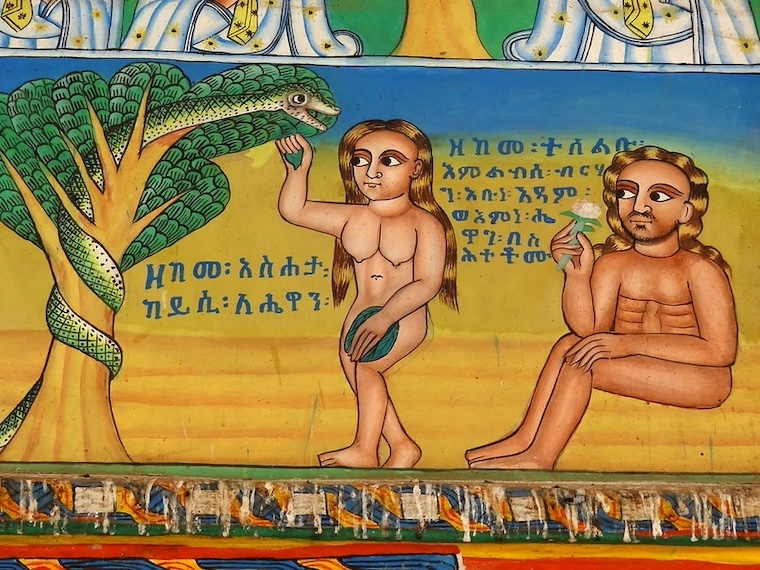
Adam & Eve & the Serpent - Facade of I Yesus Church - Axum (Aksum) - Ethiopia. From Flickr. See license here. Photo Credit: Adam Jones
“ . . . that the human race possesses its knowledge of God by nature and not from teaching is proved to us first of all by the universal yearning for the divine that is in all men . . . “
(Julian, Against the Galileans)
The Emperor Julian (331-363)—generally known as the last pagan emperor of Rome, for though raised a Christian he renounced Christianity and Christians named him Julian the Apostate1—in his famous, though no longer extant work, Against the Galileans [=Christians]—a portion of which is preserved in the critical writing of Cyril of Alexandria (376-444), a Christian Patriarch—argues that the serpent of the garden is good and the God deficient:
" . . . is it not excessively strange that God should deny to the human beings whom he had fashioned, the power to distinguish between good and evil? What could be more foolish than a being unable to distinguish good from bad? For it is evident that he would not avoid the latter, I mean things evil, nor would he strive after the former, I mean things good. And, in short, God refused to let man taste of wisdom, than which there could be nothing of more value for man. For that the power to distinguish between good and less good is the property of wisdom is evident surely even to the witless; so that the serpent was a benefactor rather than a destroyer of the human race. Furthermore, their God must be called envious. For when he saw that man had attained to a share of wisdom, that he might not, God said, taste of the tree of life, he cast him out of the garden, saying in so many words, 'Behold, Adam has become as one of us, because he knows good from bad; and now let him not put forth his hand and take also of the tree of life and eat and thus live forever.' Accordingly, unless every one of these legends is a myth that involves some secret interpretation, as I indeed believe, they are filled with many blasphemous sayings about God.”
(https://www.tertullian.org/fathers/julian_apostate_galileans_1_text.htm)
What is the hermeneutic evidence for the serpent? The answer to this question likely depends on the relationship between human and nonhuman animals. There is in the biblical text, as many commentators note, a double human creation—the first at Genesis 1:26-27, the second at Genesis 2:7, 21-22. The first humans are created by a plurality of gods (Elohim) and in their image, and they're created male and female simultaneously. The second—Adam and Eve, male and female—are created separately and by a single deity (Yaweh), though not necessarily in his image (cf. Genesis 9:6) —Adam from the dust of the ground, into which the divine breath breathes, making him a living soul, Eve somewhat later from Adam's rib. There's also a double animal creation, the first at Genesis 1:20-25, the second at Genesis 2:19. The first humans, created after the animals, are given dominion over them—and the animals are declared good, though the humans are not. (The first humans and the firmament [raqia]2 are alone not called good in Genesis 1.) Adam, on the other hand, is assigned the task of naming the animals—animals created afterwards, not before, and for the purpose of being Adam’s helpers. He is to name not the species, which are already named—whales, fishes, winged birds, cattle, serpents—rather, each living animal soul (2:19). If to name a being is to recognize the individuality thereof, dominion would seem to center on an apprehension of mere species. The act of naming the individual would imply some measure of intimacy or friendship—for how else would the names arise?—whereas dominion, however conceived, would seem more or less impersonal. Why, then, is Adam, the namer and friend of animals, unable to find a helper among them? Is there a connection between that and the serpent’s approaching Eve rather than Adam? And what sort of God creates animals to be helpers who then prove not to be that?
Julian does not ask those questions, rather, he accuses God of being “ignorant that she who was created as a help meet would be the cause of the fall . . .” Might he not have concluded the same with respect to the serpent? And might he not have asked what sort of God creates a man for the purpose of tending his garden and keeping it, only to expel him from it? Julian looks to the source of the ignorance:
“ . . . to refuse the knowledge of good and bad, which knowledge alone seems to give coherence to the mind of man; and lastly to be jealous lest man should take of the tree of life and from mortal become immortal—this is to be grudging and envious overmuch.”
If the divine act of creation springs from envy (cf. Plato's Timaeus 29 b, e)3—are we not compelled to ask, envy of whom? Maybe Julian never truly renounced Christianity after all? And apropos of the God of the garden, if he is exemplary neither in knowledge, foresight, power, nor mercy, is he a God at all? If he fears so greatly that Adam4 will eat from the tree of life and become immortal, to the point of setting cherubim and a flaming sword to guard it and keep him out, it’s difficult not to wonder how it is that the tree of life might override the divine injunction, for how could a created being surpass the power of its creator? Yet the acquisition of the knowledge of good and evil cannot be reversed or the God in his anger would have reversed it in the case of Adam. And immortality, like knowledge, is apparently inviolable, or the divine fear would not have arisen. Why, however, does the errant couple not eat of that tree against which there is no prohibition?
It would be rash to assume that like children and dreams they don’t believe in death—for death is what the God initially threatens and at first they obey, though in the case of Eve any lingering fear after the serpent’s reassurance is overridden by the desire for wisdom. Yet how does Eve know that wisdom is something good or to be desired or that she herself is not already wise? As for the couple’s failing to bound over to the tree of life, one may imagine that before they taste of knowledge there is no need, for the temporality of innocence is almost indistinguishable from eternity, and afterwards no desire, as shame and fear disclose the true character of their nakedness—ubiquitous exposure at the mercy of others. Whether or not there’s a glimmering sense in them that their true destiny is beyond this world, or that their souls are already immortal because encoded with eternal truth, or that the course of their lives is ultimately in the hands of a higher, beneficent power, there is no way to know. And yet the knowledge that the tree of the knowledge of good and evil provides would seem limited5 because it does not prevent those who taste of it from going astray, and, as will become clear, with it one may choose good, as does the serpent, or evil, as does the God, its creator, who, despite his fear of competitors in eternity, seems to preside only over the exigencies of time and to seek to suppress all striving toward transcendence. The indifference to immortality of Adam and Eve seems to bypass him.
The prohibition against eating of the tree of knowledge, moreover, applies to the second set of humans only, not the first. There is no such prohibition for the animals at all. The serpent is articulate and prudent—the Septuagint translates the Hebrew "arum" "phronimotatos" ("wisest") of the animals created in the field.6 So we may surmise that he's already eaten of the tree. For how else would he be so sure of what happens thereby? Yet if the serpent is wisest of the animals of the field, then he is not necessarily wiser than the birds of the air or the whales and fishes of the seas—and the birds who might have intervened to enlighten Eve did not. Note also that the creatures of air and sea are blessed by God and told to be fruitful and multiply, whereas those of the land are not told to be fruitful and multiply, nor are they blessed. The cattle are later called cursed by the same God in the tirade in which he curses the serpent "even beyond the cattle and the other beasts of the field."
If the serpent knows the difference between good and evil, and is surpassing in wisdom, and he chooses to help impart wisdom to Eve, is he not ipso facto choosing good over evil? The serpent does not lie—what he says comes to pass. The God lies. Eve lies. She says, "the serpent deceived me and I ate." The serpent, however, does not deceive her.7 The God deceives her, saying that those who eat of the tree of knowledge will, in that day, die. Adam and Eve do not die in that day, nor are they forever precluded from immortality, or the God would not have been seized by fear. The serpent, however, is mutilated and martyred, forever deprived of the ability to speak, and apparently deprived of whatever limbs or appendages he had at first, though not deprived of wisdom.
That animals are far from devoid of reason or wisdom is evident in key places in the bible. More than once God speaks of a covenant he makes with them. Ravens, taking orders from God, bring food to Elijah. A dove enlightens Noah about the end of the flood. God opens the mouth of Balaam's ass and she reasons with great passion, pleading for mercy. More than that, she perceives an angel in their path, long before her master does. And as if to acknowledge their intrinsic worth, animals in the beginning are not there to be eaten. Both groups of humans, and all the animals, rather, are given a vegan diet—Genesis 1:29-30, 2:9 and 16—a mandate to which the Hebrew prophets later return. (Daniel, of course, regards animal food as defilement.) Yet violence toward animals would seem to be going on somewhere in the vicinity of Eden for, immediately prior to the expulsion, the God of the garden clothes Adam and Eve in skins. Are they the product of the first couple's dominion over the animals? Or are they human skins, as some suggest, or as others, skins made from the barks of trees? Augustine speaks of sin as a penalty for sin, and providing skins of slaughtered beings as clothing, if that is what they are, may be an example of that here (see also Genesis 8:20-21 with 9:2-3), though in what the sin of Adam and Eve consists is unclear. Thomas Paine once quipped, "a man [Jesus] had to die an agonizing death because Adam and Eve ate an apple." There is, indeed, something bewildering about the excesses of the divine wrath.
Adam blames Eve for his disobedience. Eve blames the serpent and maligns him. Neither stands up to the God. Neither attempts to defend their perfectly reasonable position. If, however, for evil power the only serious sin is disobedience,8 and if in the face of great evil it's often best to choose flight over argument, is it possible that their timidity springs not from deficiency, rather, from knowledge? And yet maligning and casting blame on another, rather than taking responsibility for one's own transgressions, would not seem a choice of good, and the serpent, by contrast, seems an embodiment of valor and truth.
The animals of Genesis 1 are created good. What about those of Genesis 2? The word "good" ("tov" in Hebrew, "kalon" in Greek) appears only twice there—once when applied to the gold of Havilah—a place the location of which is still debated by scholars—and the second time when God states that it's "not good" for man to be alone, at which time he creates the second population of animals as helpers to man. So the animals are there to serve the good, and we may infer that there human + animal = good. Yet if both together are good, is it possible that each separately is anything else? For only among the first humans, who are not said to be good, does dominion define the human/animal bond (although cf. Genesis 9:2-3 where dominion though not mentioned explicitly is surely implied), which could suggest that if either side is evil, the totality will be evil.9 And yet despite crucial parts of his creation being evil, at the end of Genesis 1 God declares the totality of his work ("ta panta" in the Septuagint) "very good."10 So apropos of the talking serpent, this line of reasoning yields only an inconclusive result. And yet, whether or not he is good the way that all the animals of Genesis 1 are good, and the evidence would seem very much in his favor, there is nothing to suggest an identity between him and the serpent in the Book of Revelation, who is called Satan. Nor is there anything to suggest that Satan enters into him.11 The only hint of Satanic evil replete with envy and pride would appear to be in the disproportionate punitive cruelty of the God of the garden.12
The received narrative about the serpent (2 Corinthians 11:3) undoubtedly contributed and continues to contribute to the anti-animal sentiment that suffuses, almost defines, and may now be the downfall of, our so-called civilization. There's an uncanny irony, however, in Julian's questioning that narrative, indeed, in his extolling the creature, as, by the way, did many early Christian Gnostics, as the Nag Hammadi scriptures, discovered in 1945, reveal.13 For it was not that long after his cousin Constantius II—who raised Julian from the age of six, successor to and son of the Emperor Constantine, Julian's uncle —banned animal sacrifice and closed all pagan temples—that Julian, once emperor, restored that heinous practice and encouraged it along with the worship of pagan gods.
According to Sir Edward Gibbon, the issue of animal sacrifice was ultimately the pivotal issue driving the enmity between pagans and the earliest Christians.14 The latter unanimously—as is attested by Augustine, Eusebius, and others (and see the Septuagint for Psalm 96:5 and 1 Corinthians 10:20)—regarded the Greek and Roman gods as demons and the sacrificing of animals to them as idolatry and demon worship. When Julian rose to power, however, he went to such lengths to restore animal sacrifice that even the pagans were revolted by it. And a mere three decades or so after Julian's death at the age of thirty-two, the Emperor Theodosius I, or Theodosius the Great, permanently banned the practice again and made it a capital offense (Codex Theodosianus XVI.x.4).15
Endnotes
1 For a philosophical account of Julian, see Montaigne’s Essays, Book II, Chapter 19. For a detailed look at his noble though complex character and historical significance in securing the triumph of Christianity, see Sir Edward Gibbon’s History of the Decline and Fall of the Roman Empire, Chapters XXII-XXIV, especially Chapter XXIV, Part 4.
2 The firmament or raqia, identified as the heavens (hashamayim) or "heaven" in the King James translation, is created on the second day, the only day on which the divine maker does not call his creation "good." If he's identifying the firmament with the heavens, then clearly he intends the visible heavens. About any heaven beyond the visible world, any suprasensual heaven, he is silent.
And if the first humans are evil and made in the image of their creators, what are we to infer about the Elohim? The first humans are commanded to be fruitful and multiply, "replenish" the earth [as if it's been laid waste though previously teeming with life, as at Genesis 9:1?], subdue it, and have dominion over all the animals—a different set of orders from those given to Adam.
The first set of birds, similarly, are brought forth from the sea (Genesis 1:20), the second from the earth (Genesis 2:19).
The double creations are obviously not sustained throughout the biblical text (see Genesis 9:6), yet they are so striking in the beginning that—especially given that in so many centuries, with all the biblical erasures that are known, the passages were not erased—they would seem unmistakably to be significant hints at a deeper meaning below the surface.
3 The language of Genesis 2.1 suggests that the cosmos is to be a place of combat.
4 Although "adam" in Hebrew means both “man” and “human” and, therefore, like the Greek "anthropos," could include Eve, the verbs in that passage are all singular, indicating "the human" as their subject. Why not "the humans"?
5 Knowledge as such obviously could not cause error—or, indeed, a mistaking of evil for good—though if, as for Socrates, to choose evil is to choose what is mistakenly believed to be good, that error is found frequently with envy, or at least ontological, ressentiment envy as Nietzsche and Scheler describe it. If trivial envy vanishes once its object is achieved—you buy a car at least as good as your neighbor's and your envy of your neighbor for his car ceases—ressentiment envy, rather, broken off from its original object and festering underground, seeks not to gain for itself, rather, unprovoked and gratuitous, it seeks to deprive the other of his or her very being. The annihilation of a being, however, only increases the original inchoate hunger, which finally takes on a limitless, demonic character, the poison of which Max Scheler calls a "contagion." When Bernadette of Lourdes, in the famous Zwerfel novel, defines a "sinner" as "someone who loves evil," rather than "someone who does evil," whether knowingly or not she is highlighting the error or crippling rapaciousness of blind desire deep in the soul of the sinner. For Scheler, the antidotes for ressentiment envy are renunciation and agape.
6 The King James translators translate the Hebrew word arum as "subtil," as if to align it with the same word in the Book of Job where it has a negative connotation of "crafty" or "hubristic." The vast majority of instances of that word in the Hebrew bible occur in Proverbs, however, where it means "prudent" in the good sense. Thus the Septuagint translates the phrase containing arum as "phronimotatos" or "most prudent."
If the serpent is wisest of the creatures of the field, however, how does the tree of knowledge alone account for gradations of knowledge or wisdom? And given that whales and other sea creatures have no access to the tree, yet are apparently wiser even than the serpent, are we not to infer a separate source of knowledge and wisdom?
7 If we assume for the moment that Eve does not lie, the question arises, why does she feel deceived? The serpent said these things (Genesis 3:4-5): “Ye shall not surely die./ For God doth know that in the day ye eat thereof, then your eyes shall be opened, and ye shall be as gods, knowing good and evil.” The God later confirms the truth of that statement (Genesis 3:22). If that God is the envious liar that the serpent judiciously implies, how could Eve not suspect that her transgression would have consequences? And yet she accuses the serpent before any retribution is meted out. So we may surmise something like this.
After hearing from the serpent, she anticipates joy and power—the joy of wisdom and the power of divinity. After eating of the tree, however, she experiences only shame, most likely the fear to which Adam confesses, and therefore powerlessness, even while achieving the knowledge of good and evil of the gods (Elohim). The garden is not what it seemed at first! The God is not what he seemed at first! The serpent's characterization is validated. Is that not something she needed to know? If so, then accusing the serpent for her great disappointment would seem paradigmatic of what Sartre names mauvaise foi, or bad faith.
8 Cf. Numbers 22:20-22 where Balaam’s obedience causes God to wax wroth!
9 See also Genesis 8:20-21. Note that the dove who brings the olive leaf to Noah flees the ark thereafter and does not return, as if knowing what lay in store! Also note that immediately after Noah begins sacrificing the animals, God concludes that the imagination of the heart of man is evil from youth, as a result of which, as if pleased, he vows not to send any more floods. If evil from youth, i.e., from societal pressures, are such humans, as opposed to the first created, born good?
10 The totality theory of evil—over against the argument that the existence of evil disproves God's existence—maintains the compatibility between an omniscient, omnipotent, all-wise, beneficent God and the existence of evil, on grounds that evil enhances the goodness of the totality. That argument, however, could in principle justify any evil and vitiate any objection thereto! How, moreover, within the biblical narrative, is it possible for the totality to be "very good," if the humans, or a great percentage thereof, and the very heavens, are evil? Are we to infer that the locus of redemption is the natural world, including the animals, and the waters above the heavens, all of which, directly or indirectly, are acknowledged to be good?
The God who is the subject of the verb "he created" (bera) in Genesis 1, however, as the Zohar points out, cannot be the Elohim, because the latter is a plural whereas the verb is singular. Who, then, is the subject!? Is there an implied deus absconditus there about whom nothing explicit is said? And notice that bet-resh-aleph are the first three letters of the work, though hidden as a unit within what is generally understood to be the first word of six letters, beresheet.
11 The Ethiopian Book of Jubilees could seem to imply this. Milton states it explicitly in Book 9 of Paradise Lost.
12 Certain Christian Gnostic sects such as the Marcionites and the Cathars regarded the God of the Hebrew bible as Satan. See also John 7-8, 12:31, 18:36, and 2 Corinthians 4:4.
13 Certain of those scriptures go so far as to identify the serpent of the garden as Jesus—the one who brings light and liberates through gnosis. See John 3:14, Numbers 21:6-9, and Matthew 10:16. When Jesus tells his apostles, "Be ye therefore wise as serpents and harmless as doves," the New Testament Greek for "wise" is "phronimoi," in line not with Paul, rather, with the Septuagint. The serpents mentioned in Matthew 23:33, on the other hand, are clearly of a different sort.
14 See Hosea 6:6, a passage Jesus quotes twice at Matthew 9:13 and 12:7. Jesus' own vehement rejection of animal sacrifice is well-known and reported in various non-canonical texts. In the Gospels it's manifest in his explosion in the Temple at the table of the moneychangers and in his driving out the animals who are there to be sacrificed. (Compare, for example, Jeremiah 7:6-11 with Matthew 21:13, Mark 15-17, and Luke 19:45-46. Cf. John 2:14-17). That event, which appears in all four Gospels, apparently occurred only a few days before the crucifixion and may have provided part of the pretext for it. According to Andrew Linzey it was the precipitating cause.
See also Gibbon, Chapter 16, especially footnote 19, with Tertullian, Apologia, chapters 7-9. Without the latter and other works like it we might be led to conclude with Nietzsche that in the entire history of the world “there was only one Christian and he died on the cross.”
15 The bans on animal sacrifice in Rome also covered the Jews, to whom Julian was a great friend—if, that is, as Gibbon points out, the words “emperor” and “friend” may cohere together! He even attempted to help rebuild their Jerusalem Temple, a Temple which, before it was destroyed by Titus in 70, in the words of Andrew Linzey, was "a mass slaughterhouse." There had been a couple of other attempts by other emperors—Hadrian and Constantine—to rebuild the Temple, both of which failed. And the attempt failed this time also. Mysterious, deadly fireballs are reported to have burst forth from the interior of the structure killing many. A cross is said to have appeared in the sky and/or on the clothing of several workers, which they could not wash out, and an earthquake erupted on-site, the ground shook, and nearby buildings fell, as workers and Jews perished. Julian was thus forced to abort the project, for which even the Jews were grateful.
Posted on All-Creatures.org: December 16, 2025
Return to Animals: Tradition—Philosophy—Religion Articles
Follow us on:


- Home Page
- What's New
- Contact Us
- Action Alerts
- Animal Exploitation
- Animal Issues
- Animal Rights Activism
- Archives
- Art & Photography
- Articles Directory
- Bible
- Bible Commentary Blog
- Books
- Campaigns
- Church & Religion
- Discussions
- Events / Podcasts / Media
- Health
- Hosted Web Sites
- Humor
- Kids' Korner
- Letters
- Links
- Nature Studies
- Newsletter
- Poetry & Stories
- Prayers
- Quotations
- Recipes with Photos
- Recipes Without Photos
- Sermons
- Stop Cruelty in Churches
- Video Library
- The Mary T. and Frank L. Hoffman Family Foundation
- Email: [email protected]
A web site sponsored by The Mary T. and Frank L. Hoffman Family Foundation and all-creatures.org
Copyright © 1998-2026 The Mary T. and Frank L. Hoffman Family Foundation. All rights reserved. May be copied only for personal use or by not-for-profit organizations to promote compassionate and responsible living. All copied and reprinted material must contain proper credits and web site link www.all-creatures.org.
Fair Use Notice: This document, and others on our web site, may contain copyrighted material whose use has not been specifically authorized by the copyright owners. We believe that this not-for-profit, educational use on the Web constitutes a fair use of the copyrighted material (as provided for in section 107 of the US Copyright Law). If you wish to use this copyrighted material for purposes of your own that go beyond fair use, you must obtain permission from the copyright owner.
Thank you for visiting all-creatures.org.
