 Art and Photo Presentations from All-Creatures.org
Art by Barry Kent MacKay
In this section are copies of original works of art. All of them are dedicated to helping us live according to unconditional love and compassion, which is the foundation of our peaceful means of bringing true and lasting peace to all of God's creatures, whether they are human beings or other animals.
American Robin (Turdus migratorius)

(Artwork - 254)
American Robin (Turdus migratorius)
I believe that there is no species of wild bird better known to more people in North America than the American Robin. While, as the scientific name implies – it means “migrating thrush” – the species is quite migratory, vacating many colder parts of its vast range in the fall, and returning in the spring, that means that at one time of the year or another American Robins can be seen in every one of the Canadian provinces and territories and every continental U.S. state, plus much of Mexico, and even into the West Indies (especially western Cuba). It has been estimated that there are about 370 million American Robins, and while robins are very much at home in bleak, boreal forests – I have even seen them out on the tundra – they are so well known because they also cohabit with humans in urban and suburban settings, often nesting in close proximity to, or even on ledges provided by, our homes and other structures. They, like Killdeer, Canada Geese, and Common Starlings – but even more so – are drawn to turf grass, the mowed greenswards we so favor for lawns, parks, golf courses, and picnic grounds. But they don’t harm the grass, and in fact are searching for invertebrates to consume, most noticeably earthworms, most of which are non-native species whose presence, contrary to popular opinion, can be deleterious to native vegetation. But robins also eat fruit, and while they are among the most popular of wild birds they are often the bane of orchardists and commercial growers of berries.
Not surprisingly American Robins show considerable subspecific variation. My painting shows the nominate race, but I live near a transition zone between it, and the more northeastern form, T. m. nigridius, which has a back as dark as the head, whereas our most typical birds show contrast between the black head and the gray back. During migration dark-backed ones show up in my garden, and some transitional birds, darker than “normal” also may breed in my region, north of Lake Ontario. The palest colored robins are to be found in the arid southwest and, especially, in Mexico.
If I put titles on paintings this one might be called something like “Last Day in the Nest” as it shows a group of fledglings, in their speckled plumage, about ready to leave the nest. When they do, they have a few very dangerous days when they fly very poorly, thus are extremely vulnerable to predators. In urban areas house cats take a huge toll, as do raccoons, who often eat eggs or unfledged chicks. Robins lay three to five clear blue eggs. The blue, with a very slight greenish tinge, is a color popularly called “robin’s egg blue”. Robins start to nest very soon after they arrive on breeding grounds – late March where I live – and normally have two broods per season.
My oil painting is approximately life-size, on a 12 by 16 inch compressed wood panel.
 Previous
Return to Art by Barry Kent MacKay - Page 5
Copyright © Barry Kent MacKay
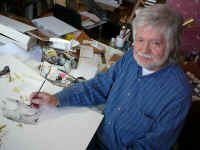
Barry describes himself as a Canadian artist/writer/naturalist.
See his website: www.barrykentmackay.com
For purchasing of original art, prints and other products GO HERE.
Return to Art by Barry Kent MacKay
Return to Art By Various Artists
Return to Art and Photo Journals and Galleries
Follow us on:


- Home Page
- What's New
- Contact Us
- Action Alerts
- Animal Exploitation
- Animal Issues
- Animal Rights Activism
- Archives
- Art & Photography
- Articles Directory
- Bible
- Bible Commentary Blog
- Books
- Campaigns
- Church & Religion
- Discussions
- Events / Podcasts / Media
- Health
- Hosted Web Sites
- Humor
- Kids' Korner
- Letters
- Links
- Nature Studies
- Newsletter
- Poetry & Stories
- Prayers
- Quotations
- Recipes with Photos
- Recipes Without Photos
- Sermons
- Stop Cruelty in Churches
- Video Library
- The Mary T. and Frank L. Hoffman Family Foundation
- Email: [email protected]
A web site sponsored by The Mary T. and Frank L. Hoffman Family Foundation and all-creatures.org
Copyright © 1998-2026 The Mary T. and Frank L. Hoffman Family Foundation. All rights reserved. May be copied only for personal use or by not-for-profit organizations to promote compassionate and responsible living. All copied and reprinted material must contain proper credits and web site link www.all-creatures.org.
Fair Use Notice: This document, and others on our web site, may contain copyrighted material whose use has not been specifically authorized by the copyright owners. We believe that this not-for-profit, educational use on the Web constitutes a fair use of the copyrighted material (as provided for in section 107 of the US Copyright Law). If you wish to use this copyrighted material for purposes of your own that go beyond fair use, you must obtain permission from the copyright owner.
Thank you for visiting all-creatures.org.
