 Art and Photo Presentations from All-Creatures.org
Art by Barry Kent MacKay
In this section are copies of original works of art. All of them are dedicated to helping us live according to unconditional love and compassion, which is the foundation of our peaceful means of bringing true and lasting peace to all of God's creatures, whether they are human beings or other animals.
Grey Crowned Crane (Balearica regulorum)
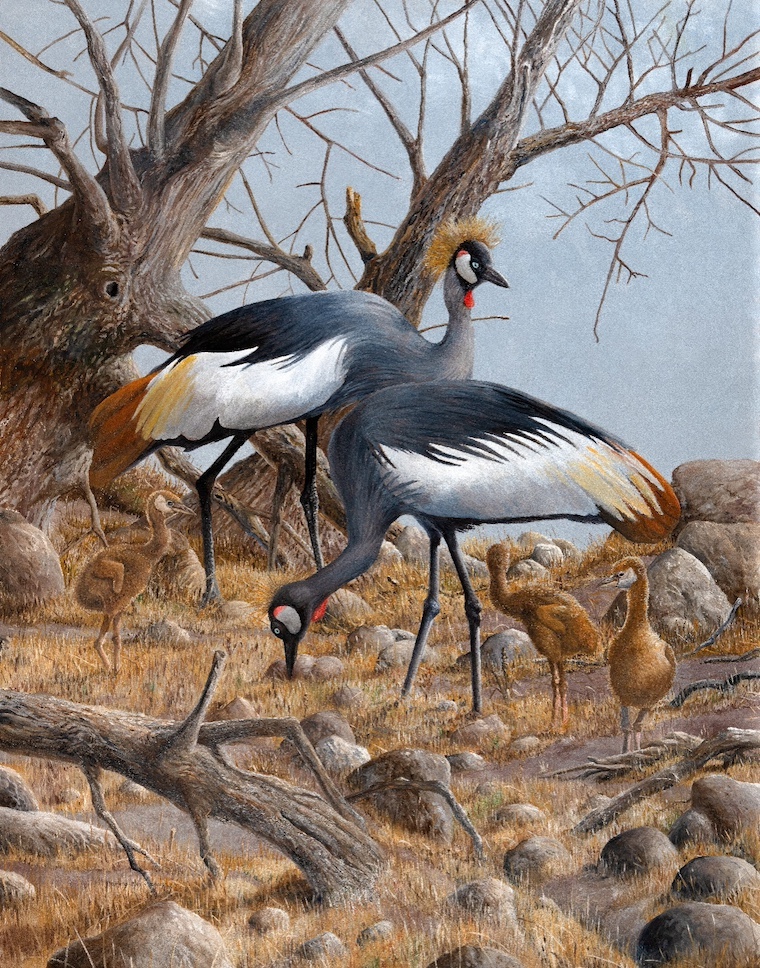
(Artwork - 255)
Grey Crowned Crane (Balearica regulorum)
The name of this bird may be confusing. It is the crane that is grey, not the crown, thus the lack of a hyphen between “grey” and “crowned”, or “gray” to give the alternative spelling of that word! The name separates this species from the very closely related and similar-looking Black Crowned Crane (B. pavonine) which has a blackish, not grey neck and body plumage. In the past some taxonomists considered them to be conspecific, but thorough analysis shows them to be two separate species, both with crowns of stiff, thin feathers that are a golden-wheat color. Both naturally occur only in Africa, but are easily kept in captivity and because of that, and their overall attractiveness, they are often seen in zoos.
The Grey Crowned Crane is the national bird of Uganda, and a stylized image of it appears in the center of the country’s delightfully colorful black, red, and yellow barred flag. The cranes stand about a meter tall and weigh about 3.5 kg (roughly 7.7 lbs). Fun fact: the two species of crowned crane are the only two of the 15 species of crane who perch in trees, thanks to a longer hind toe than other family members. They also lack the long, coiled trachea of other cranes that allows the Whooping Crane to so loudly whoop and trumpet; crowned cranes honk.
They are omnivorous, eating both plant food, such as seeds and grain, and large invertebrates such as locusts, and small vertebrates such as snakes, lizards, baby birds, mice, and frogs. They may stomp about flushing prey, and with their slender, long toes can grasp and hold small animals. They may associate with various species of African herbivores, such as antelopes.
The sad news is that the species is in decline, and while still common in some parts of Africa, it is officially listed as endangered.
I forgot to measure this painting before it sold but I think about 30 by 20 inches, in oils, on birch panel.
 Previous
Return to Art by Barry Kent MacKay - Page 5
Copyright © Barry Kent MacKay
Barry describes himself as a Canadian artist/writer/naturalist.
See his website: www.barrykentmackay.com
For purchasing of original art, prints and other products GO HERE.
Return to Art by Barry Kent MacKay
Return to Art By Various Artists
Return to Art and Photo Journals and Galleries
Follow us on:


- Home Page
- What's New
- Contact Us
- Action Alerts
- Animal Exploitation
- Animal Issues
- Animal Rights Activism
- Archives
- Art & Photography
- Articles Directory
- Bible
- Bible Commentary Blog
- Books
- Campaigns
- Church & Religion
- Discussions
- Events / Podcasts / Media
- Health
- Hosted Web Sites
- Humor
- Kids' Korner
- Letters
- Links
- Nature Studies
- Newsletter
- Poetry & Stories
- Prayers
- Quotations
- Recipes with Photos
- Recipes Without Photos
- Sermons
- Stop Cruelty in Churches
- Video Library
- The Mary T. and Frank L. Hoffman Family Foundation
- Email: [email protected]
A web site sponsored by The Mary T. and Frank L. Hoffman Family Foundation and all-creatures.org
Copyright © 1998-2026 The Mary T. and Frank L. Hoffman Family Foundation. All rights reserved. May be copied only for personal use or by not-for-profit organizations to promote compassionate and responsible living. All copied and reprinted material must contain proper credits and web site link www.all-creatures.org.
Fair Use Notice: This document, and others on our web site, may contain copyrighted material whose use has not been specifically authorized by the copyright owners. We believe that this not-for-profit, educational use on the Web constitutes a fair use of the copyrighted material (as provided for in section 107 of the US Copyright Law). If you wish to use this copyrighted material for purposes of your own that go beyond fair use, you must obtain permission from the copyright owner.
Thank you for visiting all-creatures.org.
